



We support cell configuration, battery pack assembly, protection circuit integration and custom wiring for OEM projects.
A 12V-class lithium-ion battery pack may use an 11.1V nominal 3S configuration, depending on the selected cells and equipment requirements. Before choosing a pack, the operating voltage range, current demand, charging method and available installation space must be confirmed.
12V 18650 Battery Pack Configurations
A 12V 18650 battery pack can use different series and parallel cell arrangements to achieve the required capacity and discharge capability.
For conventional 3S lithium-ion designs, the nominal pack voltage is commonly 10.8V or 11.1V, depending on the cell specification. Increasing the number of parallel cells raises nominal capacity without changing the series count.
3 series groups · 1 cell per group
3 series groups · 2 cells per group
3 series groups · 3 cells per group
Cell count and grouping illustration
Reference 3S 18650 Battery Configurations
The examples below use nominal 3.7V lithium-ion cells. They illustrate possible electrical configurations rather than confirmed YATTOX stock models.
| Reference Configuration | Cell Arrangement | Nominal Voltage | Capacity | Nominal Energy |
|---|---|---|---|---|
| 11.1V 2600mAh | 3S1P, 2600mAh cells | 11.1V | 2.6Ah | 28.86Wh |
| 11.1V 5200mAh | 3S2P, 2600mAh cells | 11.1V | 5.2Ah | 57.72Wh |
| 11.1V 7000mAh | 3S2P, 3500mAh cells | 11.1V | 7.0Ah | 77.70Wh |
| 11.1V 7800mAh | 3S3P, 2600mAh cells | 11.1V | 7.8Ah | 86.58Wh |
| 11.1V 10400mAh | 3S4P, 2600mAh cells | 11.1V | 10.4Ah | 115.44Wh |
Nominal energy is calculated using nominal voltage × capacity. Actual cell availability, discharge current, dimensions, weight, BMS and connector specifications require engineering confirmation.
What Changes Between 3S1P, 3S2P and 3S3P?
With the same cell chemistry and series count, these configurations have similar nominal voltage levels.
Adding parallel cells increases capacity and may increase available output current, depending on the cell specifications and electrical design. A larger arrangement also requires more space and adds weight.
The appropriate configuration depends on equipment runtime, load current and installation limits.
Understanding Battery Voltage and 3S Configurations
A 12V-class battery is not necessarily rated at exactly 12.0V.
A conventional 3S lithium ion battery pack using cells rated at 3.7V nominal has an 11.1V nominal voltage. When each cell is charged to 4.2V, the pack reaches a typical full-charge voltage of 12.6V.
Using 3.6V nominal cells gives a 10.8V nominal pack, with the same typical 12.6V full-charge voltage for conventional 4.2V-charge cells.
The actual operating limits must always follow the selected cell and approved battery specification.
Can an 11.1V Battery Replace a 12V Battery?
Not automatically.
An 11.1V 18650 battery pack can be considered only when the equipment accepts its complete operating voltage range.
The battery chemistry, charging voltage, continuous and peak current, protection settings, connector polarity and dimensions must also be compatible.
For example, an 11.1V nominal lithium-ion pack and a 12.8V nominal LiFePO4 pack have different charging and operating voltage characteristics. They should not be treated as interchangeable simply because both are described as 12V-class batteries.
What Should Be Checked Before Replacement?
Check the original battery specification or equipment requirements, including:
- Minimum and maximum operating voltage
- Continuous and peak discharge current
- Required capacity or operating time
- Battery chemistry and charging voltage
- Protection and temperature-sensing requirements
- Connector polarity and installation dimensions
How to Choose a Battery Pack for Your Equipment
Battery selection should begin with the equipment's electrical requirements and operating conditions, rather than nominal voltage alone.
Match Battery Capacity to Operating Time
Start with the equipment's average power consumption and expected operating time.
A preliminary estimate is:
This is a starting point, not a guaranteed capacity requirement. Conversion losses, usable discharge range, operating temperature, peak loads and battery aging must be considered during engineering review.
Check Continuous and Peak Discharge Current
Some devices draw substantially more current during startup or short load changes than during normal operation.
Confirm the continuous load, peak current and peak duration. Cells, interconnections, wiring and protection circuits must be evaluated together.
Confirm Dimensions and Connections
Installation space may limit the cell arrangement and maximum capacity.
Provide the allowable length, width and height, along with connector specifications, polarity, cable length and mounting requirements.
For compact equipment, a different cell format or layout may be preferable to adding more parallel cells.
Custom 12V Battery Pack Engineering
YATTOX supports OEM and ODM projects requiring a custom 12V battery pack to meet specific electrical and mechanical requirements.
Cell Selection and Capacity Configuration
Cell format, series/parallel arrangement and capacity are evaluated according to voltage, current, runtime and installation requirements.
Protection Circuit and BMS Integration
Depending on the approved design, battery protection may include overcharge, overdischarge, overcurrent, short-circuit and temperature monitoring functions.
Protection thresholds and current limits must be selected for the actual cells and pack configuration.
Battery Structure and Connectors
Cell arrangement, insulation, enclosure, cable length, connector type and terminal layout can be reviewed against equipment drawings or an existing battery sample.
Prototype Evaluation and Production Preparation
After confirming the technical requirements, the proposed design can proceed to sample evaluation and production planning.
The development and quotation process depends on material selection, configuration complexity, testing requirements and estimated order quantity.
Manufacturing and Quality Control
YATTOX's battery manufacturing and PACK assembly capabilities include cell evaluation, voltage and internal resistance inspection, assembly checks and quality control.
For OEM projects, inspection and acceptance criteria should be defined against the approved battery specification rather than a general performance claim.
Discuss Sample Testing Requirements →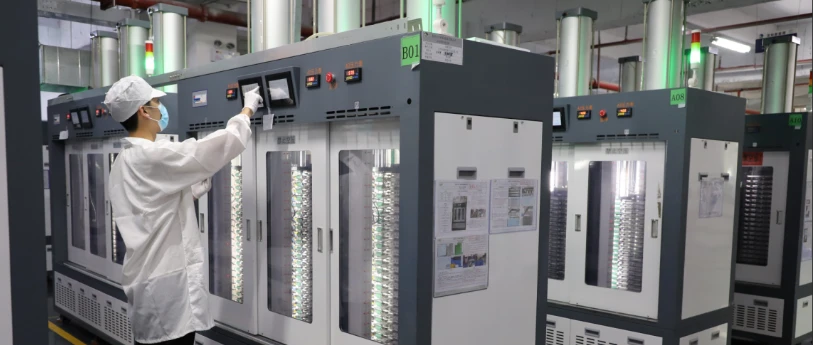
Cell Formation & Aging Equipment

YATTOX Production Workshop
Cell and Pack Inspection
Relevant checks may include cell voltage, internal resistance, pack voltage, connector polarity, wiring and assembly quality.
Electrical Performance Verification
Capacity, discharge characteristics and protection circuit operation should be evaluated using defined methods and operating conditions appropriate to the selected pack.
Sample Approval and Production Consistency
An approved sample specification provides a reference for subsequent production checks.
Product-specific test reports, required documentation and shipping compliance information should be confirmed before commercial delivery.
Frequently Asked Questions
Q1: Is an 11.1V lithium-ion battery considered a 12V battery pack?
An 11.1V nominal 3S lithium-ion battery is often described as a 12V-class pack. However, its voltage characteristics are not identical to those of every battery labeled 12V. Confirm the equipment's accepted voltage range and charging requirements before use.
Q2: How do I choose between 3S1P and 3S2P configurations?
Both use three series-connected cell groups. With the same cell type, 3S2P generally provides twice the nominal capacity of 3S1P. Actual discharge capability, size, weight and protection requirements must also be checked.
Q3: Can I use an existing 12V charger with a new lithium-ion battery pack?
Only if it matches the pack's chemistry, full-charge voltage and charging requirements. Conventional 3S lithium-ion packs using 4.2V-charge cells typically require a 12.6V constant-voltage charging stage. Follow the approved battery specification.
Q4: Can YATTOX customize battery dimensions and connectors?
YATTOX supports battery structure and connection customization. Send the maximum dimensions, capacity, load current, connector details and equipment drawings for an engineering review.
Q5: What information is needed for an OEM battery quotation?
Provide the equipment application, operating voltage range, capacity or runtime, continuous and peak current, installation dimensions, connector requirements and estimated purchase quantity. An existing battery datasheet or mechanical drawing can help clarify the project.