


Why UAV Battery Selection
Must Start with the Mission Profile
Flight time, payload, current demand, installation space and operating conditions must be evaluated together before a Li-ion battery pack is configured.


Flight Time vs. Battery Weight
Adding capacity can increase stored energy, but it also adds weight. The practical goal is to configure the lightest pack that completes the mission with sufficient landing reserve—not simply the battery with the highest mAh.


Payload and Takeoff Weight
Payload, sensors, mounting hardware and the battery itself all affect power demand. Pack sizing should use the complete takeoff mass and mission profile, rather than payload weight alone.


Continuous and Peak Current Demand
Hover and cruise determine the required continuous current, while takeoff, climb, wind correction and payload changes create short peak loads. Both must be validated to prevent excessive voltage sag and heat generation.


Environmental and Mechanical Stress
Temperature, vibration, moisture, dust and repeated installation cycles affect cell selection, enclosure design, connector reliability and expected service life.


Cell Consistency and Cycle Life
Capacity and internal-resistance differences between cells can reduce usable energy and accelerate pack imbalance. Cell grading, matching and representative cycle testing are therefore essential for repeatable fleet performance.
When Is a Lithium-Ion Battery the Right Choice for a Drone?
Li-ion and LiPo batteries support different UAV mission requirements. The right direction depends on flight behavior, usable energy, current demand, pack weight and installation space.
When Li-ion Is a Stronger Starting Point
A lithium-ion battery for a drone is usually the stronger starting point when the aircraft needs efficient cruising, longer mission time and predictable continuous power. It is commonly considered for mapping, inspection, delivery and other industrial UAVs that spend more time in steady flight than in repeated full-throttle maneuvers.
When LiPo May Be More Suitable
Li-ion is not automatically the right choice for every drone. Racing, aggressive freestyle and other applications with repeated high-current bursts often favor LiPo. The final decision should be based on usable energy, pack weight, continuous current, peak current and installation constraints.
| Mission Condition | Li-ion Direction | LiPo Direction |
|---|---|---|
| Efficient cruise and long missions | Preferred | Possible |
| Stable continuous output | Suitable | Suitable |
| Repeated extreme current bursts | Must be validated carefully | Usually preferred |
| Racing and aggressive freestyle | Usually not the first choice | Preferred |
| Thin or irregular pack shape | Cylindrical layout may be restrictive | Pouch layout is more flexible |
| Longer cycle-life target | Often advantageous | Depends on design and use |
Compare energy density, discharge capability, weight, cycle life and application fit in more detail.
Compare LiPo and Lithium-Ion BatteriesWhat We Configure in a Drone Li-Ion Battery Pack
Each pack is evaluated against the aircraft, mission profile and integration constraints.
Mission Power Requirements
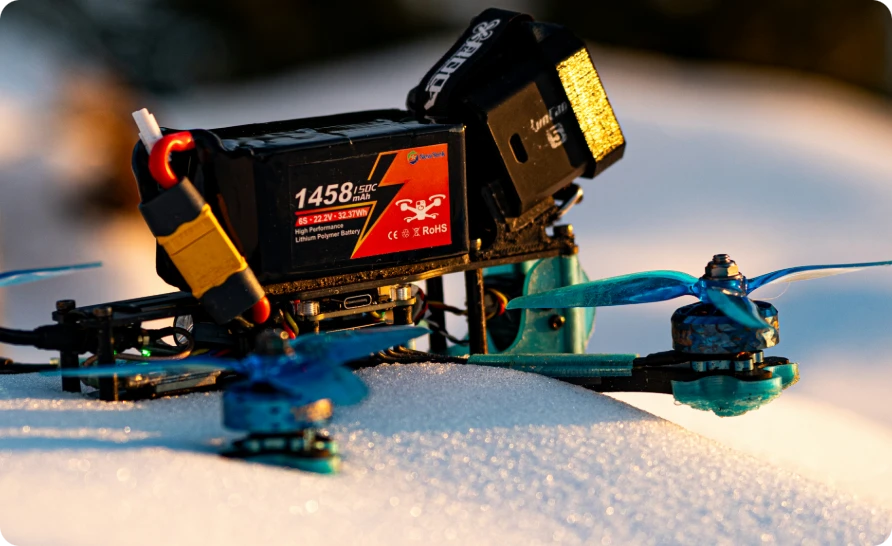
- Nominal voltage matched to the UAV power system
- Continuous current based on hover and cruise demand
- Peak current checked against takeoff, climb and transient loads
- Usable energy calculated from target flight time and landing reserve
Pack Configuration Options
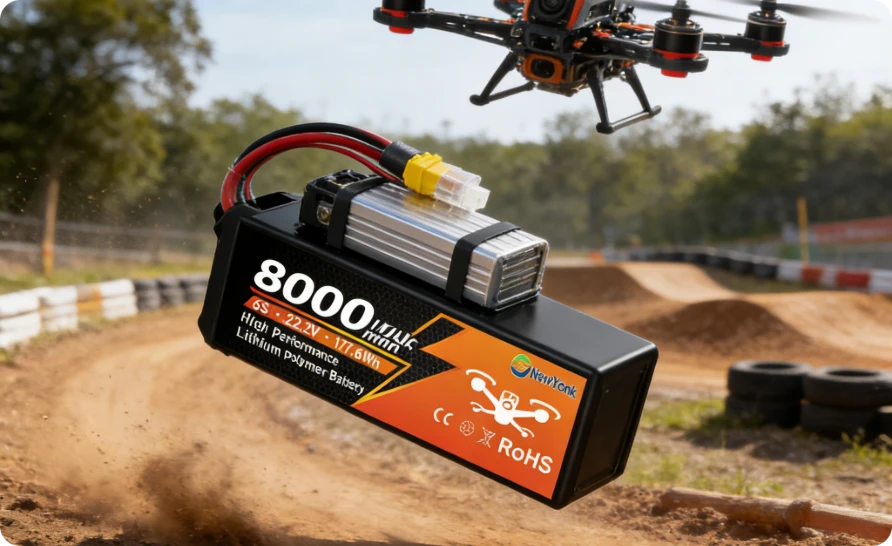
- Voltage Platforms: 2S–6S, 7S, 8S and 12S
- Capacity Range: 4,000mAh to 22,000mAh and above
- Cell Options: 18650, 21700 or another verified cell format
- Connectors: XT, EC, AS150U or a project-specific option
- Cable Options: 12AWG, 14AWG and 16AWG

Manufacturing Consistency
- Cell grading by capacity and internal resistance
- Cell matching to reduce pack imbalance
- In-process inspection through pack assembly
- Final inspection against agreed specifications
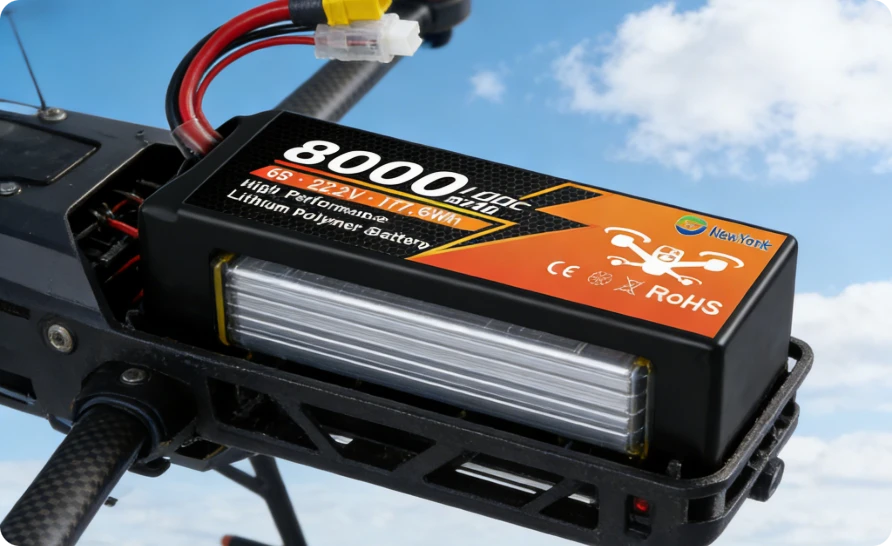
Energy and Weight Optimization
- Cell selection based on usable energy, current capability and pack weight
- Series-parallel layout evaluated against available space
- Pack-level energy density considered with thermal performance
- Voltage sag and temperature rise checked under representative load

Integration & Project Support
- BMS protection, balancing and communication options
- Custom dimensions, enclosure, mounting and cable routing
- Connector selection and strain-relief configuration
- Prototype review, load validation and pilot-production support
When a 21700 Battery Pack Makes Sense for a Drone
A 21700-based pack can support UAVs that need higher usable energy, efficient cylindrical-cell packaging and stable continuous output.
Where 21700 Cells Can Add Value
A 21700 drone battery pack can suit long-duration mapping, inspection and other missions where energy, pack weight and steady output need to be balanced.
What Should Be Checked First?
Check available space, pack weight, continuous and peak current, thermal behavior and series-parallel layout before selecting a 21700 configuration.
When a 21700 Pack May Be a Good Fit
- Long-duration mapping or inspection missions
- Steady cruise and hover loads
- Cylindrical-cell battery compartments
- Projects requiring fewer parallel connections
When Other Formats Should Be Considered
- Repeated extreme current bursts
- Very thin or irregular battery spaces
- Flexible pouch-style weight distribution
- Current above verified cell capability
Explore 21700 Li-Ion Battery Pack Options
18650 or 21700 for Your UAV?
Compare cell size, energy, current capability and pack layout before selecting the cylindrical-cell platform.
Lithium-Ion Battery Solutions by UAV Application
Different UAV missions place different demands on usable energy, current, weight, temperature performance and pack integration.
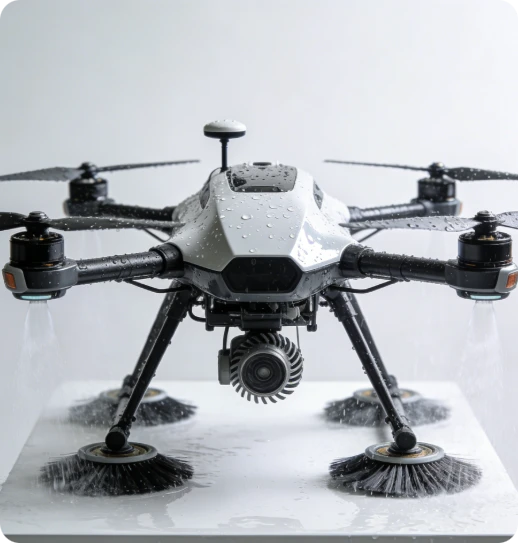
A mapping drone battery should prioritize usable energy per unit weight, efficient cruise performance and predictable landing reserve so the aircraft can complete the planned route without unnecessary battery mass.

A firefighting drone battery must be evaluated against ambient temperature, payload, peak-current demand, enclosure protection and the reliability needed for high-load emergency missions.
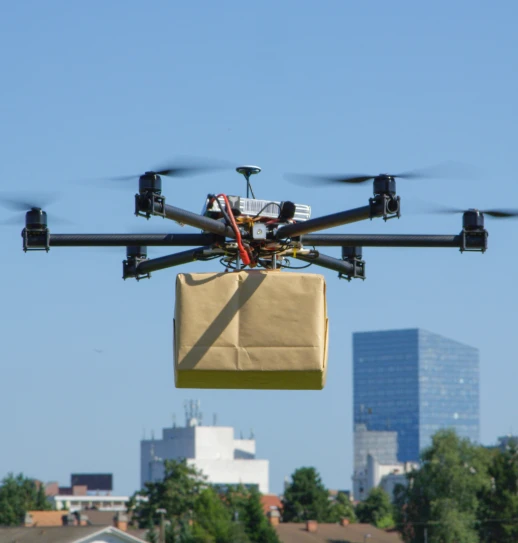
Cargo drone battery and delivery drone battery selection requires a balance between payload, route distance, continuous current and takeoff peak. Pack structure, mounting and connectors must also withstand repeated loading and vibration.
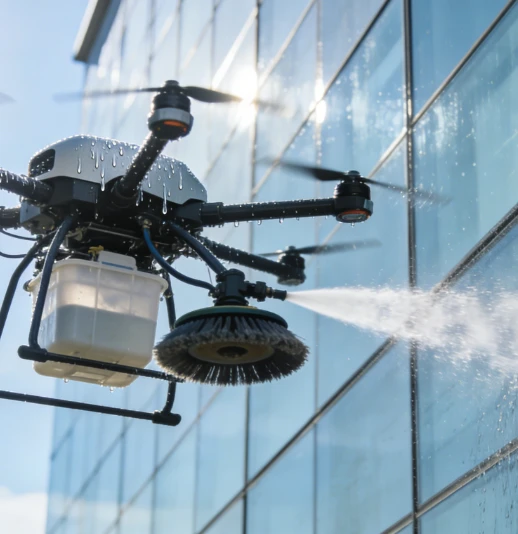
An inspection drone battery should deliver repeatable flight time, stable hovering power and reliable operation across temperature changes for repeated missions around power lines, pipelines, bridges and remote assets.
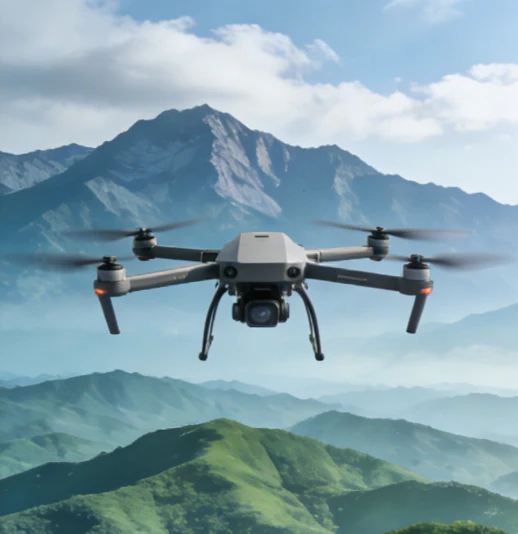
A VTOL drone battery or fixed-wing UAV battery must support takeoff and transition peaks while remaining efficient during cruise. The two flight phases should be evaluated separately when selecting cells and pack capacity.
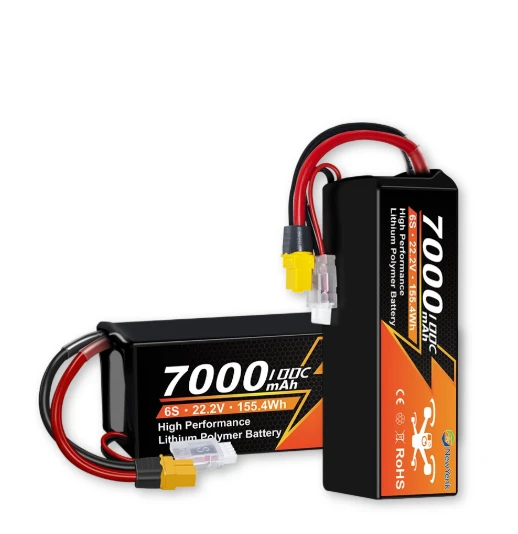
Share your UAV type, voltage, payload, flight time and weight limit. We’ll recommend a suitable battery configuration.
Get Your Custom UAV Battery Solution