


Does Higher Wh/kg Always Mean Longer UAV Flight Time? 400 vs 450 vs 500 Wh/kg Explained
October 15, 2026
A higher Wh/kg rating stores more nominal energy per kilogram, but it does not guarantee proportionally longer UAV flight time. This guide compares 400, 450 and 500 Wh/kg batteries and explains how pack weight, discharge capability, voltage sag and usable energy determine real endurance.
Table of Contents
A higher Wh/kg rating means a UAV battery can store more nominal energy for the same battery mass. In principle, this creates an opportunity to extend flight time, reduce aircraft weight or increase available payload capacity. However, higher energy density does not always translate into a proportional improvement in actual UAV endurance.
The real benefit depends on how much of that energy the aircraft can use under its operating conditions. Battery discharge capability, voltage stability, aircraft weight, propulsion efficiency and mission power demand all influence the result.
For example, moving from 400 Wh/kg to 500 Wh/kg provides 25% more nominal energy per kilogram. But it does not guarantee 25% longer flight time. A battery designed for maximum specific energy may have different current capabilities from one optimized for high-power takeoff and repeated heavy-load operation.
Understanding these trade-offs is essential when selecting a high energy density battery for mapping drones, inspection UAVs, long-range aircraft and industrial multirotor platforms.
What Does Wh/kg Mean for a UAV Battery?
Wh/kg, or watt-hours per kilogram, measures a battery's gravimetric specific energy. It describes how much nominal electrical energy is stored relative to battery mass.
For a complete UAV battery pack, the calculation is:
Pack Specific Energy (Wh/kg) = Nominal Battery Energy (Wh) ÷ Total Pack Weight (kg)
Suppose a finished battery pack stores 1,600Wh and weighs 4 kg. Its pack-level specific energy is 400 Wh/kg. A different battery with the same weight but a rating of 500 Wh/kg would theoretically store 2,000Wh.
This relationship matters because battery weight contributes directly to an aircraft's total takeoff mass. A lighter battery can reduce the load on the propulsion system, while additional stored energy can extend the time available for flight.
However, Wh/kg should not be confused with battery capacity in ampere-hours (Ah). Capacity alone does not account for voltage. A 30Ah battery operating at 22.2V stores approximately 666Wh, whereas a 30Ah battery operating at 44.4V stores approximately 1,332Wh.
For meaningful endurance comparisons, battery energy should therefore be expressed in watt-hours, while Wh/kg is used to evaluate that energy relative to the complete battery mass.
400 vs 450 vs 500 Wh/kg: How Much Additional Energy Can a UAV Carry?
Comparing 400, 450 and 500 Wh/kg is useful because it shows the potential weight and energy advantages of increasingly high-specific-energy battery technologies.
The table below assumes the same finished battery mass of 4 kg for all three options. These are theoretical comparison values, not specifications for three YATTOX products.
| Battery Specific Energy | Nominal Energy at 4 kg | Increase vs. 400 Wh/kg |
|---|---|---|
| 400 Wh/kg | 1,600Wh | Baseline |
| 450 Wh/kg | 1,800Wh | +12.5% |
| 500 Wh/kg | 2,000Wh | +25% |
At a fixed battery weight, the mathematical advantage is straightforward. A 450 Wh/kg pack carries 200Wh more energy than a 400 Wh/kg pack, while a 500 Wh/kg pack carries an additional 400Wh.
The potential improvement can also be viewed from the opposite direction. If the aircraft requires 1,600Wh of nominal energy, the theoretical battery mass falls from 4 kg at 400 Wh/kg to approximately 3.56 kg at 450 Wh/kg and 3.20 kg at 500 Wh/kg.
This creates two possible design opportunities. Engineers can maintain the original battery weight and carry more energy, or maintain the required energy and reduce battery mass.
For a weight-sensitive UAV, the second option may be particularly valuable. Reducing battery mass can lower aircraft takeoff weight and change the propulsion power required to complete the mission.
The important limitation is that these comparisons assume complete packs with the stated specific energy. A 500 Wh/kg cell does not automatically produce a 500 Wh/kg finished battery pack.
Does 25% More Battery Energy Mean 25% Longer UAV Flight Time?
Not necessarily. A percentage increase in nominal battery energy represents a potential endurance improvement, but actual flight duration depends on the power required during the mission and the proportion of battery energy that remains usable.
A simplified flight-time calculation is:
Estimated Flight Time (hours) = Usable Battery Energy (Wh) ÷ Average Electrical Power (W)
Consider an illustrative UAV that consumes an average of 2,000W during flight. Assume the battery weight remains 4 kg, and the mission plan reserves 20% of nominal energy.
| Pack Specific Energy | Nominal Energy | Energy After 20% Reserve | Calculated Flight Time |
|---|---|---|---|
| 400 Wh/kg | 1,600Wh | 1,280Wh | 38.4 minutes |
| 450 Wh/kg | 1,800Wh | 1,440Wh | 43.2 minutes |
| 500 Wh/kg | 2,000Wh | 1,600Wh | 48.0 minutes |
These figures are arithmetic examples based on constant average power, equal pack weight and an assumed 20% energy reserve. They are not measured UAV flight results. They also assume that the stated energy remains accessible under operating conditions.
Under these fixed assumptions, the increase in calculated flight time follows the increase in nominal energy. In real flight, however, usable energy and average power may change.
A multirotor requires different amounts of power during takeoff, hovering, climbing and payload operations. Wind and maneuvering also influence current demand. Even when battery weight stays constant, the battery's ability to sustain voltage under load can affect how much stored energy is accessible before the aircraft reaches its low-voltage threshold.
Consequently, the 48-minute result should not be interpreted as a guaranteed endurance figure for a 500 Wh/kg battery. Accurate predictions require aircraft-specific power data, battery discharge characteristics and suitable operating margins.
Why Higher Wh/kg Does Not Always Produce Longer UAV Endurance
The difference between nominal energy and usable flight energy becomes especially important when evaluating batteries for commercial UAV applications. Even if a battery offers greater specific energy, its performance must remain compatible with the aircraft's power requirements throughout the flight.
Discharge Capability and Peak Power Demand
A UAV battery must supply enough current for both normal operation and short periods of increased power demand.
For a fixed-wing mapping aircraft, average cruise power may be relatively modest compared with the battery's available energy. A heavy-lift multirotor, however, can draw significantly more current during takeoff, climbing and payload-intensive operations.
This difference creates an energy-versus-power trade-off. Batteries optimized for maximum specific energy may not provide the same discharge capability as batteries designed for sustained high-current operation.
For engineering selection, the relevant comparison is therefore not only how much energy the battery stores, but whether it can deliver the required power continuously and during peak-load events.
Voltage Sag and Usable Battery Energy
Voltage sag is another reason a higher-energy battery may not deliver its expected endurance advantage.
When current increases, terminal voltage drops because of internal resistance and electrochemical polarization. If the voltage falls below the aircraft's operating threshold, the system may initiate a low-voltage warning or landing procedure even though the battery still contains stored energy.
This becomes particularly important during repeated high-current operation or toward the end of discharge.
A battery with higher nominal energy but less favorable voltage behavior under the required load may provide less usable mission energy than its Wh/kg rating suggests.
Battery evaluation should therefore consider voltage under representative load conditions, not simply nominal voltage and capacity. Internal resistance, current demand, state of charge and temperature all affect how the battery behaves during flight.
Aircraft Weight and Propulsion Efficiency
Battery energy cannot be evaluated independently of the aircraft carrying it.
Increasing battery capacity often increases battery mass. For multirotor UAVs, the propulsion system must generate enough thrust to support the resulting aircraft weight throughout the flight.
This means adding battery energy can also increase the power required to remain airborne. Depending on the aircraft configuration, the additional energy may produce progressively smaller endurance gains.
A higher-specific-energy battery can address this problem in two ways: it may provide more energy without increasing battery weight, or it may meet the existing energy requirement with a lighter pack.
For long-range fixed-wing platforms, aerodynamic efficiency, aircraft mass and cruise operating conditions also influence the result. The relationship between specific energy and endurance is consequently different for a mapping aircraft, an industrial inspection multirotor and a heavy-lift agricultural drone.
Temperature and Battery Aging
Battery performance also changes with operating temperature and accumulated use.
At low temperatures, increased internal resistance and reduced electrochemical reaction rates can limit discharge capability and usable capacity. Consequently, energy-density figures measured under favorable conditions may not accurately represent performance during cold-weather missions.
Repeated cycling introduces another consideration. A battery's available capacity and internal resistance can change as it ages, potentially affecting mission endurance even when the aircraft and flight profile remain unchanged.
For commercial UAV fleets, the battery with the highest initial Wh/kg may not always provide the best long-term operating value. Cycle-life performance should be compared under relevant depth-of-discharge, current and temperature conditions rather than from an isolated cycle-count claim.
Cell vs. Pack Energy Density: Why 500 Wh/kg Needs Careful Interpretation
As advanced battery technologies approach 500 Wh/kg, understanding the difference between cell specifications and complete battery-pack performance becomes essential. A related overview of assembly levels is covered in Li-ion battery cell vs module vs pack.
In September 2026, Amprius announced its SiCore500 lithium-ion cell for long-endurance unmanned aviation. The company reported a specific energy of 500 Wh/kg at a 1C continuous discharge rate, with commercial availability targeted for the fourth quarter of 2026.
This development demonstrates the progress of high-specific-energy battery technology, but the announced value refers to the cell rather than a complete UAV battery pack.
A finished pack includes additional materials and components required for electrical connection, structural integration, insulation and, where applicable, monitoring and protection. These components contribute to installed mass without increasing the nominal energy stored in the cells.
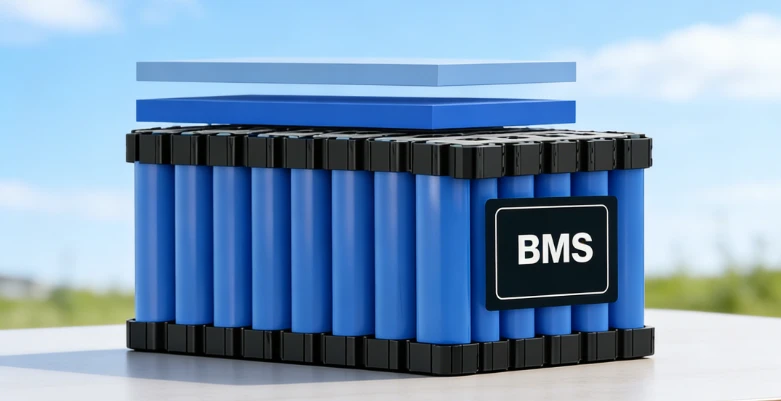
A finished pack adds structure, wiring and a BMS on top of the cells themselves—components that contribute to installed mass without adding nominal energy.
For example, if a battery assembly contains 2,000Wh of nominal energy and its finished weight is 4.5 kg, its pack-level specific energy is approximately 444 Wh/kg, regardless of the higher cell-level rating used in its construction.
Before comparing energy-density claims from different suppliers, verify three details:
- Measurement level: Does the published Wh/kg refer to an individual cell, a battery module or the finished pack installed on the UAV?
- Included weight: Does the specified mass account for wiring, connectors, insulation, structural components and any required protection hardware?
- Test conditions: What discharge rate, operating temperature and measurement conditions support the stated energy-density value?
These details determine whether two battery specifications can be compared fairly. A cell-only value should not be compared directly with another manufacturer's complete-pack measurement.
For UAV integration, finished pack weight and usable energy under the intended operating conditions are generally more meaningful than an isolated cell-level rating.
What Do Real Semi-Solid-State UAV Battery Specifications Show?
A practical way to evaluate high energy density battery performance is to examine actual pack specifications rather than relying only on theoretical energy-density levels.
YATTOX offers semi-solid-state batteries for UAV applications where battery weight, discharge capability and long-endurance requirements must be considered together.
Its published 30,000mAh battery series includes several voltage configurations. Using the stated nominal energy and pack weight, the finished-pack specific energy can be calculated as follows.
| Configuration | Nominal Voltage | Nominal Energy | Pack Weight | Calculated Pack Wh/kg |
|---|---|---|---|---|
| 6S1P / 30Ah | 22.2V | 666Wh | 1.965 kg | 339 Wh/kg |
| 8S1P / 30Ah | 29.6V | 888Wh | 2.590 kg | 343 Wh/kg |
| 12S1P / 30Ah | 44.4V | 1,332Wh | 3.835 kg | 347 Wh/kg |
| 14S1P / 30Ah | 51.8V | 1,554Wh | 4.460 kg | 348 Wh/kg |
Source: YATTOX 30,000mAh Semi-Solid-State Battery Specifications. Calculated specific-energy figures are rounded from published nominal energy and pack weight.
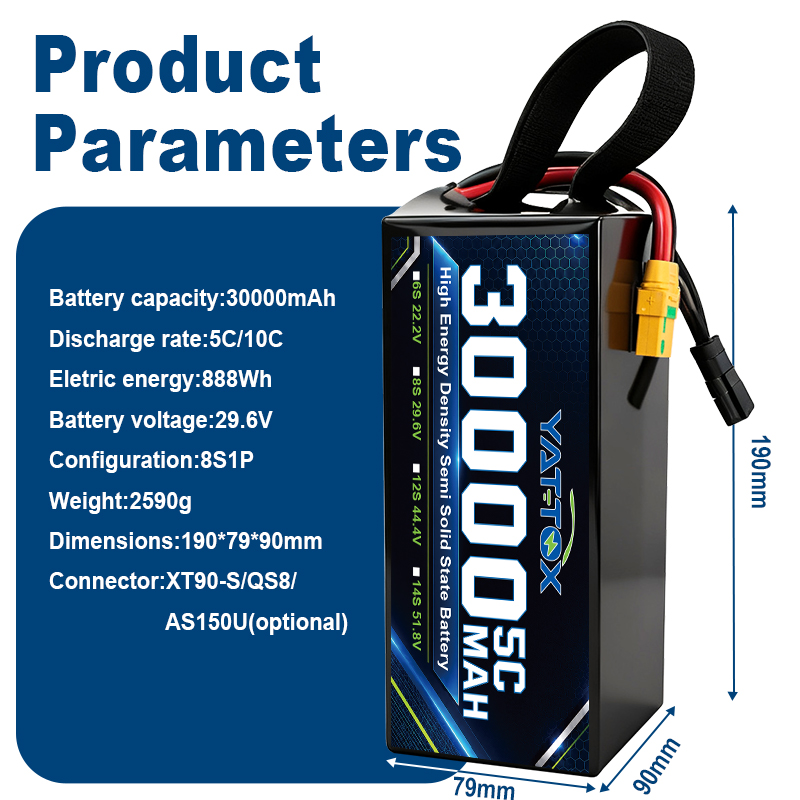
Published parameters for the 30,000mAh 8S1P semi-solid-state pack: 888Wh at 2,590 g, giving roughly 343 Wh/kg at finished-pack level.
The 30Ah product series is also specified with a 5C continuous and 10C peak discharge rating, corresponding to 150A continuous and 300A peak current. Listed connector options include XT90-S, QS8 and AS150U. These are published product ratings; the permissible duration and conditions of peak discharge should be confirmed for the intended application.
These specifications illustrate an important distinction: battery selection must consider available energy, total pack weight and discharge performance together.
For example, the 6S and 12S versions share the same 30Ah capacity, but their nominal energy differs substantially because of their voltage configurations. The 12S pack stores twice the nominal energy of the 6S version, while also carrying more mass.
The correct choice depends on the UAV's electrical architecture, installation constraints and required current. A higher-voltage pack is not automatically interchangeable with a lower-voltage system.
The same principle applies to larger batteries. YATTOX's published 60,000mAh 6S1P model stores 1,332Wh at a listed weight of 3.93 kg, equivalent to approximately 339 Wh/kg at finished-pack level. Its higher capacity supports a different combination of energy, current and installation requirements.
These examples are not intended to represent 400, 450 or 500 Wh/kg YATTOX products. They demonstrate how published battery specifications can be used to evaluate practical energy-to-weight performance.
Which UAV Applications Benefit Most From Higher Energy Density?
The value of higher specific energy depends on the aircraft's mission profile. Long-endurance platforms, heavy-lift multirotors and commercial fleets may all benefit from improved battery technology, but not necessarily in the same way.
Long-Endurance Mapping and Inspection UAVs
Mapping and inspection UAVs often operate over extended distances or predefined flight routes. In these applications, additional usable energy can reduce the frequency of battery changes or support longer missions.
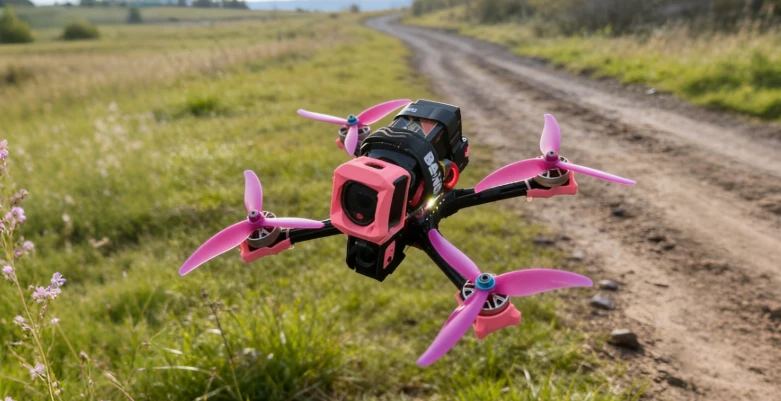
Long-endurance mapping and inspection platforms gain the most from higher usable energy, provided the pack can still support takeoff and climb phases.
Fixed-wing aircraft with relatively stable cruise power demand may be particularly suitable for energy-focused battery configurations, provided the pack can also support takeoff, climbing and other higher-power flight phases.
For multirotor inspection platforms, however, hover power and wind correction remain significant considerations. Engineers should evaluate energy consumption across the complete mission rather than estimating endurance from cruise or hover data alone.
Agricultural and Heavy-Lift Multirotor Drones
Agricultural UAVs experience different operating conditions. Payload weight may change as spraying material is consumed, while repeated takeoff, climbing and maneuvering can create substantial current demand.
For these platforms, a high Wh/kg rating is useful only if the battery also provides suitable continuous current, peak-current capability and voltage stability.
Battery weight remains important, but reducing weight should not compromise the aircraft's ability to deliver power during its most demanding operating conditions.
A battery with somewhat lower specific energy but a more appropriate discharge profile may therefore be preferable to a higher-energy alternative that cannot reliably support the required load.
Commercial UAV Fleets With Repeated Daily Flights
For UAV fleet operators, battery selection extends beyond the endurance of a single flight.
Repeated charging and discharging, operating temperature, usable capacity over time and replacement frequency all influence the practical value of a battery system.
Higher specific energy may reduce battery mass or extend individual missions, but fleet procurement also requires attention to cycle-life testing, charging compatibility and performance consistency.
A comparison based only on initial Wh/kg can overlook these operating costs. Long-term battery evaluation should therefore reflect the intended flight schedule and maintenance requirements.
How Should Engineers Select a High Energy Density UAV Battery?
Selecting the right battery requires a system-level evaluation rather than choosing the highest available Wh/kg rating. The objective is to identify a pack that meets the aircraft's energy, power, weight and installation requirements throughout its intended mission.
A practical UAV battery evaluation can be organized into four steps:
- Define the mission requirements. Confirm the aircraft type, maximum takeoff weight, payload, target flight duration and maximum allowable battery weight. These parameters establish the operating constraints and help identify whether endurance or power delivery is the primary limitation.
- Estimate the usable energy requirement. Use measured or estimated average electrical power to calculate the energy needed for the mission. Include an appropriate reserve for landing, environmental variation and unexpected operating conditions rather than treating all nominal battery energy as available for flight.
- Verify discharge and voltage performance. Compare the battery's continuous and peak current capability with the UAV's actual electrical demand. Review voltage behavior, internal resistance and expected operating temperature to determine whether sufficient usable energy can be delivered under load.
- Confirm pack integration and service requirements. Check voltage compatibility, finished pack weight, physical dimensions, connector requirements and installation constraints. For commercial applications, also consider charging arrangements, operating frequency and cycle-life expectations.
Flight logs containing voltage and current measurements can make this process more accurate. They reveal how the aircraft behaves during takeoff, hovering, climbing, cruise and landing, allowing engineers to assess the real power profile rather than relying only on nominal component specifications.
Once these requirements are understood, different battery configurations can be compared on a consistent basis. The most suitable solution may be a higher-energy pack, a lighter pack or a design optimized for stronger discharge capability.
How YATTOX Supports UAV Battery Selection and Pack Integration
For UAV manufacturers developing long-endurance or weight-sensitive platforms, battery selection often requires balancing several competing requirements. Increasing stored energy can improve endurance potential, but the chosen configuration must also satisfy the aircraft's discharge, installation and operating constraints.
YATTOX supports customized UAV battery development using LiPo, Li-ion and semi-solid-state battery solutions. Its battery engineering capabilities include voltage and capacity customization, pack structure optimization and electrical interface integration.
Based on the project's requirements, the evaluation can focus on three areas:
- Energy and weight optimization: Assess suitable cell chemistry, nominal energy, capacity and finished pack weight against the aircraft's endurance and payload targets.
- Discharge and electrical compatibility: Match voltage configuration, continuous and peak current requirements, and connector selection to the UAV's propulsion and electrical systems.
- Pack integration and quality control: Consider battery dimensions, structural requirements and production consistency, supported by relevant voltage inspection, internal-resistance screening and traceability processes.
YATTOX's semi-solid-state battery solutions also support customized voltage, capacity and structural configurations for weight-sensitive UAV applications.
For an engineering evaluation, useful starting information includes the UAV's aircraft type, maximum takeoff weight, payload and target flight time. Existing battery voltage, available installation space, average and peak current demand, operating temperature and expected flight frequency further define the design requirements.
These inputs make it possible to determine whether the project would benefit more from higher energy density, reduced installed battery weight or stronger discharge performance.
Rather than selecting a battery based on Wh/kg alone, the goal is to develop a configuration that matches the aircraft's real operating conditions and performance priorities.
Is a 500 Wh/kg Battery Always Better Than 400 or 450 Wh/kg?
No. A 500 Wh/kg battery provides greater nominal energy per kilogram than a 400 or 450 Wh/kg battery, but that advantage does not guarantee better performance in every UAV.
For aircraft with relatively moderate power demand and strict weight limits, very high specific energy can offer meaningful endurance potential. For heavy-lift platforms or UAVs with demanding peak-current requirements, discharge capability and voltage stability may have greater influence on usable flight performance.
It is also essential to compare values measured at the same level. A 500 Wh/kg cell specification should not be treated as equivalent to a 500 Wh/kg finished battery pack.
The best UAV battery is not necessarily the one with the highest Wh/kg, but the one that delivers sufficient usable energy and power at an acceptable installed weight for the intended mission.
Choosing that battery requires consideration of the aircraft, propulsion system, payload, operating environment and battery design as a complete system.
Frequently Asked Questions About UAV Battery Energy Density
Does higher Wh/kg always increase drone flight time?
No. Higher Wh/kg provides more nominal energy for the same battery mass, but real flight time also depends on average power consumption, current demand, voltage stability and usable battery capacity. It creates the potential for longer endurance rather than guaranteeing a fixed percentage increase.
Is a 500 Wh/kg battery better than a 450 Wh/kg battery?
A 500 Wh/kg battery has approximately 11.1% more nominal energy per kilogram than a 450 Wh/kg battery at the same measurement level. Whether it is better for a particular UAV depends on discharge capability, pack weight, voltage performance and operating conditions.
What is the difference between cell-level and pack-level Wh/kg?
Cell-level Wh/kg measures the specific energy of an individual battery cell. Pack-level Wh/kg includes the total weight of the finished battery assembly, including its electrical and structural components. For UAV installation, finished-pack weight is generally the more relevant figure.
Can a lower-energy-density battery outperform a higher-energy-density battery?
Yes. In applications requiring substantial continuous or peak power, a lower-specific-energy battery with suitable discharge capability and voltage stability may deliver more usable energy under the actual flight load.
Are semi-solid-state batteries suitable for long-endurance UAVs?
Semi-solid-state batteries can be suitable for long-endurance UAV applications because their designs may offer an advantageous balance of specific energy, weight and operating performance. Suitability still depends on the exact cell chemistry, pack configuration, discharge rating and aircraft requirements.
What information is needed to evaluate a custom UAV battery?
The most useful information includes aircraft type, maximum takeoff weight, payload, required voltage, target flight duration, available battery space and electrical power demand. Average and peak current measurements, operating temperature and expected flight frequency help refine the selection.
Evaluate Your UAV Battery Requirements With YATTOX
Higher energy density can create opportunities for longer endurance and lower system weight, but the right battery must also match your aircraft's electrical, mechanical and operational requirements.
Share your UAV's voltage, payload, battery weight limit, average and peak current, installation space and target flight time. YATTOX can support battery configuration evaluation and customized PACK development based on your project's requirements.
Explore YATTOX UAV Battery Solutions and 30,000mAh semi-solid-state UAV batteries to compare published energy, weight and discharge specifications for your platform.