


Which Is Better 18650 Or 21700 For Drones?
May 29, 2026
If you are comparing 18650 and 21700 cells for drones, you are not just comparing two battery sizes. You are deciding how your UAV should balance endurance, weight, discharge, thermal behavior, and pack complexity. That is why the right answer is rarely as simple as “21700 is better.” In this guide, I focus on the comparison that actually matters: which cell format fits your drone design target better.
Table of Contents
What Are 18650 and 21700 Batteries?
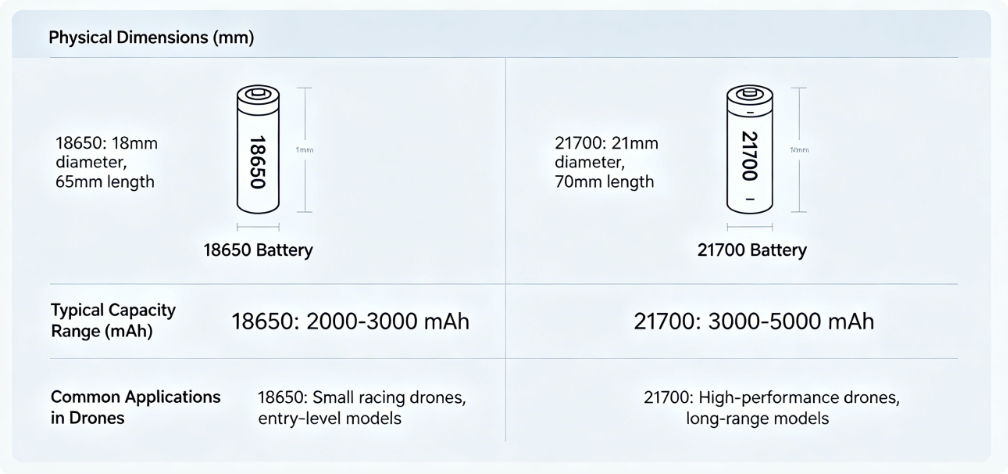
An 18650 cell is a cylindrical lithium cell that measures about 18 mm by 65 mm. A 21700 cell is about 21 mm by 70 mm. The larger size usually allows the 21700 format to carry more capacity per cell, but that does not automatically make it the better choice for every drone.
1.18650 Battery
The 18650 battery format is still useful in UAV pack design because it offers mature supply, flexible layout, and a form factor that works well in tighter spaces. If your drone is compact, narrow, lightweight, or built around lower continuous power demand, 18650 can still be very practical.
2.21700 Battery
A 21700 battery usually gives you more capacity per cell and often reduces the number of cells needed in the pack. That can improve pack efficiency, reduce interconnections, and make it easier to build longer-endurance UAV systems. This is why 21700 is frequently discussed in more modern endurance-driven drone projects.
18650 vs 21700 for Drones: What Is the Difference?
The real comparison is not just about physical size. It is about what that size changes in the battery pack and in the aircraft.
1.Capacity
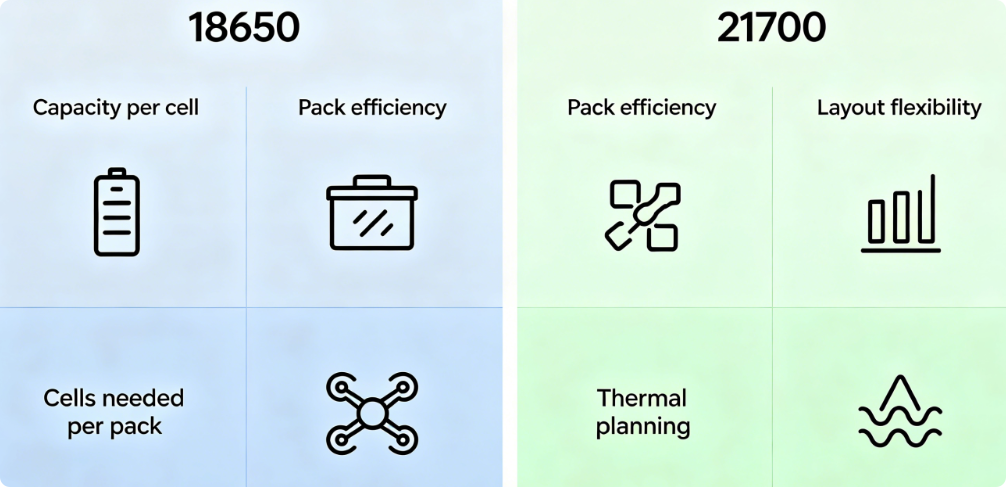
This is the most obvious difference. A 21700 cell usually stores more energy than an 18650 cell. For drones, that can mean fewer cells to reach the same flight-time target. If your project is endurance-focused, this is a major reason 21700 often comes out ahead.
2.Energy Density
When people ask which is better, they often really mean which format gives better energy for the weight and volume available. In many cases, 21700 performs better here because higher capacity per cell can help improve pack-level efficiency. That is especially useful in long-endurance and industrial UAV battery systems where every gram and every watt-hour matter.
3.Discharge Capability
The answer here depends on the aircraft. If your drone needs moderate but sustained output, both formats can work. If the application demands higher current over longer missions, the better option depends on the exact cell model and pack design, not just whether it is 18650 or 21700. In other words, this comparison should be made at the pack level, not only at the cell level.
4.Weight and Size
A single 21700 cell is larger and heavier than a single 18650 cell. But comparing one cell to one cell can be misleading. What matters more is the total battery pack. If a 21700-based pack can hit your target with fewer cells, it may still deliver a better overall result in energy-to-weight terms than an 18650 pack.
5.Thermal and Structural Impact
Thermal performance is important in drone battery design because heat affects consistency, reliability, and cycle life. Larger cells can change how heat moves through the pack. They can also change spacing, cell count, busbar layout, and structural packaging. That is why the better cell format is often the one that creates the better pack, not just the better single-cell spec.
Here is the simplest comparison:
Factor | 18650 | 21700 | Why It Matters for Drones |
Capacity per cell | Lower | Higher | Important for endurance |
Cells needed per pack | More | Fewer | Affects structure and complexity |
Pack efficiency | Good | Often better | Important for UAV design |
Layout flexibility | Higher | Moderate | Useful in compact airframes |
Single-cell size | Smaller | Larger | Affects available packing space |
Thermal planning | Design-dependent | Design-dependent | Important for mission reliability |
Which Cell Is Better for Long-Endurance Drones?
For many long-endurance drone projects, 21700 is often the better choice. The reason is not simply “bigger is better.” The real advantage is that more capacity per cell can help simplify the pack while improving energy efficiency.
1.Why 21700 Often Fits Endurance Better
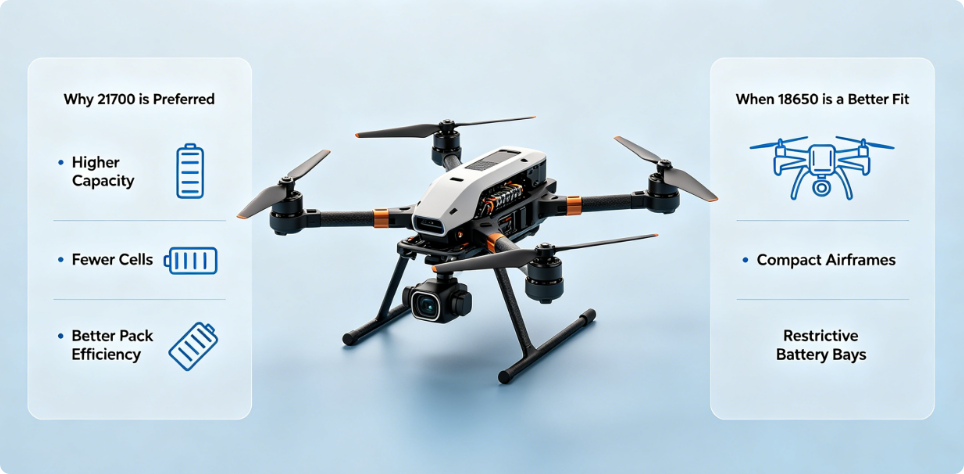
If your priority is flight time, a 21700-based pack often makes more sense because it can achieve a higher energy target with fewer cells. That can reduce pack overhead, simplify connections, and make better use of internal battery space. In endurance UAV design, that kind of improvement is valuable because the battery is one of the biggest factors in mission duration.
2.When 18650 Still Makes Sense for Endurance UAVs
There are still cases where 18650 is the better answer. If the battery bay is narrow, the airframe structure is restrictive, or the overall system benefits from more flexible cell arrangement, 18650 may still win. A good UAV design does not choose 21700 just because it is newer. It chooses the format that fits the aircraft better.
18650 or 21700 for Industrial UAVs?
This is where the comparison becomes more practical. Industrial UAV projects usually care about more than just cell size. They care about mission duration, payload support, operating consistency, thermal behavior, maintenance, and pack reliability.
1.Why 21700 Often Aligns with Modern Industrial UAV Design
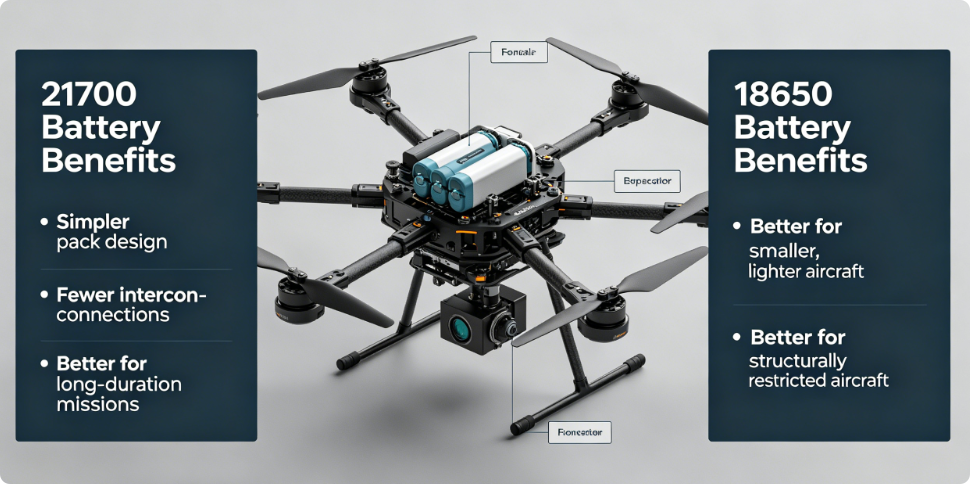
In many industrial UAV platforms, 21700 is attractive because fewer cells can make the battery pack cleaner to build and easier to manage. Fewer welds, fewer interconnections, and fewer monitoring points can all help simplify the system. For a modern industrial drone, that can improve pack integration and support better long-duration operation.
2.Why 18650 Still Has a Role
That does not mean 18650 has no place in industrial UAVs. If the aircraft is smaller, lighter, or restricted by structure, 18650 may still be the better fit. Some projects need packaging flexibility more than they need the highest possible capacity per cell.
Is 21700 Always Better Than 18650?
A lot of discussions make it sound like 21700 has replaced 18650 across the board. That is not how real UAV design works. In many modern long-endurance and industrial projects, 21700 does have strong advantages. But that does not make it the right answer for every drone.
1.When 21700 Is Usually Better
Choose 21700 when your design priorities are:
longer flight time
higher pack efficiency
fewer cells in the battery pack
endurance-focused or industrial UAV applications
2.When 18650 Is Usually Better
Choose 18650 when your design priorities are:
tighter or narrower battery spaces
more flexible pack geometry
lightweight or lower-power platforms
compact drone structures where layout matters more than maximum cell capacity
Here is a fast decision view:
Drone Requirement | Better Choice |
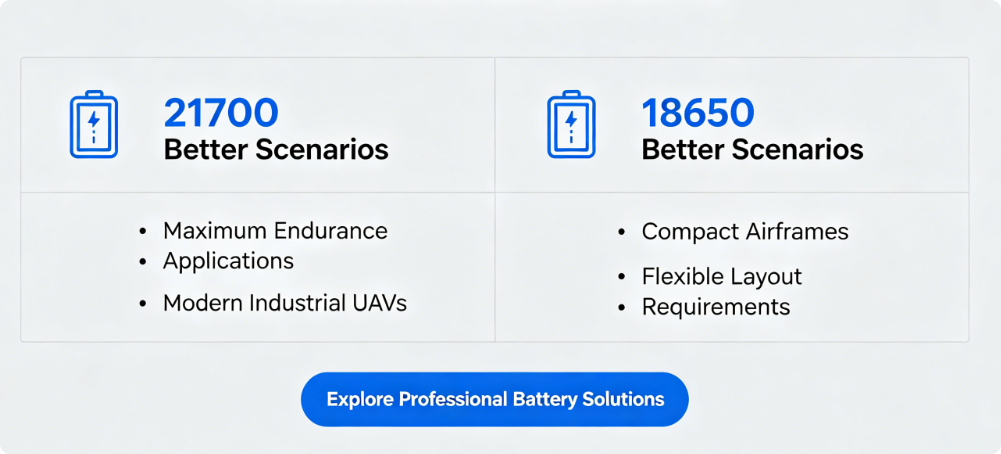
Maximum endurance | 21700 |
Modern industrial UAV pack | 21700 |
Compact airframe layout | 18650 |
Low-power lightweight platform | 18650 |
Fewer cells per pack | 21700 |
More flexible pack arrangement | 18650 |
How Cell Choice Affects Drone Pack Design
This is where many comparisons stop too early. The cell format affects far more than capacity.
1.Cell Count and Pack Complexity
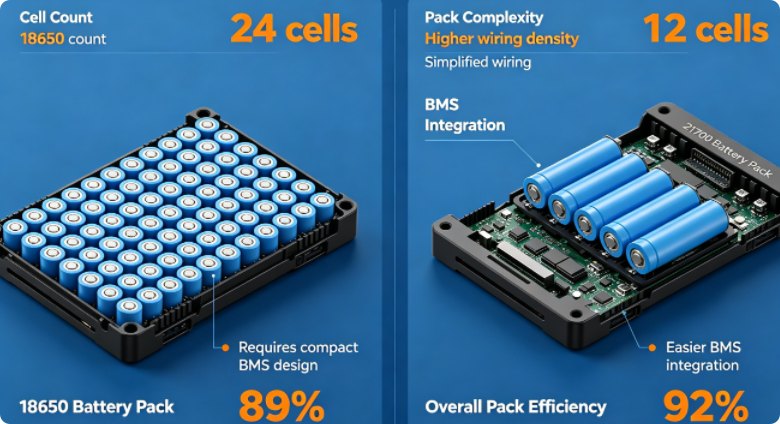
A 21700 pack often needs fewer cells for the same energy target. That can reduce interconnections and simplify part of the pack structure. An 18650 pack may need more cells, but it gives you more freedom in layout and shape.
2.Pack-Level Wh/kg
For drones, pack-level energy density often matters more than cell-level specs. Once you add housing, connectors, BMS, structural support, and wiring, the best cell on paper may not always create the best pack in practice. That is why UAV battery decisions should always be made at the pack level.
3.BMS and Integration
More cells usually mean more complexity in monitoring, balancing, and pack management. Fewer cells can simplify BMS design, but only if the larger cell format still fits the aircraft properly. So again, the better choice is not the one with the bigger number. It is the one that gives the whole battery system a cleaner solution.
How to Choose Between 18650 and 21700 for Your Drone
The easiest way to decide is to start from the aircraft, not the battery.
1.Choose 21700 If...
Choose 21700 if you want:
stronger endurance potential
better pack efficiency for modern UAV design
fewer cells in the pack
a battery direction better suited to industrial or long-range aircraft
2.Choose 18650 If...
Choose 18650 if you need:
more flexible pack layout
tighter structural fit
better compatibility with compact airframes
a lower-power drone where the highest cell capacity is not the main goal
Final Thoughts
So, which is better, 18650 or 21700 for drones? For many modern long-endurance and industrial UAV projects, 21700 is often the stronger choice because it supports higher energy and better pack efficiency. But 18650 still has real value in compact, lightweight, or lower-power drone platforms where structure and layout flexibility matter more.
The better choice is not just about cell size. It is about what helps the full battery pack work better for the aircraft.
If you are choosing between 18650 and 21700 for a real UAV project, it helps to work with a team that looks beyond the cell label and evaluates the full system, including energy density, thermal behavior, discharge demand, structural limits, and pack design. In our low-altitude battery development, we work around practical priorities such as high energy density, wide-temperature operation from -40°C to 60°C, long cycle life, and tightly controlled manufacturing quality for demanding UAV conditions.
If you are comparing 18650 and 21700 for a real drone battery project, explore Yattox and talk with us about your flight-time target, pack size limits, and current demand to find the more suitable UAV battery path.
FAQs
1.Is 21700 better than 18650 for drones?
Not always. 21700 is often better for long-endurance and industrial UAV projects because it usually offers higher capacity per cell and better pack efficiency. 18650 can still be the better choice for compact, lightweight, or lower-power drone platforms.
2.Why do long-range drones often use 21700 cells?
Many long-range drones use 21700 cells because they can support higher energy with fewer cells in the pack. That often helps improve endurance, reduce pack complexity, and make better use of available battery space.
3.Are 18650 batteries still used in UAVs?
Yes. 18650 cells are still used in UAV battery packs, especially where flexible pack layout, compact structure, or lighter-duty power demand matters more than maximum capacity per cell.
4.Which is better for industrial UAV battery packs, 18650 or 21700?
For many modern industrial UAV applications, 21700 is often the stronger option because it can support higher energy targets and simpler pack design. However, 18650 may still work better if the airframe has tighter structural limits or more specialized pack requirements.
5.Does 21700 always give better flight time than 18650?
Not automatically. 21700 often improves endurance potential, but actual flight time still depends on the full battery pack, including energy density, weight, discharge demand, and aircraft efficiency.
6.Is 18650 lighter than 21700 for drone battery packs?
A single 18650 cell is lighter than a single 21700 cell, but pack design matters more than single-cell weight. In some drone battery packs, 21700 can still deliver a better overall energy-to-weight result because fewer cells may be needed.
7.How do I choose between 18650 and 21700 for my drone?
Start with your real design target. If you want longer flight time, higher pack efficiency, and a more modern endurance-oriented UAV battery setup, 21700 is often the better direction. If you need tighter packaging, more layout flexibility, or a lighter low-power system, 18650 may be the better fit.