


Is LiPo Or Lithium-Ion Better For Drones?
May 30, 2026
In this guide, I focus on that decision path. You will see where LiPo has the advantage, where lithium-ion makes more sense, and how to think about the trade-off in a way that matches real drone use instead of generic battery theory.
Table of Contents
Quick Answer: Is LiPo or Lithium-Ion Better for Drones?
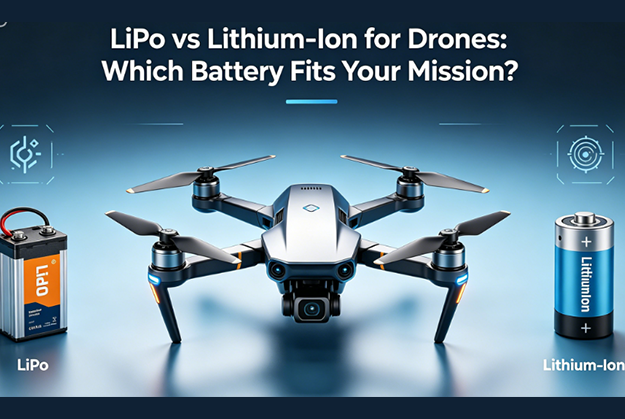
If you want the short answer, choose LiPo when your drone needs stronger output and faster response. Choose lithium-ion when your drone needs longer flight time and better energy efficiency.
That sounds simple, but the real difference shows up in the air. A LiPo battery usually feels more immediate under throttle and is better suited to aggressive flying. A lithium-ion battery usually gives you more usable time aloft, but it often feels calmer and less aggressive under heavy load. So the better battery is not the one with the better reputation. It is the one that better matches your drone’s mission.
Drone Priority | Better Battery Type | Main Reason |
Fast response and punch | LiPo | Higher discharge performance |
Longer flight time | Lithium-ion | Better energy density |
Racing or freestyle | LiPo | Stronger power delivery |
Long-range cruising | Lithium-ion | Better endurance |
Mission efficiency | Depends | Must match aircraft use |
LiPo vs Lithium-Ion Battery in Real Drone Use
The biggest difference between these two battery types is not what they look like on paper. It is how they change the way the drone flies.
1.What You Feel in Flight
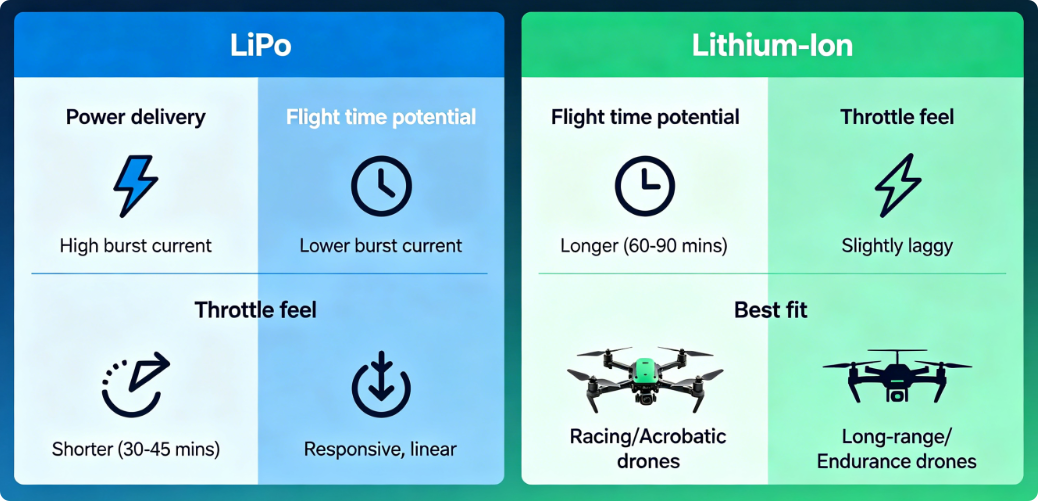
A LiPo battery usually gives you a more immediate power feel. When you raise throttle, the response is sharper, recovery is quicker, and the aircraft feels more willing to change direction under load. That makes a noticeable difference in any drone that flies aggressively.
A lithium-ion battery tends to feel smoother and more measured. That is not automatically a weakness. In steady flight, that calmer power delivery can work well. But if the drone needs repeated bursts of strong output, the difference becomes more obvious.
2.What You Gain in Mission Duration
This is where lithium-ion often stands out. For aircraft built around longer, steadier flight, the extra energy efficiency can translate into more useful mission time. If your goal is to stay in the air longer rather than demand peak output, that trade-off can be worth it.
3.What Changes in Pack Efficiency
Battery choice also affects the full pack, not just the flight feel. A lithium-ion battery is often chosen when pack-level energy efficiency matters more than aggressive performance. A LiPo battery is often chosen when the electrical system must respond faster to changing load. This is why the right answer is rarely about chemistry alone. It is about what the battery must do inside the full aircraft system.
Factor | LiPo Battery | Lithium-Ion Battery |
Power delivery | Higher | Lower |
Flight time potential | Moderate | Higher |
Throttle feel | More direct | Softer |
Best fit | Performance-focused drones | Endurance-focused drones |
Main trade-off | Shorter endurance | Weaker burst response |
When LiPo Is Better for Drones That Need Power and Response
There are many drone missions where endurance is not the main question. In those cases, LiPo usually becomes the stronger option because the aircraft needs more immediate output.
1.For FPV and High-Throttle Flying
If you fly FPV racing or aggressive freestyle, LiPo is usually the better choice. These drones ask for quick power delivery, stronger acceleration, and rapid throttle recovery. A battery that feels too soft can make the aircraft less precise and less competitive.
2.For Drones That Need Immediate Control
Some drones are not built for long smooth cruising. They are built for faster response and more active control. In these cases, LiPo helps the aircraft stay more connected to pilot input. That matters when every change in throttle affects the line, the timing, or the recovery.
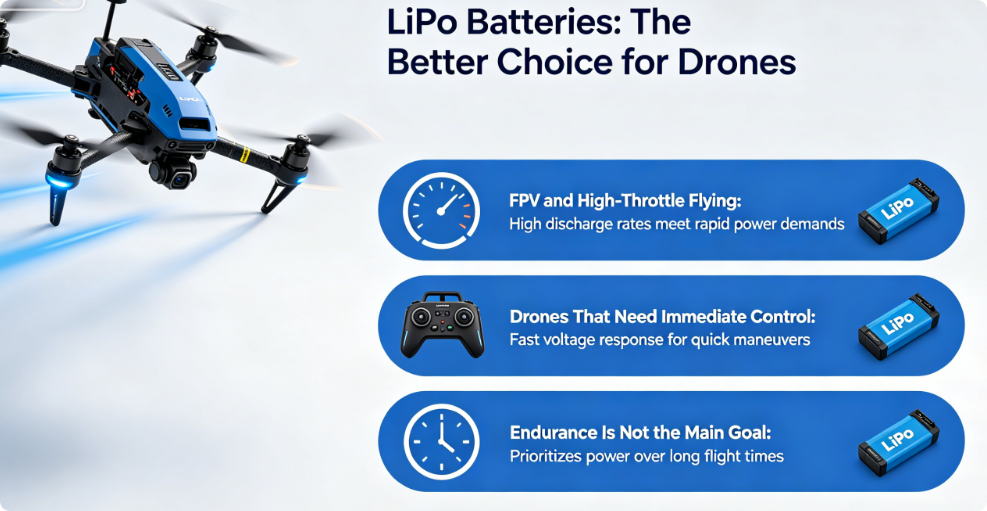
3.When Endurance Is Not the Main Goal
If your mission does not depend on staying in the air longer, then there is less reason to sacrifice output for extra efficiency. That is one reason LiPo remains the more natural answer for drones where responsiveness matters more than duration.
When Lithium-Ion Is Better for Drones That Need Longer Flight Time
There are also drone missions where aggressive output matters less than staying efficient over time. In these cases, lithium-ion often becomes the more practical choice.
1.For Long-Range and Steady Flight
A long-range aircraft usually benefits more from endurance than from aggressive punch. If your drone spends more time cruising than accelerating hard, a lithium-ion battery often fits the mission better.
2.For Efficiency-Focused UAV Design
Some drones are designed around mission time, not flying style. Inspection flights, endurance UAV tasks, and other steady-use cases often care more about energy efficiency than instant throttle feel. That is where lithium-ion can offer a stronger advantage.
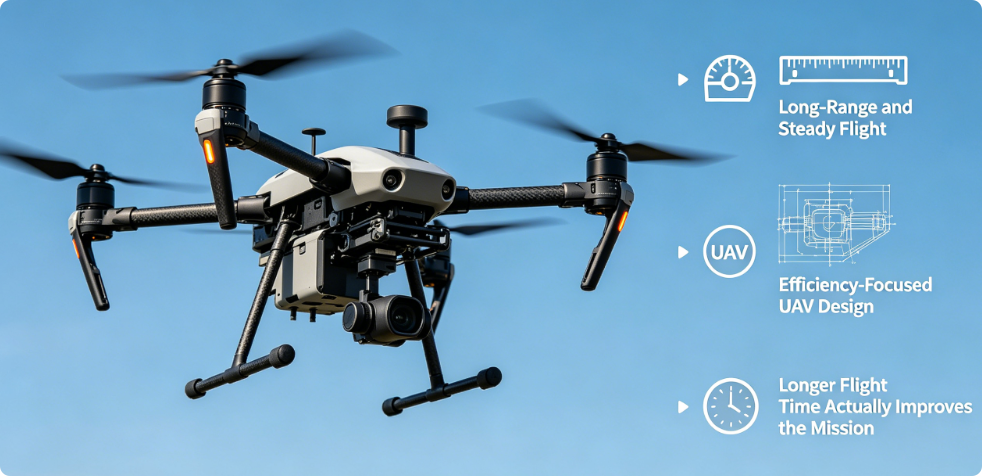
3.When Longer Flight Time Actually Improves the Mission
Extra flight time is only valuable if it helps the mission. For endurance drones, it often does. A longer route, more time on station, or fewer battery swaps can make lithium-ion the better battery direction.
LiPo or Lithium-Ion for Different Drone Missions
The easiest way to make this decision is to stop asking which battery is better in general and start asking which battery is better for your mission.
Drone Mission | Better Battery Type | Why |
FPV racing | LiPo | Higher discharge and faster response |
Freestyle FPV | LiPo | Better punch and recovery |
Long-range FPV | Lithium-ion | Longer flight time |
Cinematic drone | Depends | Balance of control and endurance |
Industrial UAV | Often lithium-ion | Better mission efficiency |
Final Thoughts
So, is LiPo or lithium-ion better for drones? If your drone needs stronger output, faster response, and more direct control, LiPo is usually the better answer. If your drone needs longer endurance and better energy efficiency, lithium-ion is often the better direction.
The key is not to treat battery choice like a popularity contest. The better battery is the one that fits the work your drone is meant to do. If you are comparing battery directions for FPV, long-range, industrial, or custom drone projects, explore Yattox and find the battery path that better matches your aircraft and mission.
FAQs
1.Is LiPo better than lithium-ion for drones?
Not always. LiPo is usually better for drones that need stronger output, faster response, and more direct control, while lithium-ion is often better for drones that need longer flight time and better energy efficiency.
2.Why do FPV drones usually use LiPo batteries?
FPV drones usually use LiPo batteries because they need quick power delivery, stronger acceleration, and faster throttle recovery. These qualities matter more in racing and freestyle than longer endurance.
3.Is lithium-ion better for long-range drones?
In many cases, yes. A lithium-ion battery is often the better direction for long-range drones because it can support longer flight time and better energy efficiency for steady missions.
4.Can lithium-ion batteries be used in FPV drones?
They can, but they are not always the best choice. In FPV builds that rely on repeated bursts of strong output, lithium-ion can feel softer under load than LiPo. That is why it is more common in long-range FPV than in racing or aggressive freestyle.
5.Which battery is better for industrial UAVs, LiPo or lithium-ion?
For many industrial UAV missions, lithium-ion is often the better choice because it supports longer mission duration and better efficiency. However, LiPo may still be better if the drone needs more immediate power or stronger control response.