


6S vs 12S Drone Battery: Voltage, Current and UAV Compatibility
October 27, 2026
Compare 6S vs 12S drone batteries by voltage, current, ESC compatibility and flight time. Find the right battery configuration for your UAV with YATTOX.
Table of Contents
A 6S drone battery delivers 22.2V nominal (25.2V fully charged), while a 12S drone battery delivers 44.4V nominal (50.4V fully charged). At the same electrical power, a 12S system draws about half the current of a 6S system, reducing resistive losses in cables and connectors.
The choice depends on your drone's motor, ESC, power requirements and battery weight. A 12S battery is not a direct upgrade for a drone designed to run on 6S, nor does higher voltage automatically mean longer flight time.
6S vs 12S Drone Battery: What's the Difference?
The “S” indicates the number of cells connected in series. More cells in series increase battery voltage.
For standard LiPo cells rated at 3.7V nominal and 4.2V fully charged:
| Specification | 6S Battery | 12S Battery |
|---|---|---|
| Cells in series | 6 | 12 |
| Nominal voltage | 22.2V | 44.4V |
| Fully charged voltage | 25.2V | 50.4V |
| Energy at 22Ah | 488.4Wh | 976.8Wh |
| Current at 2,000W | About 90A | About 45A |
| System requirement | 6S-compatible powertrain | 12S-compatible powertrain |
These values apply to standard LiPo cells. LiHV and other battery chemistries may use different nominal and charging voltages.
A 12S pack provides twice the nominal voltage of a 6S pack using the same cell chemistry. However, the battery's energy depends on both voltage and capacity (Ah).
How Does Battery Voltage Affect Current and Efficiency?
A 12S system draws about half the current of a 6S system when delivering the same electrical power at nominal voltage.
For example, a drone requiring 2,000W would draw approximately:
- 6S at 22.2V: 90A
- 12S at 44.4V: 45A
The relationship is simple:
Current (A) = Power (W) ÷ Voltage (V)
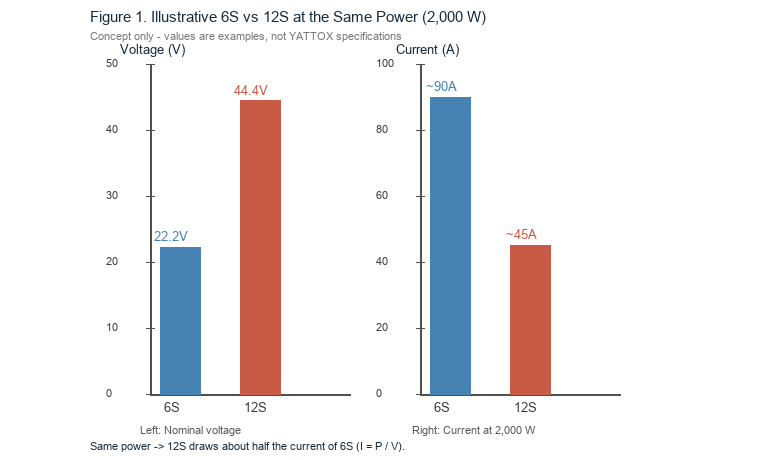
Figure 1. Illustrative 6S vs 12S comparison at the same 2,000W power level: the 12S configuration operates at twice the nominal voltage and draws roughly half the current. Example values for concept illustration, not YATTOX specifications.
Lower current reduces resistive heating in wires and connectors. Because these losses increase with the square of current (I²R), halving the current reduces the loss in an identical conductor to one-quarter.
This can make higher-voltage architectures useful for power-demanding UAVs. However, it does not guarantee a fixed improvement in overall efficiency. Motor performance, ESC design, battery resistance and operating conditions still affect the result.
Can You Use a 12S Battery on a 6S Drone?
No, not unless the drone's electrical system is specifically designed or modified to support 12S voltage.
A fully charged 12S LiPo battery reaches 50.4V, compared with 25.2V for 6S. Connecting it to components rated only for 6S may cause electrical damage.
Check three areas before changing voltage.
Motor and ESC Compatibility
The ESC must support the battery's maximum voltage, and the motor must be suitable for the intended voltage, speed and propeller load.
Motor KV is especially important. A motor designed for a 6S setup may run at an excessive speed when supplied with 12S voltage unless the propulsion system is redesigned.
Wiring and Power Distribution
The power distribution board, connectors, capacitors and onboard voltage converters must support the higher voltage.
Although a 12S system may draw less current at the same power, this does not mean existing wiring or electronic components can be reused without checking their ratings.
Charger and Battery Monitoring
A charger designed only for 6S cannot charge a 12S pack.
For smart batteries, also check the battery management interface and any communication requirements between the pack and flight controller.
If your UAV is already built around 6S, choosing a suitable 6S battery is usually more practical than converting the entire power system.
Does a 12S Drone Battery Last Longer Than 6S?
Not necessarily. Flight time depends on usable energy (Wh), aircraft weight and average power consumption—not voltage alone.
Consider two battery comparisons.
Same capacity:
- 6S 22Ah = 488.4Wh
- 12S 22Ah = 976.8Wh
The 12S pack stores twice the nominal energy, but a comparable pack would generally contain more cells and weigh more. That additional weight affects the aircraft's power demand.
Same nominal energy:
- 6S 22Ah = 488.4Wh
- 12S 11Ah = 488.4Wh
These two packs have the same nominal energy. The 12S system may benefit from lower current, but that alone does not establish which aircraft will fly longer.
A basic flight-time estimate is:
Flight Time (hours) = Usable Energy (Wh) ÷ Average Power (W)
For example, 400Wh of usable battery energy at an average consumption of 1,000W gives 24 minutes before any additional operational reserve is deducted.
Actual results depend on the aircraft's weight, propulsion efficiency, flight conditions and usable discharge range.
Which Is Better for Your UAV: 6S or 12S?
Neither configuration is universally better. The correct choice depends on the aircraft's powertrain and operating requirements.
Choose 6S for an Existing 6S Power System
A 6S battery is the straightforward choice when your motor, ESC and charging equipment are already designed for six-cell operation.
For example, a UAV using a 6S electrical system may need a different battery capacity for a longer mission. In that case, compare available energy, discharge current, pack weight and dimensions before considering any change to the voltage architecture.
YATTOX offers 6S UAV battery configurations for applications with different capacity and discharge requirements. See YATTOX UAV battery solutions for available platforms.
Consider 12S for a Higher-Voltage UAV Design
A 12S battery is worth considering when the aircraft is designed for higher-voltage operation, particularly where elevated power demand would otherwise require substantial current.
This may apply to agricultural drones, cargo UAVs and other industrial platforms using compatible 12S propulsion systems.
However, the voltage configuration should be selected alongside motor and ESC ratings, battery mass, available installation space and charging equipment. A heavy-lift drone does not automatically require 12S simply because it carries a large payload.
What Should You Check Before Ordering a 6S or 12S UAV Battery?
Once the voltage architecture is confirmed, the next step is finding a battery that meets the aircraft's electrical and mechanical requirements.
For existing UAV platforms, begin with the approved electrical specifications. For new designs, provide the expected load profile and installation limits so that battery voltage, capacity and discharge performance can be evaluated together.
| Requirement | Information to Confirm |
|---|---|
| Voltage | 6S, 12S or another configuration |
| Capacity | Required Ah or Wh |
| Discharge | Continuous and peak current |
| Battery weight | Maximum allowable pack mass |
| Dimensions | Available installation space |
| Connection | Connector type and cable requirements |
| Charging | Charger compatibility and charging requirements |
| Battery management | Monitoring or communication needs |
| Order details | Sample quantity and estimated volume |
YATTOX manufactures UAV battery packs across common voltage platforms, including lithium polymer drone batteries and semi-solid-state configurations for industrial platforms.
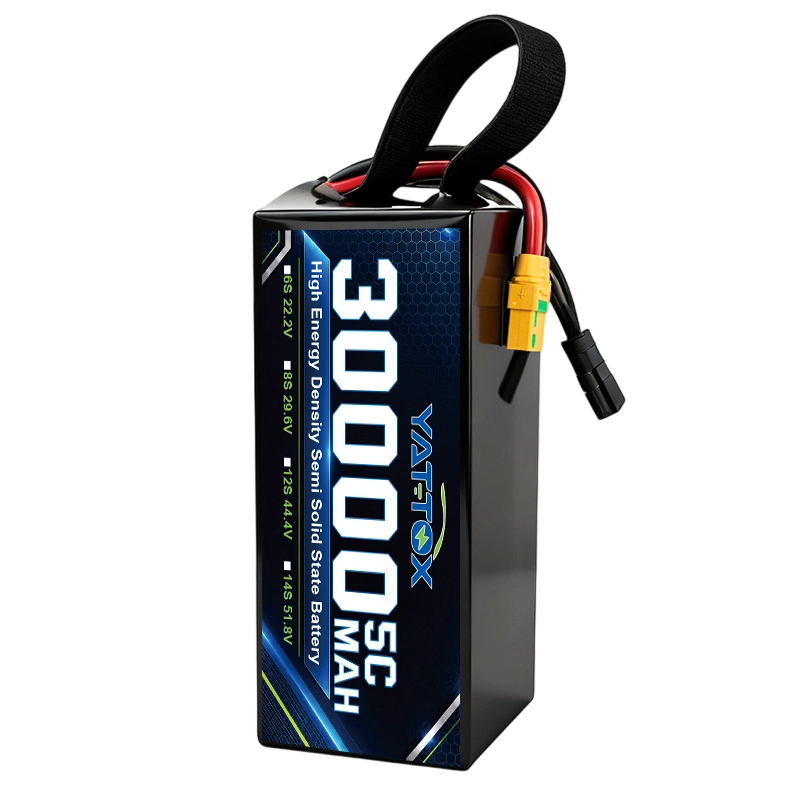
YATTOX 30,000mAh semi-solid-state UAV battery pack. Available configurations cover different voltage platforms, capacities and discharge requirements for industrial UAV applications.
Explore YATTOX UAV battery packs to compare available configurations and discuss custom battery requirements.
FAQs About 6S and 12S Drone Batteries
What is the voltage of a 6S drone battery?
A standard 6S LiPo battery has a nominal voltage of 22.2V and reaches 25.2V when fully charged.
What is the voltage of a 12S drone battery?
A standard 12S LiPo battery has a nominal voltage of 44.4V and reaches 50.4V when fully charged.
Is 12S better than 6S for heavy-lift drones?
A 12S architecture can reduce current at the same power, making it useful in some higher-power UAV systems. However, the aircraft must have compatible motors, ESCs and electrical components. Payload weight alone does not determine the correct battery voltage.
Can two 6S batteries be connected in series for 12S?
Yes, compatible 6S packs can be connected in series to provide 12S nominal voltage, but only in a system designed for that arrangement. Battery matching, charging, wiring and monitoring must follow the approved equipment specifications.
Does a 12S battery require a different charger?
Yes. The charger must support the battery's cell count, chemistry, maximum voltage and charging requirements. A 6S-only charger is not suitable for a 12S pack.
Conclusion
A 6S drone battery operates at 22.2V nominal, while a 12S battery operates at 44.4V. Higher voltage reduces current at the same power, but battery selection still depends on the complete UAV electrical system.
For an existing 6S aircraft, prioritize compatible battery capacity, discharge performance and dimensions. For a new high-power UAV design, evaluate whether a 12S architecture offers practical electrical and integration advantages.
Need a 6S or 12S battery for your UAV project? Browse YATTOX UAV battery solutions or send your voltage, capacity, current, dimensions and order requirements to discuss a suitable configuration.