


Can a UAV Battery Really Work at −20°C? What Buyers Should Check
October 21, 2026
Can a UAV battery work at −20°C? This guide explains how cold affects capacity, voltage and discharge power, the difference between discharge and cold-start ratings, and the specifications buyers should check before choosing a battery for winter UAV operations.
Table of Contents
Can a UAV battery operate at −20°C (−4°F)? Yes, certain battery designs can support subzero discharge, but a minimum operating-temperature rating does not guarantee normal capacity, full discharge power or the same flight time available at room temperature.
For industrial drones carrying inspection equipment, mapping sensors or heavy payloads, this distinction matters. Cold weather can increase battery internal resistance, reduce usable energy and cause voltage to fall more sharply during high-current operations such as takeoff and climbing.
Quick Answer: A UAV battery can be suitable for −20°C operation if its actual cell temperature, usable energy, continuous and peak discharge capability, loaded voltage and charging restrictions are compatible with the mission. The minimum temperature on a datasheet alone is not sufficient evidence.
Buyers should also check whether a specialized low-temperature cell design, battery preheating or thermal management is necessary. More importantly, the selected battery pack must meet the aircraft's power and installation requirements under the expected operating conditions.
Does a −20°C UAV Battery Rating Guarantee Normal Performance?
A battery labeled for −20°C operation is not necessarily capable of delivering its room-temperature performance at −20°C.
The first question is what the manufacturer means by the temperature rating.
For example, a specified discharge-temperature range may indicate that the battery is permitted to discharge under certain conditions. It does not necessarily establish how much capacity remains available or whether full rated current can be sustained at the lowest stated temperature.
A cold-start rating may describe the battery's ability to begin operation from a specified initial temperature. However, this is different from maintaining the required electrical performance during an entire mission.
Capacity retention is another separate measurement. A supplier may report the percentage of capacity retained at a given temperature, but that figure must be interpreted alongside discharge current, cutoff voltage and whether the battery was preheated.
These distinctions help prevent buyers from treating different technical claims as equivalent.
Ambient Temperature vs. Battery Cell Temperature
Ambient temperature is not the same as the temperature inside a battery.
A UAV operating in −20°C air may begin its mission with a battery that was stored or preheated at a warmer temperature.
During flight, the pack can generate heat through internal electrical losses while airflow and surrounding structures remove heat. Its cell temperature may therefore increase or decrease depending on the aircraft's power demand and thermal design.
Consequently, a battery tested after preheating cannot automatically be assumed to deliver the same performance when started from a fully cold-soaked condition.
For UAV procurement, the starting temperature, conditioning procedure and actual measured cell temperature should be included when comparing low-temperature performance claims.
What Happens to UAV Battery Capacity and Voltage at −20°C?
Lithium batteries depend on electrochemical reactions and lithium-ion transport to deliver electrical energy.
At low temperatures, slower reaction kinetics and ion transport generally increase internal resistance and polarization. Under load, this can produce a larger voltage drop and reduce the amount of energy available before the battery reaches its discharge endpoint.
Research on low-temperature lithium-ion battery performance published through the U.S. Department of Energy identifies slower ion transport, increased electrolyte and interfacial resistance, and reduced charge-transfer kinetics as important factors affecting battery behavior in cold environments. These effects can contribute to reduced discharge capacity and lower voltage under load.
The severity of these effects depends on the cell chemistry, battery construction, state of charge, discharge current and actual cell temperature.
How Much Battery Capacity Is Lost at −20°C?
There is no universal capacity-loss percentage that applies to every LiPo or lithium-ion UAV battery at −20°C.
Suppose a battery provides 1,000Wh under a defined reference condition but delivers only 700Wh during a hypothetical test at −20°C.
Its delivered-energy retention would be:
Energy Retention = 700Wh ÷ 1,000Wh × 100% = 70%
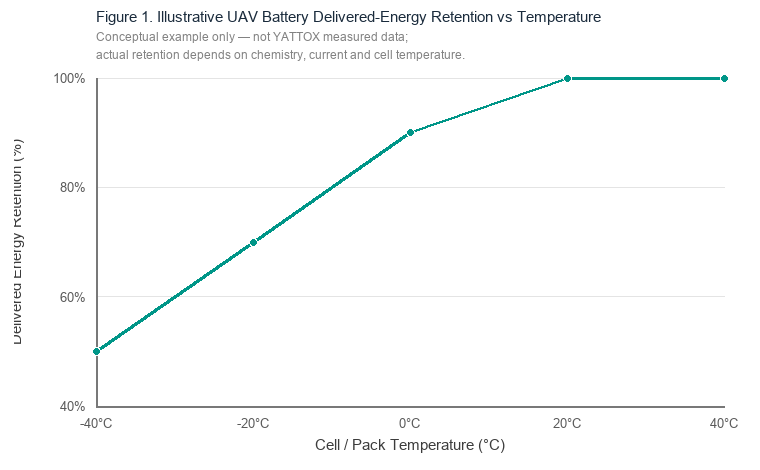
Figure 1. Illustrative UAV battery delivered-energy retention versus temperature. The example is conceptual, not measured test data, and does not represent any YATTOX product.
This example illustrates the calculation method. It is not a measured YATTOX result or a general claim that all lithium batteries retain 70% of their energy at −20°C.
Changing the discharge current, cutoff voltage or starting cell temperature could produce a different result.
Buyers should also distinguish capacity retention, measured in Ah, from delivered-energy retention, measured in Wh. The two may differ because battery voltage changes throughout discharge.
For UAV flight-time evaluation, delivered energy is particularly important because it describes the electrical energy available to the aircraft under the tested conditions.
Why Cold-Weather Voltage Sag Matters During Takeoff
A battery that delivers acceptable energy at low current may still struggle to support the high current demanded during takeoff.
As current increases, voltage loss across the battery's internal resistance also increases. Cold-related resistance changes can make this behavior more pronounced.
If loaded voltage approaches the aircraft's warning or protective threshold, the flight controller may initiate a low-battery response before the battery has delivered the amount of energy expected from its nominal capacity.
This is not merely a theoretical concern. ArduPilot's battery failsafe documentation explains how monitored voltage, remaining-capacity estimates and configured protection thresholds can trigger protective actions.
Actual behavior depends on the flight-controller hardware, measurement configuration and selected failsafe settings.
A battery should therefore be assessed against the UAV's peak-current requirement and minimum acceptable loaded voltage, not only its nominal capacity.
Which Cold-Weather UAV Battery Specifications Matter Most?
For UAV manufacturers and purchasing teams, the most useful specifications describe how a battery behaves under the intended operating conditions.
A room-temperature C-rating or a broad temperature range may help narrow the options, but neither is sufficient to qualify a pack for subzero missions.
| Supplier Specification | What It May Establish | What It Does Not Automatically Prove |
|---|---|---|
| Discharge temperature down to −20°C | Operation is permitted within stated conditions | Full nominal capacity or room-temperature discharge current |
| Cold start at −20°C | Startup capability under specified initial conditions | Adequate power throughout the complete mission |
| Capacity retention at −20°C | Capacity remaining under a particular test | Identical energy output or performance at different currents |
| Integrated battery heating | A means of raising or maintaining pack temperature | Sufficient flight endurance after accounting for heating energy |
| Low-temperature cell design | A cell designed to address cold-weather limitations | Verified suitability for the UAV's particular power requirements |
Does a 25C UAV Battery Still Deliver 25C at −20°C?
Not necessarily.
C-rating expresses discharge current relative to battery capacity. For example, a 10Ah battery rated at 25C corresponds to a stated discharge current of 250A under the rating's specified conditions.
That calculation does not prove the same current is available at −20°C.
The cell's voltage response, internal resistance, thermal behavior and permitted discharge conditions must also be considered.
Two batteries with identical room-temperature C-ratings may behave differently when cold because their cell chemistry, electrode design and pack construction differ.
A low-temperature discharge curve can provide more useful evidence than a room-temperature C-rating alone, particularly when the UAV experiences substantial current demand during takeoff.
What About Battery Weight and Energy Density?
Cold-weather performance improvements can introduce design trade-offs.
A specialized cell formulation may have a different energy-to-weight performance from another cell design. Integrated heating, insulation, sensors and additional protective components can also contribute to the finished pack's mass.
For an aircraft with a strict takeoff-weight limit, the relevant comparison is the complete installed system rather than the cell alone.
A heating system may also consume energy from the flight battery or require an external source before takeoff.
Therefore, a heated battery should be assessed according to its usable mission energy after any onboard heating consumption, as well as its total installed weight.
Higher cell-level Wh/kg does not automatically translate into a lighter or longer-lasting cold-weather UAV power system.
Do Low-Temperature UAV Batteries Need Self-Heating Systems?
Not every UAV operating below 0°C requires a self-heating battery.
The need for heating depends on whether the selected cells can safely deliver the necessary power at their starting temperature and throughout the intended mission.
For some aircraft, maintaining the battery within a qualified temperature range before takeoff may be sufficient. Other applications may require additional thermal-management measures during operation.
Specialized Low-Temperature Cells vs. Heated Battery Packs
A specialized low-temperature cell is designed to address cold-weather electrochemical limitations through its materials or construction.
A heated battery pack takes a different approach: it raises the temperature of the cells so they can operate within a more favorable thermal range.
These approaches are not interchangeable. A battery with integrated heating still needs cells and electrical components that meet the intended load requirements, while a specialized low-temperature cell does not automatically eliminate every need for temperature management.
A suitable engineering decision should account for the minimum expected temperature, current demand, flight duration and whether the battery will begin operation from a cold-soaked condition.
What Should Buyers Check in a Self-Heating UAV Battery?
An integrated heating system introduces its own operating requirements.
Buyers should confirm the power source, target cell temperature, heating time, sensing arrangement and protective controls.
It also matters whether heating begins automatically under defined conditions or requires an approved operator action. The control method should be compatible with the battery system and the aircraft's operating procedure.
For onboard heating, energy consumption must be included in mission calculations.
For externally powered preheating, the aircraft's starting battery temperature and subsequent cooling behavior remain important.
Neither preheating nor self-heating should be interpreted as permission to operate beyond the manufacturer's approved temperature, electrical or thermal limits.
How Should UAV Operators Prepare Batteries for −20°C Flights?
Winter UAV operation requires attention to both battery condition and the aircraft's complete operating environment.
Battery temperature, loaded voltage, current demand and available energy should be considered together when preparing for subzero missions. Cold-weather operation may reduce electrical performance margins, so battery preparation and flight planning should reflect the limits of the particular aircraft and battery system.
Specific temperatures, warm-up periods and flight procedures should always follow the relevant aircraft and battery manufacturer's instructions rather than a universal winter-flight rule.
For a UAV intended to work near −20°C, the preparation process should address four practical areas:
- Battery condition before installation. Confirm that the pack is undamaged, appropriately charged and at a temperature permitted by the manufacturer for the intended operation.
- Preflight temperature management. Use only approved preheating or thermal-management methods. Confirm that the battery's actual temperature meets the applicable starting conditions.
- Loaded voltage and flight monitoring. Review available voltage, current, temperature and battery-status information. Account for the aircraft's actual takeoff and payload demands.
- Landing and subsequent charging. Maintain an appropriate mission reserve and ensure the pack is within its permitted charging-temperature range before recharging.
An aircraft should not be used to validate an unqualified battery simply by increasing payload or extending flight time under extreme cold conditions.
Likewise, hovering after takeoff should not be treated as a universal method for making an otherwise unsuitable cold battery safe. If the pack cannot support the required takeoff load at its initial temperature, it must be addressed before flight.
Battery heating, flight control and charging should be considered parts of the same operating procedure.
What Should Buyers Ask a Low-Temperature UAV Battery Supplier?
A supplier does not necessarily need to provide a complete research-level test program before an initial discussion can begin.
However, the buyer should be able to understand the limits of any claimed low-temperature capability.
For an initial evaluation, a product specification sheet, clear operating limits and available performance information may be enough to identify potential battery options.
For demanding industrial UAV projects, more detailed engineering validation may be needed before a configuration is approved.
| Specification | Why Buyers Need It |
|---|---|
| Minimum discharge temperature | Identifies the stated operating boundary and its conditions |
| Usable Ah and Wh at −20°C | Shows available charge and energy under a defined test |
| Continuous discharge current at low temperature | Indicates whether sustained flight power can be supported |
| Peak discharge current and duration | Helps assess takeoff and climbing requirements |
| Loaded voltage curve | Shows voltage behavior during the specified discharge load |
| Charging temperature range | Defines when charging is permitted |
| Finished battery weight and dimensions | Establishes aircraft integration and payload implications |
| Heating and protection requirements | Clarifies additional power, controls and operating restrictions |
Five questions can help structure the supplier discussion:
- Which exact battery model supports the stated temperature range? Confirm whether the specification applies to a standard product, specialized low-temperature cell or customized pack.
- What usable capacity and energy are available at the target temperature? Ask for Ah or Wh figures together with the discharge current, starting cell temperature and cutoff conditions.
- Can the battery support the aircraft's peak current when cold? Confirm the applicable discharge rating, peak duration and loaded voltage behavior.
- Does the battery require preheating or temperature-controlled charging? Establish the relevant procedures and any additional heating, sensing or protection requirements.
- Will the complete pack fit the UAV's electrical and mechanical requirements? Check voltage, total weight, dimensions, connectors and compatibility with the power system.
If the supplier cannot immediately provide every item, the missing information should be treated as a qualification question rather than assumed to be satisfactory.
The distinction is between identifying a potentially suitable product and confirming that it meets the exact mission requirements.
Which UAV Battery Type Works Best for Cold-Weather Missions?
The appropriate battery type depends on the aircraft's power profile and the performance available from the specific battery design at the intended temperature.
For a heavy-lift multirotor, substantial takeoff current and voltage stability may be the main priorities. A high-discharge LiPo configuration can be a relevant starting point, provided its low-temperature power capability is suitable.
A mapping or long-range inspection aircraft may place greater emphasis on usable energy and installed battery weight. Li-ion or semi-solid-state configurations may be considered when endurance and energy density are important design priorities.
However, a semi-solid-state battery should not automatically be considered superior to a LiPo battery in cold weather. Actual performance depends on the cell design, discharge conditions and pack integration.
For fixed-wing platforms, sustained cruise demand and takeoff power requirements should be considered together. For multirotors and agricultural UAVs, peak-current requirements can be particularly important.
The choice therefore needs to reflect both the battery chemistry and the aircraft's mission profile.
YATTOX offers lithium polymer battery solutions, including a product range with published low-temperature operating characteristics.
These options can form a starting point for cold-weather UAV selection. The applicable temperature and discharge limits of the specific configuration should be confirmed before it is selected for a demanding mission.
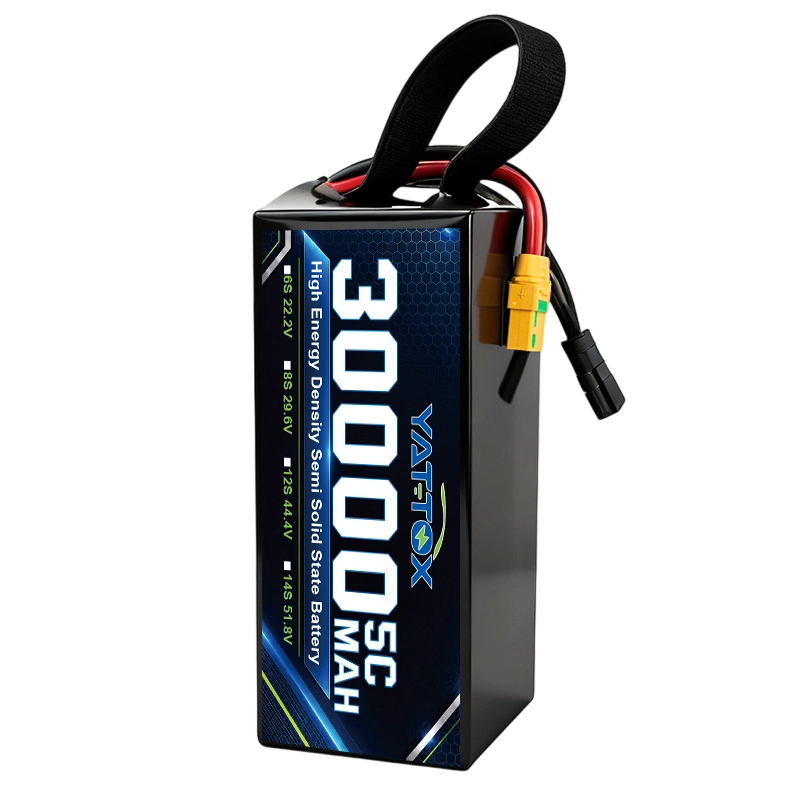
YATTOX 30,000mAh semi-solid-state UAV battery pack, one of the configurations considered for mapping and long-range UAV platforms where usable energy and installed weight are priorities.
How YATTOX Supports Cold-Weather UAV Battery Projects
Cold-weather UAV projects can involve different priorities: high takeoff power, extended endurance, strict weight limits or compatibility with existing aircraft systems.
YATTOX supplies LiPo, Li-ion and semi-solid-state battery solutions for UAV manufacturers, equipment integrators and industrial drone applications.
Its UAV battery solutions include configurable voltage, capacity, discharge characteristics, pack dimensions, connectors and compatible monitoring or protection interfaces.
For cold-weather projects, the evaluation can focus on battery chemistry and electrical requirements, mechanical integration and the temperature conditions under which the aircraft is expected to operate.
A heavy-lift multirotor may need stronger peak-current capability, while a mapping UAV may prioritize usable energy and reduced pack weight. In either case, battery selection should account for the actual performance limits of the chosen configuration.
YATTOX also supports cell-to-PACK development and battery manufacturing processes involving voltage inspection, internal-resistance testing and production traceability.
These capabilities support battery configuration development and manufacturing consistency. They do not, by themselves, establish a specific capacity-retention or discharge-current guarantee at −20°C.
For an initial discussion, buyers do not need to prepare an exhaustive technical report.
An existing battery model or required voltage, UAV application and expected minimum operating temperature can provide a starting point. Payload, current demand, flight-time targets and installation requirements can then be reviewed during the technical evaluation.
This allows the selection process to focus on suitable battery options and any configuration changes or additional validation needed for the project.
Frequently Asked Questions About UAV Batteries at −20°C
Can a standard LiPo battery operate at −20°C?
Some LiPo batteries may be permitted to discharge at −20°C under specified conditions, but this does not guarantee normal capacity or full discharge power. Suitability depends on the particular cell design and manufacturer-approved operating limits.
Is a −20°C discharge rating the same as a −20°C cold-start rating?
No. A discharge-temperature rating describes an operating boundary under specified conditions, while a cold-start rating concerns the battery's initial operating state. Neither alone proves that the pack can complete a particular UAV mission.
Does a low-temperature UAV battery always need heating?
No. Heating is only necessary when required by the battery's operating limits or the aircraft's thermal and power requirements. Some suitable battery designs may support the intended conditions without integrated heating.
Can a UAV battery rated for −20°C be charged at −20°C?
Not automatically. Discharge and charging temperature limits must be checked separately. Charging below the permitted cell-temperature range can create degradation and safety risks.
Why does a drone show a low-battery warning sooner in winter?
Cold temperatures can increase internal resistance and reduce the energy available under load. The resulting voltage drop may cause the flight controller to reach its configured battery-warning threshold earlier.
What information should I provide when sourcing a cold-weather UAV battery?
Start with the UAV application, existing battery model or required voltage, and minimum expected operating temperature. Payload, flight-time targets, current demand, available space and connector requirements can then help refine the selection.
Is a −20°C UAV Battery Right for Your Aircraft?
A battery described as suitable for −20°C operation may be a candidate for winter UAV missions, but the temperature rating alone does not establish whether it can deliver the required energy and power.
The more useful decision is based on the selected battery's discharge conditions, usable energy, loaded voltage, peak-current capability, charging restrictions and any required temperature management.
For some applications, a suitable high-discharge LiPo configuration may be the right starting point. Others may require a different cell or pack design to balance energy, weight and operating conditions.
The best cold-weather UAV battery is the one that meets the aircraft's verified mission requirements—not simply the one with the lowest advertised operating temperature.
Discuss Your Cold-Weather UAV Battery Requirements With YATTOX
Looking for a battery for winter inspection, mapping or industrial UAV operations?
YATTOX supports customized UAV battery configurations with selectable voltage, capacity, discharge characteristics, pack dimensions and connector options.
Share your UAV application, existing battery model or required voltage, and expected minimum operating temperature. Our team can help review relevant battery options and discuss configuration requirements.
Further payload, current and flight-time information can be provided as the project progresses.
Discuss Your Cold-Weather Battery Requirements
Explore YATTOX UAV Battery Solutions and lithium polymer battery options to compare published low-temperature operating characteristics before selecting a configuration.