


Custom UAV Battery RFQ: From Initial Inquiry to Production Quote
October 21, 2026
Prepare a custom UAV battery RFQ from initial inquiry to production quote. This guide explains which specifications, samples, order details and quotation terms buyers should confirm at each stage.
Table of Contents
A custom UAV battery project rarely begins with a complete engineering specification. A drone manufacturer may know the required flight time and payload but still be finalizing the battery compartment. A purchasing team may have an existing battery sample but no detailed electrical drawings. In both cases, supplier discussions can begin before every technical decision has been made.
The challenge is moving from an initial inquiry to a quotation that reflects the battery the aircraft actually needs.
A custom UAV battery RFQ can begin with basic application details, an existing battery model or target voltage, and estimated order quantity. However, a reliable production quote requires agreed electrical requirements, mechanical constraints, interfaces, sample acceptance criteria and commercial terms.
The information needed changes as the project develops. An early budget estimate may help determine whether a design is commercially feasible, while a production quotation should reflect a defined battery configuration and agreed scope.
For UAV OEMs, system integrators and procurement teams, understanding these stages helps reduce specification misunderstandings, unnecessary design revisions and unexpected quotation differences.
Starting a Custom UAV Battery Inquiry Without Complete Specifications
Not every custom battery inquiry needs to arrive with a finished drawing, detailed bill of materials or complete test specification.
During early aircraft development, engineers may still be evaluating the propulsion system, payload and installation layout. Waiting until every parameter is finalized can delay useful discussions with potential battery suppliers.
An initial inquiry can establish whether the manufacturer has relevant battery platforms, available cell options and the ability to address the project's broad electrical and mechanical constraints.
For example, a UAV manufacturer developing an inspection multirotor might initially know that the aircraft uses a 12S electrical system, needs a longer flight time than its current configuration and has limited battery compartment space. That information can support an initial technical discussion, even if the final current profile and pack dimensions are not yet confirmed.
The outcome may be a preliminary configuration recommendation, a request for additional technical details or, where sufficient information exists, an indicative budget quotation.
However, an indicative price should not be confused with a confirmed production price.
If current requirements, pack construction or order quantities are still uncertain, the supplier may need to state assumptions or provide a quotation subject to later engineering confirmation.
This distinction protects both parties from treating an early estimate as a final specification agreement.
Defining the First UAV Battery Configuration
The first RFQ should establish what the battery is intended to power and the practical limits that the aircraft imposes.
For a new UAV project, useful information includes the aircraft type, target voltage, required mission duration, expected payload and estimated purchase quantity.
For an existing platform, the current battery model, label information, photographs or available drawings can provide an additional starting point.
A battery photograph may help identify its general construction, connector and physical arrangement, but it cannot reliably establish internal cell chemistry, discharge capability or protection features on its own.
When available, flight logs and current measurements are particularly helpful because they reveal the actual electrical demand of the UAV rather than relying only on a target flight-time figure.
The amount of information required also depends on the purchasing stage.
| RFQ Stage | Information Usually Available | What the Supplier Can Evaluate | What Remains Open |
|---|---|---|---|
| Initial inquiry | UAV application, existing battery or target voltage, approximate quantity | Potential configurations and technical feasibility | Detailed current, dimensions and interface requirements |
| Engineering quotation | Defined electrical load, pack constraints, interfaces and quantity assumptions | A configuration-based quotation with stated assumptions | Sample validation and final design details |
| Sample validation | Sample specification, test plan and acceptance criteria | Fit, electrical compatibility and agreed performance checks | Design revisions and release approval |
| Production quotation | Approved design or agreed specification, volume and delivery terms | Price and supply terms for the defined production scope | Purchase scheduling and subsequent change control |
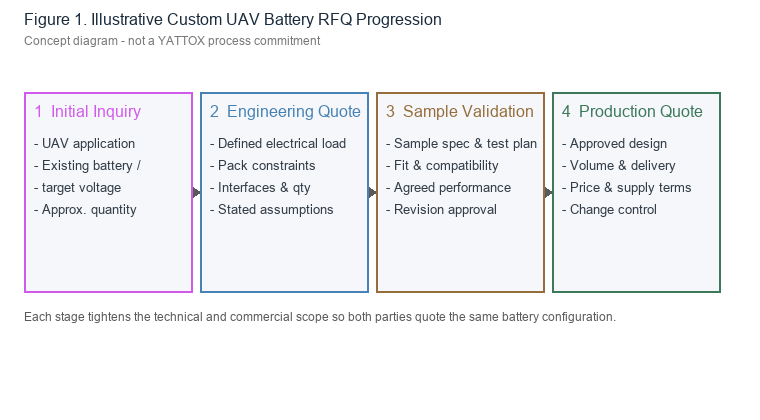
Figure 1. Illustrative custom UAV battery RFQ progression. The four stages show how technical and commercial scope tightens from an initial inquiry to a production quotation. This is a concept diagram, not a YATTOX process commitment.
These stages describe a practical procurement progression, not a mandatory sequence for every manufacturer.
A straightforward replacement battery may move through the process relatively quickly. A new UAV platform involving unfamiliar electrical interfaces, unusual structural constraints or a smart battery system may require additional engineering review.
The important point is to make unresolved requirements visible instead of allowing different suppliers to make incompatible assumptions.
Moving From Initial RFQ to Engineering Quotation
An engineering quotation becomes more meaningful once the project has a sufficiently defined technical scope.
Voltage and capacity provide only part of that scope. Two battery packs with identical nominal voltage and watt-hours may differ significantly in current capability, weight, dimensions, connector configuration and monitoring requirements.
These differences influence both engineering suitability and manufacturing cost.
Electrical Requirements and Discharge Profile
The quotation should define the battery's required voltage platform and operating characteristics.
For an existing UAV, the voltage configuration must be compatible with its motors, ESCs, power distribution and onboard electronics.
The required capacity should be evaluated alongside the aircraft's actual energy demand. Continuous and peak discharge requirements also matter because a battery sized only for average power may not support takeoff, climbing or heavy-payload operation.
When precise load information is unavailable, the engineering team can provide preliminary estimates and identify the measurements still needed.
A supplier may then discuss possible battery configurations, but final discharge capability should be checked against the selected cells, pack design and intended operating conditions.
Mechanical and Connector Compatibility
A battery that satisfies electrical requirements may still be unsuitable if it cannot fit within the aircraft or if its weight affects the intended payload capacity.
The RFQ should therefore establish the battery compartment dimensions, allowable pack weight and relevant installation constraints.
For existing aircraft, connector photographs and cable measurements can help identify the current interface. Before finalizing the design, the actual connector model, polarity, wire gauge and cable length should be confirmed.
These details are not merely cosmetic. Electrical connection requirements influence current-carrying capability, voltage losses, installation and maintenance.
Mechanical details also matter when the pack requires a particular mounting position, protective structure or cable exit direction.
BMS, Charging and Communication Requirements
Not every UAV battery requires the same battery management architecture.
Some battery configurations rely on external monitoring and charging arrangements, while other aircraft require an integrated BMS, telemetry communication or specific protection functions.
The RFQ should clarify the aircraft's actual requirements rather than automatically specifying a BMS for every design.
When communication is necessary, the engineering scope should identify the required protocol and relevant interface behavior. The name of a protocol alone may not be enough to establish compatibility between a smart battery and the aircraft.
Charging requirements should also be defined, including the intended charger, voltage limits, applicable interfaces and any temperature-related restrictions.
These decisions affect pack electronics, integration effort and the final quotation.
Confirming UAV Battery Samples Before Production
Sample development is the stage where a proposed battery configuration can be evaluated against the actual UAV.
Before sample production begins, the buyer and supplier should agree on what is being built and which requirements will be used to determine whether the sample is acceptable.
For an existing drone, this may include installation fit, connector compatibility, voltage range and observed performance under representative operating conditions.
For a new UAV platform, the test scope may also cover discharge behavior, thermal performance, communication interfaces and interaction with the aircraft's charging and monitoring systems.
The acceptance criteria should reflect the intended application.
For example, a high-current agricultural multirotor may require evaluation of loaded voltage and temperature during representative takeoff and operating loads. A long-endurance mapping platform may place greater emphasis on usable energy, mass and sustained mission performance.
These are engineering evaluation examples, not claimed YATTOX customer test results.
When Does a Sample Revision Affect the Quote?
Sample feedback can lead to changes in cell selection, capacity, mechanical structure, connector layout or electronics.
Some changes may be minor. Others can alter material costs, manufacturing processes, tooling requirements or qualification work.
If a prototype requires a different connector, the cost impact may be limited to the electrical interface and associated work. If the redesign requires a different cell configuration or structural package, the effect can be substantially broader.
For this reason, buyers should document the sample revision and request an updated quotation when changes affect the agreed manufacturing scope.
Sample approval should confirm the configuration that is intended for production, not merely that a prototype can power the UAV.
A practical approval record identifies the sample version, applicable specifications, test outcomes, accepted deviations and remaining open items.
This helps prevent the production order from referring to a design that differs from the sample the engineering team approved.
Why Two Custom UAV Battery Quotes May Differ
Receiving two different prices for the same custom UAV battery RFQ does not necessarily mean one supplier is quoting incorrectly.
The suppliers may have interpreted an incomplete specification differently, selected different components or included different services.
A lower quoted unit price may exclude engineering work, sample testing, special connectors or documentation that another supplier included.
The most useful comparison therefore examines the quotation's technical and commercial scope alongside the price.
| Quotation Difference | What the Buyer Should Compare |
|---|---|
| Cell selection | Chemistry, capacity, discharge requirements and proposed cell configuration |
| Pack design | Weight, dimensions, structural materials and agreed mechanical requirements |
| BMS or communication | Included protection, monitoring hardware, protocol and integration work |
| Wiring and connectors | Connector model, cable specifications, layout and included accessories |
| Samples and engineering | Prototype costs, revisions, testing and any tooling charges |
| Documentation | Included test records, transport documents and project-specific requirements |
| Order volume | Quantity assumptions, batch structure and any pricing tiers |
| Delivery conditions | Packaging, shipping responsibilities, lead-time assumptions and commercial terms |
A meaningful comparison requires suppliers to quote against an equivalent specification wherever possible.
For example, a battery assembled from a different cell chemistry or without a required communication interface should not be treated as technically identical simply because the nominal voltage and capacity match.
Buyers should also separate one-time development costs from recurring production costs when those items are quoted separately.
This allows procurement teams to compare the expected cost of the actual project instead of focusing on a single unit-price figure.
Order Quantity, Documentation and Delivery Requirements
The commercial portion of a custom battery RFQ should be discussed before the buyer treats a technical quotation as a production-ready offer.
Estimated sample quantity, expected production volume and purchasing schedule can affect material planning and manufacturing arrangements.
A project requiring a few prototype packs may have different purchasing economics from an ongoing production program.
Buyers should state whether the quantity represents an initial trial order, a forecast or a committed purchase. This helps avoid quotations based on volume assumptions that the project cannot yet support.
Documentation and shipping requirements also need attention, particularly when prototype lithium batteries will be transported internationally.
The IATA Guidance Document for Lithium Batteries and Sodium Ion Batteries explains relevant transport considerations, including requirements associated with UN 38.3 testing and specific provisions for certain untested pre-production prototypes and low-production-run batteries.
The applicable procedure depends on the battery design, shipment configuration, transport mode and relevant regulations. An untested prototype should not be assumed eligible for ordinary commercial battery shipping.
UN 38.3 is a transport-test requirement; it does not independently demonstrate that a battery meets every electrical, mechanical or operational requirement of a UAV application.
For procurement, the practical step is to clarify which documents are required, which are available for the exact battery configuration and who is responsible for arranging the shipment.
The quotation should also identify any documentation, testing, packaging or logistics costs that are excluded from the stated price.
How YATTOX Supports Custom UAV Battery Development
Moving from an initial UAV battery inquiry to a production quotation requires coordination between electrical requirements, pack integration and procurement planning.
YATTOX provides custom UAV battery solutions for industrial drone platforms with different endurance, payload and discharge requirements.
Its supported configuration options include LiPo, lithium-ion and semi-solid-state battery technologies, voltage and capacity customization, pack dimensions, connector selection, cable layout and BMS integration where required.
The same product range supports different UAV applications, including mapping, inspection, agricultural and cargo platforms.
For a replacement battery project, a review can begin with the existing model, voltage, approximate dimensions and aircraft operating requirements.
For a new UAV platform, the starting point may instead be the target voltage, payload, required flight time and expected operating profile.
As the project develops, additional information about discharge current, installation, communication requirements, sample approval and purchase quantities can help define a more accurate engineering and commercial scope.
YATTOX also offers OEM/ODM customization, sample development and batch production support. These capabilities provide a route for discussing battery configuration changes and subsequent production requirements.
The appropriate next step depends on how much of the project has already been defined. A preliminary inquiry may lead to a technical review, while a project with an approved configuration can move toward production quotation discussions.
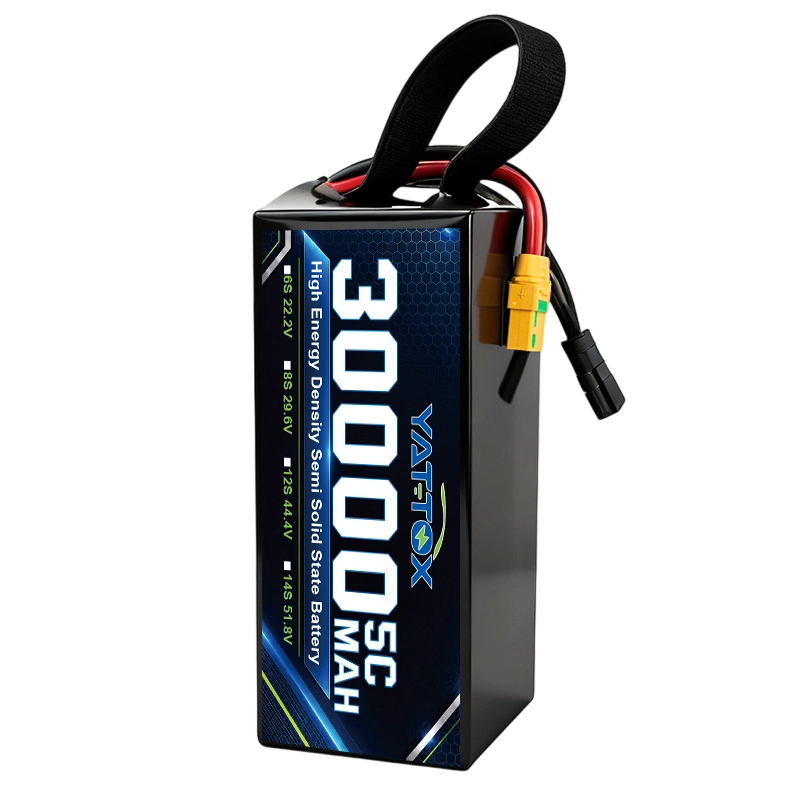
YATTOX 30,000mAh semi-solid-state UAV battery pack. Custom configurations across LiPo, lithium-ion and semi-solid-state technologies can be discussed from an initial inquiry through sample validation to production.
Frequently Asked Questions About Custom UAV Battery RFQs
Can I request a custom UAV battery quote without complete specifications?
Yes. An initial inquiry can begin with the UAV application, existing battery model or target voltage, and estimated quantity. However, an accurate engineering or production quotation may require additional information about current demand, dimensions, interfaces and manufacturing requirements.
Can photos of an existing drone battery help with an RFQ?
Yes. Photographs can help identify the pack layout, label information, connector and approximate installation arrangement. They cannot reliably verify internal chemistry, discharge capability or protection features, so additional specifications or measurements may still be necessary.
Is voltage and capacity enough to obtain an accurate battery quotation?
Usually not. Voltage and capacity establish basic electrical characteristics, but the quotation may also depend on discharge performance, pack structure, weight, connectors, protection features, order volume and testing requirements.
Do I need to confirm the BMS before ordering a custom UAV battery?
The required monitoring and protection architecture should be confirmed before finalizing a battery design. Some UAV systems may require integrated BMS or communication functions, while others use different external monitoring arrangements.
Is a prototype quotation the same as a production quotation?
No. A prototype quotation may include development or small-batch costs, while production pricing depends on the approved design, agreed quantity and manufacturing scope. Design changes after sample approval may require updated pricing.
Does every custom UAV battery require UN 38.3 documentation?
Transport requirements depend on the battery and shipping circumstances. Many commercial lithium battery shipments are subject to UN 38.3-related provisions, while specific prototype shipments may be handled under exceptional procedures with applicable approvals. The requirements should be confirmed for the exact shipment.
From RFQ to a Practical UAV Battery Solution
A useful custom UAV battery RFQ does not need to begin as a complete engineering dossier.
Early discussions can identify potential configurations and unresolved requirements. More accurate quotations become possible as the electrical, mechanical and commercial scope is confirmed.
Sample validation then provides an opportunity to verify compatibility and document any revisions before the production specification is approved.
The goal is not to provide the longest RFQ checklist. It is to make sure the buyer and manufacturer are quoting the same battery configuration, under the same technical and commercial assumptions.
Start Your Custom UAV Battery Inquiry With YATTOX
Developing a new UAV platform or looking for a battery replacement that better matches your aircraft?
YATTOX supports customized battery configurations, sample development and OEM/ODM production for industrial UAV projects.
Share your UAV application, current battery model or target voltage, expected flight time and estimated quantity. Additional electrical, mechanical and interface requirements can be reviewed as the project develops.
Discuss Your Custom UAV Battery Requirements
Explore YATTOX UAV Battery Solutions and lithium polymer battery options to review available platforms before starting your inquiry.