


Why Does Hot Weather Slow Down UAV Battery Charging Between Flights?
November 26, 2026
Why does hot weather slow UAV battery charging after flight? Learn how battery temperature, cooling time and charger limits affect repeated drone operations.
Table of Contents
A drone lands after a demanding flight, its battery is connected to the charger, and the operator expects it to be ready for the next mission. Instead, charging starts slowly—or does not start at all.
This can happen during summer agricultural operations, industrial inspections and other UAV missions involving repeated flights. The problem is not necessarily a faulty charger or a worn-out battery.
Hot weather can slow UAV battery charging because the pack may still be too warm after flight. If its temperature is outside the permitted charging conditions, a compatible charger or battery protection system may reduce charging current or delay charging until the battery cools.
High ambient temperatures make that cooling process more difficult. For operators running several flights a day, the resulting delay can become as important as the charging time itself.
Why Is a UAV Battery Still Hot After Landing?
A UAV battery generates heat while delivering current to the aircraft. During takeoff, climbing, spraying or other high-power operations, current flowing through the battery produces internal losses. Some of that electrical energy becomes heat rather than useful output.
One component of the heat generated by resistive losses can be described by:
P = I²R
Here, I represents current and R represents resistance. This simplified relationship shows why higher discharge current can substantially increase resistive heating. Actual battery heating also involves electrochemical effects and varies with cell design, state of charge and operating conditions.
The battery does not become cool the moment the motors stop. Heat accumulated inside the cells and pack structure takes time to move toward the surface and dissipate into the surrounding air. A pack may still have elevated internal temperatures even when its outer casing no longer feels particularly hot.
Summer conditions can make the situation worse. Direct sunlight, a hot vehicle interior and poorly ventilated charging areas can increase battery temperature or reduce the rate at which it cools.
For an industrial UAV, a completed flight therefore does not automatically mean the battery is ready to be recharged.
What Happens When a Hot Battery Is Connected to a Charger?
Lithium battery charging must take place within the temperature and electrical limits specified for the particular battery.
Some intelligent UAV battery systems monitor temperature and can reduce charging power or prevent charging when the battery is too hot. Other battery packs rely on an external charger, temperature sensing and the operating procedures specified by the battery manufacturer.
The response depends on the actual equipment. For example, DJI's official charging support information identifies high battery temperature and high charging-environment temperature as possible reasons for reduced charging power. DJI also explains that some intelligent flight batteries stop charging when their temperature is outside the permitted range.
That does not mean every UAV battery has the same temperature threshold or automatic protection function.
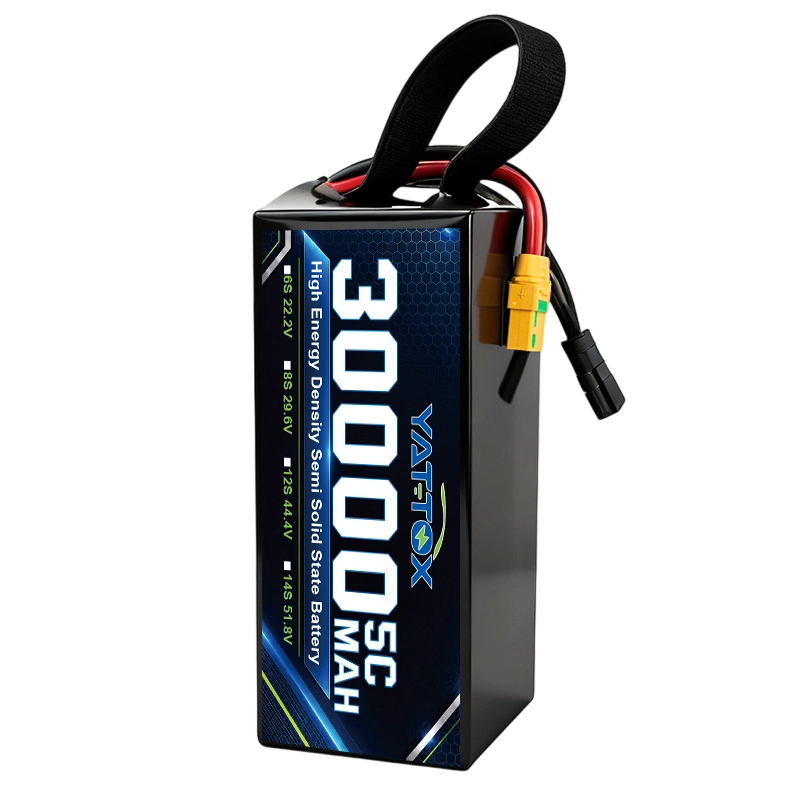
A YATTOX lithium polymer UAV battery pack. Confirm the approved charging-temperature range and current limits from the exact model's technical documentation rather than assuming a universal limit.
Charging Temperature Is Not the Same as Discharge Temperature
A battery may be permitted to discharge at a temperature where charging is restricted. This distinction matters when reviewing battery specifications. An advertised operating-temperature range should not be treated as the approved charging-temperature range unless the manufacturer explicitly says so.
For example, some DJI intelligent flight batteries have published charging ranges such as 5–40°C, while different industrial battery systems may specify different conditions. These are model-specific examples, not universal charging limits for UAV batteries.
A battery's approved charging temperature, maximum charging current and charging method should come from the selected model's technical documentation.
If charging is delayed because the battery is too hot, increasing the charge-current setting is not an appropriate workaround.
Why Does Charging Take Longer During Repeated Flights?
The delay between UAV flights involves more than the time displayed by the charger. Consider the sequence of a typical battery rotation:
Flight → Landing → Battery cooling → Charging → Battery ready for reuse
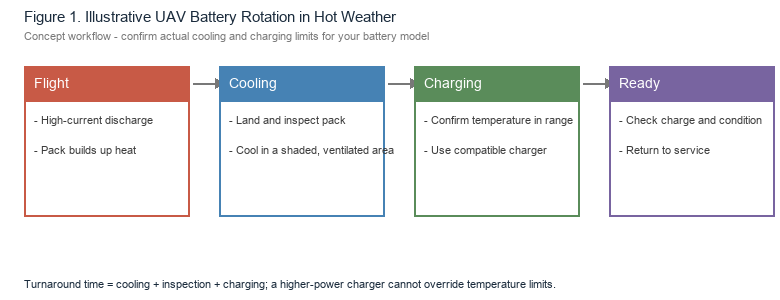
Illustrative battery rotation: flight, cooling, charging and return to service. Turnaround time depends on cooling conditions, charging limits and the number of available packs.
A battery returning from a high-current mission may require time to reach its permitted charging condition. Once charging begins, the available charging current and the required state of charge determine how long the next stage takes.
In hot weather, additional time may be spent waiting for the battery to cool. If the charging area is poorly ventilated or exposed to sunlight, that delay may become longer. An operator can then face a situation where an aircraft is available for its next mission but the replacement battery is not ready.
This is especially relevant to agricultural spraying, where flights may be repeated throughout the working day.
Why Battery Turnaround Matters More Than Charger Time Alone
A charger advertised as capable of completing a charge in a certain number of minutes does not necessarily provide that result under every field condition. Published charging times may depend on starting battery temperature, initial state of charge, charger settings and other specified test conditions.
For operational planning, the more useful measurement is the time from when a battery finishes one mission to when it is ready for another. That interval includes any necessary cooling, inspection and charging.
Tracking the complete interval helps operators identify whether the delay is caused mainly by temperature, charger capacity or the number of available batteries.
Will a Higher-Power Charger Reduce the Waiting Time?
A higher-power charger may reduce charging time when the battery is within its approved charging conditions and the system permits the additional current. It cannot eliminate a temperature restriction.
The permitted charging current depends on the cell specifications, battery configuration, charger and any applicable protection or monitoring system.
There is also an important distinction between the charger's maximum output and the current that the battery is allowed to accept at a particular moment. If the battery is above its approved charging temperature, a more powerful charger does not automatically make charging safe or faster.
For OEM drone projects, charger selection should therefore include more than a headline wattage figure. The battery's charging limits, supported charge profile, connector arrangement and temperature requirements must also be checked.
How Can Operators Organize Battery Rotation in Hot Weather?
The most practical approach is to make temperature management part of routine battery rotation, rather than treating every returned battery as immediately ready to recharge.
Battery temperature should be checked using the available approved measurement or monitoring method, not solely by touching the casing.
There is no reliable universal cooling period for every UAV pack. Cooling time depends on battery size and construction, its temperature after flight and the surrounding environment.
Operators should also avoid improvised cooling methods that expose batteries to moisture, condensation, mechanical damage or temperatures outside their specified limits.
Any battery showing swelling, damage, leakage, unusual odor or other signs of abnormal behavior should be removed from normal operation and handled according to the manufacturer's safety procedures.
| Operational Stage | Recommended Check | Why It Matters |
|---|---|---|
| After landing | Check the battery for abnormal heat, damage or warnings | Identifies batteries requiring attention |
| Cooling period | Place batteries in a dry, shaded, suitably ventilated area according to manufacturer instructions | Supports cooling without additional sun exposure |
| Before charging | Confirm the battery is within its specified charging temperature range | Avoids charging outside approved conditions |
| During charging | Use a compatible charger and follow the approved charging procedure | Maintains electrical and temperature compatibility |
| Before the next flight | Confirm charge status, physical condition and applicable aircraft requirements | Helps avoid returning an unsuitable battery to service |
Plan the Entire Rotation, Not Just the Next Charge
For repeated UAV missions, battery inventory and charging arrangements should be reviewed together. An operator may need to evaluate how many batteries are required for the expected flight schedule, whether charging resources are sufficient and how often returned batteries cannot be charged immediately.
The required number of batteries cannot be determined from charger power alone. Actual mission duration, available charging time, permissible charging current, cooling conditions and required battery reserves all influence the plan.
What Should UAV Manufacturers Check When Specifying a Battery?
For UAV manufacturers and system integrators, hot-weather charging delays are relevant during battery and charger selection—not only after the aircraft enters service.
A battery intended for repeated industrial UAV operations should be assessed against the expected electrical and environmental conditions. Key specifications to confirm include:
| Requirement | Information to Confirm |
|---|---|
| Aircraft power system | Nominal and operating voltage range |
| Mission load | Continuous and peak discharge current |
| Battery configuration | Chemistry, capacity, dimensions and weight |
| Charging limits | Approved charging temperature and current |
| Charger compatibility | Charge profile, voltage, connections and supported controls |
| Thermal conditions | Expected post-flight and charging-environment temperatures |
| Operational duty | Flight frequency and expected battery rotation |
| Validation | Relevant battery and charger testing under representative conditions |
A UAV operating in hot weather may require a different charging plan from an aircraft performing occasional flights in a controlled environment, even when both use batteries with similar nominal capacity. It is also important to distinguish between conditions a battery can tolerate during discharge and the conditions under which it may safely accept charge.
Matching a Custom UAV Battery to the Application
YATTOX supplies LiPo, Li-ion and other battery configurations for UAV manufacturers, including solutions involving different voltages, capacities, dimensions, discharge requirements, wiring and connectors. For custom projects, these specifications can be reviewed alongside the aircraft's intended mission profile and charging system.
The YATTOX UAV Battery Range provides battery options for industrial drone applications. Battery selection can also be considered in the context of UAV and drone lithium-ion battery applications.
For operations involving repeated flights in hot environments, buyers should confirm the approved charging-temperature range, charge-current limits and available validation information for the exact battery configuration under consideration. No fixed hot-weather charging time or special thermal performance should be assumed without model-specific supporting data.
Frequently Asked Questions
Why is my drone battery charging slowly after a flight?
The battery may still be warm from discharge, or the charging environment may be too hot. On supported systems, temperature protection can reduce charging power or delay charging. Charger compatibility, initial state of charge and battery condition can also affect charging time.
Can I charge a UAV battery immediately after landing?
Only when the battery is within its manufacturer's permitted charging conditions. If it is too hot, allow it to cool according to the product instructions before charging. A successful landing does not mean the battery has already reached a suitable charging temperature.
What temperature is too hot for charging a drone battery?
There is no universal limit for every UAV battery. Some DJI batteries specify charging ranges such as 5–40°C, but these limits should not be applied to unrelated models. Always check the charging-temperature specifications of the actual battery and charger.
Does a more powerful charger prevent heat-related charging delays?
No. Higher charger power can help only when the battery and charging system permit the higher current. It cannot override the battery's specified temperature limits.
How can UAV operators reduce charging delays in summer?
Keep batteries away from direct sunlight and hot enclosed spaces, allow them to cool in suitable conditions, use compatible chargers and plan battery rotation around actual cooling and charging times. Follow model-specific instructions rather than relying on a fixed waiting period.
Final Thoughts
Hot weather can increase the time between UAV flights because a battery must be ready for charging before it can be recharged. High post-flight temperature, limited cooling conditions and charger restrictions can all contribute to the delay.
For operators, the solution begins with suitable battery handling and realistic rotation planning. For UAV manufacturers, it begins earlier: selecting a battery and charging arrangement that can be evaluated against the aircraft's actual operating conditions.
For a custom UAV battery project, share your aircraft voltage, discharge-current requirements, capacity target, charging system and expected environmental conditions with YATTOX.
The engineering team can review the requested battery configuration and discuss the technical information needed for application assessment.