


What Should UAV Buyers Check Before Ordering a Semi-Solid-State Battery?
November 12, 2026
Before ordering a semi-solid-state UAV battery, compare voltage, capacity, pack weight, discharge current, charging compatibility and supplier test records.
Table of Contents
Semi-solid-state batteries are becoming an option for industrial drones that need more onboard energy without excessive battery weight. But choosing one for a UAV is not as simple as comparing capacity or looking for the highest advertised energy density.
For OEM buyers and drone engineers, the more useful questions are practical: Will the battery fit the aircraft? Can it supply enough current throughout the mission? Is the charging system compatible? And what test information can the supplier provide?
This guide explains what to check before ordering a semi-solid-state UAV battery, using actual YATTOX battery configurations to show how these requirements affect product selection.
What Should You Check Before Buying a Semi-Solid-State UAV Battery?
Before ordering, confirm six things: battery voltage, usable energy, pack weight and dimensions, continuous and peak discharge requirements, charging compatibility, and testing documentation. These specifications should be checked against the drone's actual operating conditions rather than evaluated separately.
A useful purchasing checklist is:
| What to Check | Why It Matters |
|---|---|
| Voltage and cell configuration | Must match the motor, ESC and power system |
| Capacity and energy (Wh) | Determines how much nominal energy is available |
| Battery weight and dimensions | Affects payload allowance, balance and installation |
| Continuous and peak discharge | Must support the aircraft's actual current demand |
| Charging specifications | Prevents incorrect charging profiles and compatibility problems |
| Testing and documentation | Helps buyers verify performance, safety and shipment requirements |
For a commercial UAV project, these checks should be completed before moving from sample evaluation to volume purchasing.
How Do Voltage and Capacity Affect UAV Battery Selection?
Voltage and capacity are often the first two specifications buyers compare. Both are important, but they describe different aspects of battery performance.
Voltage must be compatible with the aircraft's electrical system, while capacity indicates the amount of charge a battery can store. Nominal energy, measured in watt-hours (Wh), provides a more useful starting point when comparing packs with different voltages.
The basic calculation is:
Nominal Energy (Wh) = Nominal Voltage (V) × Capacity (Ah)
For example, YATTOX offers a 30,000mAh semi-solid-state battery in several configurations:
| Configuration | Nominal Voltage | Capacity | Nominal Energy |
|---|---|---|---|
| 6S1P | 22.2V | 30Ah | 666Wh |
| 8S1P | 29.6V | 30Ah | 888Wh |
| 12S1P | 44.4V | 30Ah | 1,332Wh |
| 14S1P | 51.8V | 30Ah | 1,554Wh |
Source: YATTOX 30,000mAh Semi-Solid-State Battery product specifications.
Although all four configurations have the same 30Ah capacity, their nominal energy values differ because their voltages are different.
That does not mean the highest-voltage configuration is automatically the best choice. A 12S battery should only be selected when the aircraft's motors, ESC, power distribution system and charging equipment support that voltage range.
For OEM projects, voltage compatibility comes before capacity optimization.
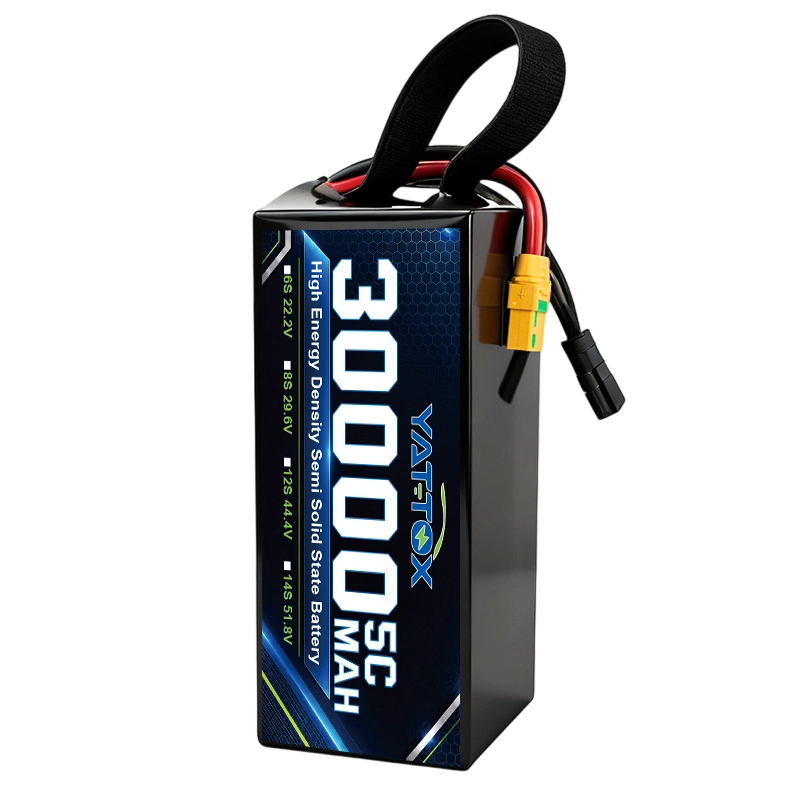
YATTOX 30,000mAh semi-solid-state UAV battery, published in 6S1P to 14S1P configurations with 5C continuous and 10C peak discharge ratings.
Why Should Buyers Compare Battery Weight, Dimensions and Energy Density?
Battery weight directly affects an aircraft's available payload and flight efficiency. The dimensions also determine whether the pack can be installed securely without interfering with other components.
Instead of comparing advertised cell energy density alone, UAV buyers should examine the specifications of the complete battery pack.
For example, YATTOX lists the following 6S semi-solid-state battery options:
| Specification | 30,000mAh | 60,000mAh | 72,000mAh |
|---|---|---|---|
| Nominal voltage | 22.2V | 22.2V | 22.2V |
| Nominal energy | 666Wh | 1,332Wh | 1,598.4Wh |
| Pack weight | 1,965g | 3,930g | 4,710g |
| Dimensions | 187 × 77 × 67.6mm | 232 × 123 × 70mm | 279 × 152 × 56.8mm |
| Calculated pack energy density | ≈339Wh/kg | ≈339Wh/kg | ≈339Wh/kg |
Calculated energy density = listed nominal energy ÷ listed complete pack weight. Values are calculated from the published product specifications, not independent test results.
The larger packs provide more nominal energy, but they also take up more space and add weight.
For instance, moving from the 30,000mAh configuration to the 60,000mAh configuration doubles nominal energy from 666Wh to 1,332Wh. However, the listed pack weight also doubles.
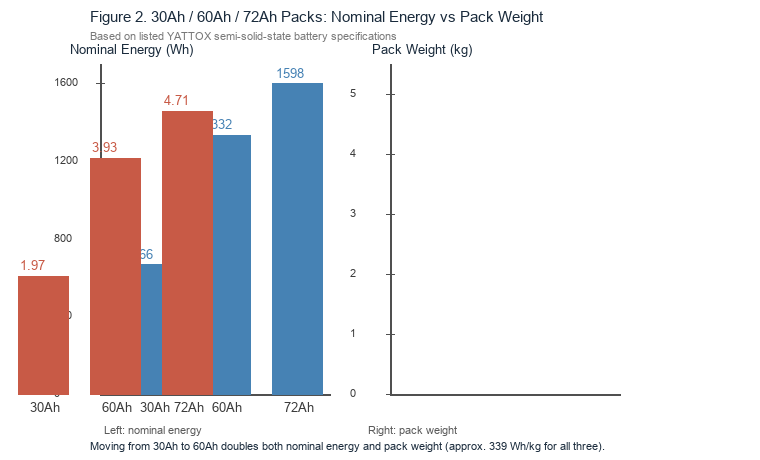
Nominal energy and complete pack weight of the listed 30Ah, 60Ah and 72Ah 6S semi-solid-state configurations. Data from published YATTOX product specifications.
Whether that change improves flight endurance depends on how efficiently the UAV carries the additional weight and how much average power it consumes.
When checking physical compatibility, buyers should also consider the mounting method, cable exit direction, connector clearance, vibration exposure and allowable center-of-gravity range.
A battery that offers more energy is not necessarily suitable for an aircraft with limited installation space or payload capacity.
How Much Discharge Current Does a UAV Battery Need?
A semi-solid-state battery must supply enough current for the aircraft's normal operation and short periods of higher load.
This is especially important for agricultural drones, heavy-lift multirotors and other UAVs that experience changing power demands during takeoff, climbing and maneuvering.
Battery discharge performance is commonly expressed using a C-rating. The basic relationship is:
Current (A) = Capacity (Ah) × C-rating
YATTOX lists its 30,000mAh semi-solid-state series with 5C continuous and 10C peak discharge ratings. Based on those specifications:
- 30Ah × 5C = 150A continuous current
- 30Ah × 10C = 300A peak current
- The 60,000mAh series is listed at 300A continuous and 600A peak current
However, a peak current rating should not be treated as a continuous operating limit. Buyers should confirm the permitted peak duration, temperature conditions and test method with the supplier.
The aircraft's maximum current requirement should also be evaluated together with the battery's voltage behavior under load. A high-capacity battery may still be unsuitable if its discharge capability cannot support the motors during demanding flight conditions.
Before placing an order, provide the supplier with the aircraft's estimated continuous current, maximum current and expected duration of peak loads.
Are Semi-Solid-State Batteries Compatible with Existing UAV Chargers?
Not automatically. Semi-solid-state describes a battery technology, but it does not establish a universal charging voltage or charging profile.
Charging requirements depend on the specific cells, series configuration and battery design. For example, a 6S and a 12S battery require different charging arrangements, even when they belong to the same product family.
Before purchasing, check:
- Maximum charging voltage and the specified charge-current limit
- Supported charging method and cell-balancing requirements
- Charger voltage and current capability
- Main power and balance connector compatibility
- Whether the battery includes protection or monitoring electronics
- Required temperature limits and charging precautions
Do not assume that a charger designed for a conventional LiPo battery will automatically support every semi-solid-state pack. Buyers should request the exact charging specifications for the selected model and confirm that the charger and battery protection arrangements are compatible.
This is particularly important when replacing an existing battery technology or integrating a custom pack into a new UAV platform.
What Battery Testing and Documentation Should OEM Buyers Request?
Product specifications are useful, but they do not replace validation. Before approving a semi-solid-state battery for a commercial UAV project, request available test information relevant to the intended operating conditions.
Electrical and Performance Verification
Important areas include:
- Capacity and energy measurement conditions
- Continuous discharge and peak current test conditions
- Voltage behavior under representative loads
- Battery temperature during discharge
- Cell voltage and internal resistance consistency
- Charging and balancing performance
- Cycle-life testing conditions, where applicable
Not every supplier provides the same testing package. The required evidence should be agreed upon during sample evaluation.
When cycle-life figures are supplied, check the charging rate, discharge rate, temperature, depth of discharge and remaining capacity criterion. A cycle-count claim without these conditions is difficult to compare.
Safety and Shipping Documentation
OEM buyers should also confirm which test reports and transport documents apply to the exact cell or battery pack being purchased.
For lithium batteries intended for transportation, the UN 38.3 test summary is an important document to check. The applicable requirements depend on the battery design and shipment arrangements.
The International Air Transport Association (IATA) publishes guidance on lithium battery transportation, including classification, packaging and documentation requirements.
Reference: IATA Dangerous Goods Guidance.
For custom battery designs, buyers should confirm whether changes to the configuration require additional testing or documentation before shipment. A general supplier certification does not automatically establish compliance for every customized pack.
What Information Should You Send to a Semi-Solid-State Battery Supplier?
A clear technical requirement helps the supplier determine whether an existing model is suitable or whether customization is necessary. For UAV projects, the initial inquiry should include:
| Information | Example or Required Detail |
|---|---|
| UAV application | Agricultural, mapping, inspection or heavy-lift drone |
| Battery voltage | Required nominal voltage and operating range |
| Capacity or energy target | Desired Ah or Wh |
| Current demand | Continuous current and peak current with duration |
| Installation space | Maximum length, width and height |
| Weight restriction | Maximum allowable battery pack weight |
| Electrical interface | Connector type, cable length and wire requirements |
| Charging system | Charger specifications and battery monitoring needs |
| Operating conditions | Ambient temperature, mission duration and load profile |
| Project quantity | Samples, planned order volume and purchasing schedule |
This information is especially useful when standard battery models do not meet the required installation or performance conditions.
For example, a mapping UAV may prioritize energy capacity and pack weight, while a heavy-lift multirotor may place greater emphasis on current delivery and electrical compatibility. The two applications should not automatically use the same battery configuration.
How Can YATTOX Support Custom Semi-Solid-State UAV Battery Projects?
YATTOX offers semi-solid-state battery configurations for industrial UAV and other high-energy applications. Its published product range includes multiple capacities with 6S, 8S, 12S and 14S configurations. Specific model pages list nominal energy, weight, dimensions, discharge ratings and available connector options.
For example, the 30,000mAh series is listed with:
- 6S1P to 14S1P configuration options
- 22.2V to 51.8V nominal voltage
- 5C continuous and 10C peak discharge ratings
- XT90-S, QS8 and AS150U connector options
YATTOX also provides battery pack configuration support for projects requiring particular dimensions, electrical connections and application requirements.
Buyers can review the YATTOX Semi-Solid-State Battery Range and the 30,000mAh Semi-Solid-State Battery Specifications before submitting an inquiry.
For an OEM project, the next step is to compare the available specifications with the aircraft's actual voltage, current, space and weight requirements, then confirm the final configuration and validation requirements with the YATTOX engineering team.
Frequently Asked Questions
1. Where can I buy semi-solid-state batteries for industrial drones?
Industrial UAV manufacturers can purchase semi-solid-state battery packs through specialized battery manufacturers and suppliers. For OEM projects, look for suppliers that provide model-specific voltage, capacity, weight, discharge and charging specifications. YATTOX offers multiple semi-solid-state UAV battery configurations with options for project-specific integration.
2. Are semi-solid-state batteries the same as solid-state batteries?
No. Semi-solid-state batteries retain a liquid or gel-based component in their electrolyte system, while all-solid-state designs use solid electrolytes. The technologies should not be treated as interchangeable. Buyers should confirm the actual battery chemistry, specifications and validation evidence rather than relying on the product label alone.
3. Are semi-solid-state batteries better for long-endurance drones?
They can be suitable for long-endurance UAVs when their complete pack energy, weight and discharge characteristics match the mission. However, higher advertised energy density does not guarantee longer flight time. Aircraft efficiency, payload, operating conditions and the weight of the finished battery pack must also be considered.
4. Can a semi-solid-state UAV battery replace a standard LiPo battery?
Only after checking voltage range, charging requirements, discharge capability, dimensions, weight and connector compatibility. A battery with the same nominal voltage or capacity may behave differently under load. Replacement suitability should be evaluated using the exact product specifications and the aircraft manufacturer's electrical requirements.
5. What is the difference between 5C continuous and 10C peak discharge?
A 5C continuous rating describes the listed sustained discharge capability under specified conditions, while a 10C peak rating refers to a higher current allowed for a limited period. For a 30Ah battery, these correspond to 150A and 300A respectively. The allowable peak duration and temperature conditions should be confirmed with the manufacturer.
6. What documents should UAV battery buyers request before ordering?
Ask for the product specification sheet, applicable electrical and performance test information, charging instructions and relevant transport documentation. For lithium battery shipping, confirm the applicable UN 38.3 test summary. If the design is customized, establish which tests and documents apply to the final battery configuration.
7. Can semi-solid-state UAV batteries be customized?
Yes, depending on the manufacturer's capabilities and the proposed design. Customization may involve voltage, capacity, pack dimensions, weight targets, connector type and wiring. Buyers should provide electrical requirements, installation constraints, expected operating conditions and order quantity so the supplier can evaluate the project.
Final Thoughts
A semi-solid-state UAV battery should be selected for the aircraft it will power, not simply for its chemistry or advertised energy density.
Before ordering, compare complete pack specifications, verify current and charging compatibility, review the available testing documentation and confirm that the battery fits the aircraft's mission and installation requirements.
For industrial UAV manufacturers evaluating custom battery configurations, YATTOX can review project requirements and help identify suitable options from its semi-solid-state battery product range.
Share your UAV voltage, current demand, capacity target, installation dimensions and expected order quantity with YATTOX to discuss a suitable battery configuration.