


How Can UAV Buyers Verify a LiPo Battery Manufacturer's Capabilities?
November 12, 2026
Learn how to verify a LiPo battery manufacturer's production, testing, quality control and traceability before choosing a supplier for custom UAV projects.
Table of Contents
Two LiPo battery suppliers may offer the same voltage, capacity and discharge rating. That does not necessarily mean they have the same manufacturing capabilities or quality controls.
For UAV manufacturers, purchasing teams and system integrators, the challenge is finding out what a supplier actually produces, how its batteries are tested and whether it can maintain consistent quality across production batches.
The most useful way to verify a LiPo battery manufacturer is to examine its production responsibilities, equipment, cell consistency controls, model-specific test records and batch traceability. Factory descriptions and certifications are useful starting points, but they should be supported by evidence relevant to the battery being purchased.
This guide explains what UAV buyers should check and how to interpret the information suppliers provide.
Does the Supplier Manufacture Battery Cells, Assemble Packs, or Both?
The first step is to understand which manufacturing activities the supplier performs. The terms battery manufacturer, cell manufacturer and battery pack assembler are sometimes used interchangeably, but they describe different responsibilities.
A cell manufacturer produces individual battery cells through processes involving electrode preparation, cell assembly, electrolyte filling, formation and other manufacturing operations.
A battery pack assembler combines selected cells into a specified electrical configuration and integrates the required mechanical structure, wiring, connectors and, where applicable, protection or monitoring electronics.
Some companies operate both cell production and PACK assembly facilities. Others specialize in only one part of the process. Neither model automatically guarantees better battery quality. What matters is whether the supplier can identify its responsibilities and demonstrate appropriate controls.
For example, a supplier may manufacture its own cells but outsource certain pack assembly operations. Another supplier may purchase qualified cells and operate a dedicated PACK production line. Both arrangements can be suitable for UAV projects if the manufacturing scope, quality responsibilities and applicable records are clear.
A useful first question is: Which parts of this battery will be produced at your facility, and which parts will come from external suppliers? The answer should identify actual production activities rather than simply repeating that the company provides OEM/ODM services.
| Manufacturing Activity | What Buyers Should Verify |
|---|---|
| Cell manufacturing | Production location, process capabilities and cell quality controls |
| Cell sourcing | Cell model, supplier identification and incoming inspection |
| Pack assembly | Series/parallel configuration, connections, insulation and assembly inspection |
| Electrical integration | Connectors, wire specifications, polarity and protection requirements |
| Final inspection | Battery-level checks, inspection records and acceptance criteria |
What Production Capabilities Should a UAV Battery Manufacturer Demonstrate?
UAV batteries place different demands on manufacturing depending on their intended applications. A high-current multirotor battery may require careful attention to cell selection, electrical connections and thermal behavior. A long-endurance UAV pack may place greater emphasis on energy-to-weight ratio, dimensions and consistent performance over extended discharge periods.
Before approving a supplier, buyers should check whether its production capabilities match those requirements.
Cell Production and Process Control
Where a manufacturer produces lithium polymer cells, relevant processes can include electrode coating, calendering, cell assembly, formation and aging. These processes affect cell characteristics, but the presence of equipment alone does not establish final product performance.
Buyers can ask how key process parameters are monitored, what inspection stages exist and how nonconforming cells are handled. For example, formation and aging processes may help identify abnormal cell behavior before cells are released for subsequent production stages.
However, buyers should not assume that a manufacturer using a particular process automatically achieves a specific discharge rating or cycle life. Those results require appropriate testing.
Battery Pack Assembly and Integration
For a custom UAV battery, pack assembly is as important as individual cell performance. The manufacturer needs to accommodate the selected voltage and capacity configuration while maintaining appropriate electrical and mechanical connections. Important capabilities include:
- Series and parallel cell configuration
- Cell connection and insulation methods
- Pack dimensions and structural protection
- Connector and cable selection
- Polarity and electrical connection checks
- Integration of monitoring or protection electronics where required
The selected connector and wire gauge should support the aircraft's actual electrical requirements. A supplier's ability to offer XT60, XT90 or other connectors does not, by itself, establish that every option is suitable for a particular UAV current profile. For high-current applications, the final design should be evaluated at the complete battery-pack level.
How Can Buyers Evaluate Cell Consistency and Quality Control?
Battery consistency is particularly important when multiple cells operate together in a pack. Cells with different capacities, internal resistances or states of charge may behave differently during charging and discharging. Such differences can contribute to uneven cell voltages, reduced usable pack energy or additional thermal stress under certain operating conditions.
For this reason, buyers should understand how a manufacturer evaluates cell consistency before and during pack assembly.
Open-Circuit Voltage and Internal Resistance
Two common measurements are open-circuit voltage (OCV) and internal resistance (IR). OCV measurement provides information about a cell's voltage under defined measurement conditions. It can support screening and consistency checks, but it does not independently verify cell capacity or long-term health.
Internal resistance measurement provides information related to a cell's electrical behavior. Differences in resistance can affect voltage drop and heat generation under load. However, IR results depend on the measurement method, temperature and other conditions. Values collected using different procedures may not be directly comparable.
Buyers should therefore ask:
- At which production stages are OCV and IR measured?
- Are cells measured under consistent conditions?
- How are acceptable ranges determined?
- What happens when a cell falls outside the specified limits?
- Are inspection results associated with the relevant production batch?
A supplier should be able to explain its control approach without necessarily disclosing confidential manufacturing formulas or internal process limits.
Why Matching Cells Matters
Matching cells is not simply a matter of choosing cells with similar label capacities. Capacity, internal resistance, voltage condition and other relevant characteristics can influence pack behavior.
For a multi-cell UAV battery, buyers should ask how cells are selected and grouped for the intended configuration. The purpose is to reduce avoidable variation within the battery pack, not to claim that every cell will behave identically throughout its service life.
Manufacturing controls provide a foundation for consistent assembly, but final pack performance must still be evaluated under relevant operating conditions.
What Test Records Should Be Linked to the Battery Model?
A battery manufacturer may have extensive testing capabilities. UAV buyers need to distinguish between having testing equipment and providing results for the battery they actually intend to purchase. A company may have environmental chambers, short-circuit test equipment and discharge testing facilities. These are useful capabilities, but their existence does not prove that a particular battery model has passed every possible test.
The most useful test evidence identifies the battery configuration, test conditions, measured results and applicable acceptance criteria. The required records depend on the battery and the project.
| Test or Inspection | What Buyers Should Look For |
|---|---|
| Capacity test | Battery model, charge/discharge conditions and measured capacity |
| Discharge performance | Current, duration, voltage limits and temperature conditions |
| Internal resistance | Measurement method, temperature and relevant limits |
| Temperature evaluation | Test load, measurement locations and recorded conditions |
| Cell consistency | Relevant screening or pack inspection criteria |
| Cycle-life evaluation | Cycle definition, charge/discharge conditions and capacity-retention criterion |
| Final electrical inspection | Pack voltage, polarity, connectors and applicable acceptance checks |
For a high-discharge UAV pack, loaded voltage and temperature behavior may be more relevant than an unsupported claim of a high C-rating. For a long-endurance UAV, buyers may need to compare usable energy, pack mass and performance under representative discharge conditions. A test performed on one battery model should not automatically be treated as proof of another configuration's performance.
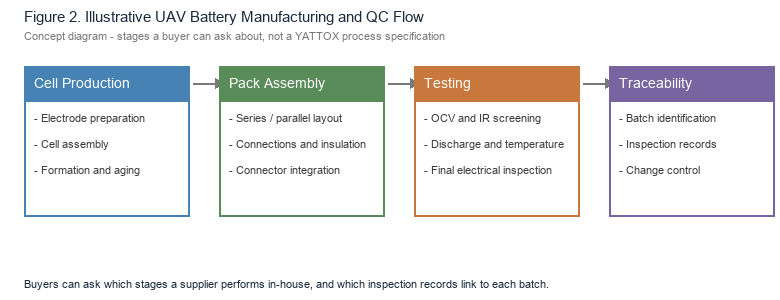
Illustrative manufacturing and QC flow: cell production, pack assembly, testing and batch traceability. Buyers can ask which stages a supplier performs in-house and which inspection records link to each batch.
What About Certifications and UN 38.3?
Certifications and compliance documents also need to be checked carefully. A quality management certificate concerns a defined management system and its certified scope. It does not automatically establish the performance of every individual battery pack.
Similarly, UN 38.3 addresses lithium battery transport testing. It does not replace application-specific verification of UAV discharge performance, installation suitability or service life. When reviewing a UN 38.3 test summary, buyers should check that the manufacturer, model information and relevant test identification correspond to the battery being supplied.
Official reference: UNECE Manual of Tests and Criteria.
For customized battery designs, the manufacturer and shipping parties should determine whether the existing documentation applies or additional testing is required. The key distinction is between a supplier possessing general compliance documentation and a buyer having evidence applicable to the intended battery configuration.
How Can Buyers Check Batch Traceability and Production Consistency?
A successful sample evaluation is useful, but it does not establish that every later production batch will have identical characteristics. This becomes more important when a UAV manufacturer moves from a small number of evaluation units to ongoing battery purchasing. Material availability, production conditions, component changes and inspection practices can all affect manufacturing consistency.
Buyers should ask how the supplier identifies production batches and manages changes that may affect the approved battery specification.
What Does Battery Traceability Mean?
Battery traceability means that a manufacturer can associate a battery or production lot with relevant manufacturing and quality information. Depending on the system, records may include component information, production dates, inspection results, equipment records or batch identifiers. A Manufacturing Execution System (MES) can support data collection and traceability, but an MES alone does not prove that every required record is complete or accessible.
Useful questions include:
- Can the supplier identify the production batch of a delivered battery?
- Which inspection records are associated with that batch?
- How are nonconforming products identified and handled?
- How are approved design revisions controlled?
- How are changes to critical components communicated?
The answers should be evaluated against the project's actual requirements. Not every customer needs access to the same level of production detail. However, there should be a clear understanding of what evidence the manufacturer can provide when a quality issue occurs.
Why Production Changes Matter
A custom UAV battery may be approved using a specific cell configuration, connector or electrical design. If a critical component changes during later production, the original validation results may no longer fully represent the modified design.
Buyers should therefore establish which changes require notification, engineering review or additional testing. This is especially important for ongoing OEM projects where batteries must remain compatible with an established aircraft platform.
The objective is not to eliminate every production variation. It is to ensure that changes affecting the approved specification are appropriately controlled and assessed.
YATTOX LiPo Battery Manufacturing and Quality Control
YATTOX manufactures lithium polymer batteries and custom battery packs for UAV, RC and industrial applications. Its manufacturing operations cover battery cell production, PACK assembly and battery configuration for different electrical and application requirements.
YATTOX operates three production facilities in China, supporting different stages of battery manufacturing:
| Manufacturing Facility | Main Function |
|---|---|
| Dongguan YATTOX Headquarters | Battery cell manufacturing |
| Hunan YATTOX Factory | Battery production |
| Dongguan YATTOX PACK Factory | Battery pack assembly |
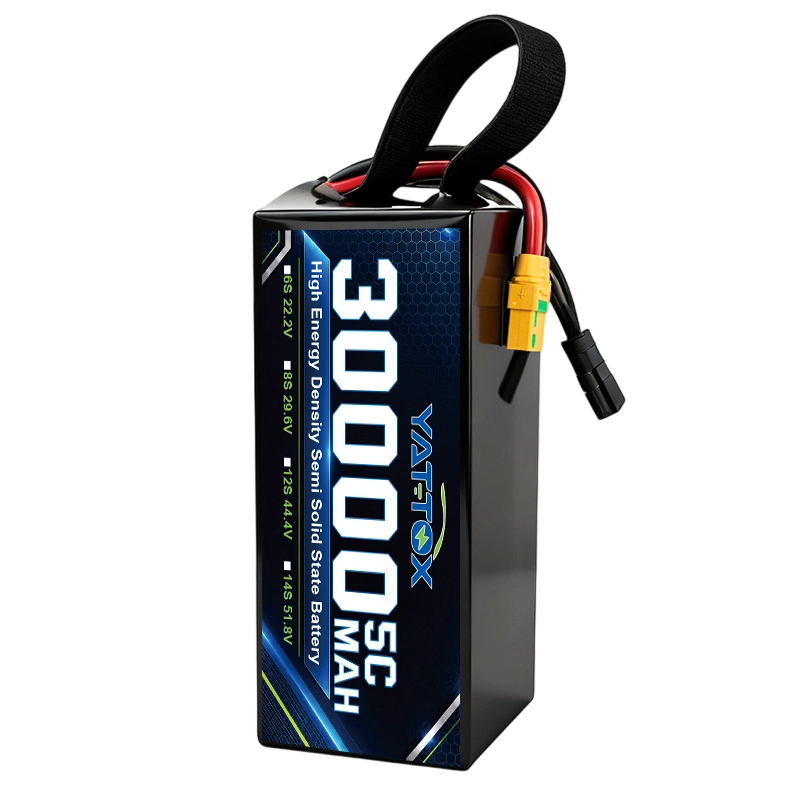
YATTOX industrial UAV battery pack. Manufacturing covers cell production, PACK assembly and battery configuration for UAV, RC and industrial applications.
Cell Manufacturing and Production Processes
Battery cell production involves electrode preparation, cell assembly, formation and aging. These processes help establish the electrical and physical characteristics of the finished cells. YATTOX's manufacturing capabilities include cell production equipment, formation and aging processes, and controlled production environments.
Production quality control also includes open-circuit voltage (OCV) inspection and internal resistance (IR) checks to support cell screening and consistency evaluation. These controls are important for UAV battery packs that combine multiple cells in series or parallel configurations.
Battery Pack Assembly and Customization
YATTOX supports custom LiPo battery configurations based on the electrical and physical requirements of UAV applications. Available configuration options include:
- Series and parallel cell arrangements
- Battery voltage and capacity
- Pack dimensions and installation requirements
- Wire gauge and cable length
- Connector selection
- Application-specific discharge requirements
Battery pack design must account for more than nominal capacity or discharge rating. Actual current demand, electrical compatibility, weight restrictions and installation space also influence the final configuration. For example, a battery used in a high-current multirotor UAV may require different discharge and connection characteristics from a pack designed for a long-endurance inspection aircraft.
Battery Testing and Production Traceability
YATTOX's quality-control capabilities include electrical inspection, environmental testing equipment and production traceability processes. Testing facilities cover areas such as temperature and humidity, overcharge and over-discharge, short-circuit testing, and drop testing. MES-supported manufacturing processes help organize production and quality information.
For custom UAV battery projects, relevant testing requirements should be established according to the selected battery model and intended operating conditions. The availability of particular test reports, batch records and validation documents should be confirmed for each project rather than assumed to apply to every battery configuration.
UAV Battery Solutions for OEM Projects
YATTOX provides LiPo battery solutions for UAV manufacturers requiring specific voltage, capacity, discharge performance and integration configurations. Its product range includes batteries for multirotor platforms, industrial UAVs and other applications with varying power and endurance requirements.
Explore the YATTOX UAV Battery Range for available configurations or view Lithium Polymer Battery Solutions for additional cell and battery pack options.
For custom projects, YATTOX can evaluate battery configuration requirements, production arrangements and applicable quality documentation with OEM customers.
Frequently Asked Questions
1. How can I tell whether a LiPo battery supplier is a real manufacturer?
Ask which production processes the supplier operates directly, where those activities take place and what manufacturing evidence is available. Factory photographs, equipment information, production scope and inspection records can help establish its responsibilities. A supplier may manufacture cells, assemble packs or do both.
2. Does a battery manufacturer need to produce its own cells?
Not necessarily. Some manufacturers produce cells and assemble packs, while others assemble battery packs using qualified cells from external suppliers. Either arrangement can be suitable if cell sourcing, manufacturing responsibilities, testing and quality controls are appropriate for the intended UAV application.
3. Why should UAV buyers check cell internal resistance?
Internal resistance affects how cells respond to electrical loads and can contribute to voltage drop and heat generation. Differences between cells may affect pack consistency. However, IR readings depend on the measurement method and conditions, so buyers should review how values are measured and evaluated rather than relying on a single number.
4. Is a battery manufacturer's ISO certification enough to verify product quality?
No. A management system certification demonstrates conformity within a defined certification scope. It does not independently prove a specific UAV battery's capacity, discharge capability, cycle life or electrical compatibility. Buyers should also request relevant model-specific specifications and performance evidence.
5. What is the difference between a battery test report and a factory inspection record?
A test report documents results obtained under specified test conditions. A factory inspection record may document checks conducted during production or before shipment. Their purposes differ, and buyers should identify which records are needed to verify the selected battery configuration and production batch.
6. How can buyers verify consistency between UAV battery batches?
Ask how the manufacturer identifies production lots, records relevant inspections, handles nonconforming products and controls changes to approved designs. Where needed, buyers can agree on batch acceptance requirements and review relevant production or inspection records before shipment.
7. Can YATTOX manufacture custom LiPo batteries for UAV applications?
Yes. YATTOX manufactures lithium polymer batteries and supports custom battery pack configurations for UAV applications. Customization options include voltage, capacity, dimensions, wiring and connector selection. Specific production requirements, validation procedures and documentation can be discussed according to the battery design and project needs.
Final Thoughts
Choosing a LiPo battery manufacturer requires more than comparing battery specifications and factory claims.
For UAV projects, buyers should establish who manufactures the cells and packs, how consistency is controlled, what tests are applicable to the selected battery model and whether the supplier can identify production batches and manage important changes. These checks help distinguish documented manufacturing capabilities from general marketing claims.
YATTOX combines lithium polymer battery manufacturing, PACK assembly and battery configuration capabilities to support UAV and OEM applications. Its production and quality-control processes provide a foundation for evaluating custom battery requirements, while model-specific testing and documentation should be confirmed during project assessment.
If you are evaluating a supplier for a custom UAV battery project, contact YATTOX to discuss the required battery configuration, manufacturing scope and available quality documentation.