


How To Choose LiPo Batteries For FPV Drone
May 30, 2026
In this guide, I focus on what helps you choose faster: start with how you fly, then match the battery to the frame, and only after that compare voltage, capacity, and discharge.
Table of Contents
How to Choose LiPo Batteries for FPV Drone by Flying Goal
A faster way to choose a LiPo battery for FPV drone is to start with the job you expect the quad to do. Different FPV setups do not just fly differently — they ask for different battery priorities. Once the flying goal is clear, it becomes much easier to rule out the wrong packs and focus on the ones that actually fit the build.
1.If You Fly Racing FPV
For racing, the battery should favor speed and quick recovery over extra duration. The better choice is usually a pack that helps the quad stay sharp through repeated throttle changes and technical sections, rather than one that simply keeps it airborne longer.
2.If You Fly Freestyle FPV
For freestyle, the better direction is usually a more balanced pack. You want enough output for harder moves, but you also want the session to feel usable and controlled from start to finish. A battery that makes the quad feel too heavy or too short-lived usually misses that balance.
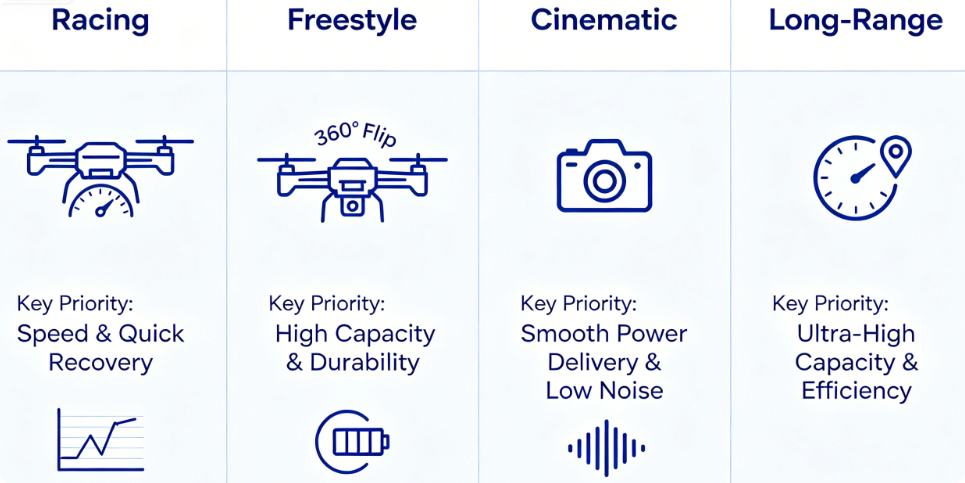
3. If You Fly Cinematic or Casual FPV
For cinematic or casual FPV, battery choice is less about aggressive performance and more about keeping the quad easy to manage. In these setups, a steadier power feel is often more useful than pushing for the most extreme setup possible.
4.If You Fly Long-Range FPV
For long-range FPV, the battery should be chosen around efficiency and usable flight time. The aim is not simply to carry more energy, but to support a longer route without pushing the build into an inefficient or overly heavy setup.
How to Match an FPV LiPo Battery to Quad Size
Once your flying goal is clear, the next step is to match the battery to the size of the quad. This part is easy to overlook, but it makes a big difference. The same FPV battery logic does not work equally well across every frame.
A smaller quad is more sensitive to battery weight. A larger quad may carry more energy, but it still needs the pack to feel appropriate in the air. So instead of asking what battery is “best,” it is often better to ask what battery makes sense for this frame size.
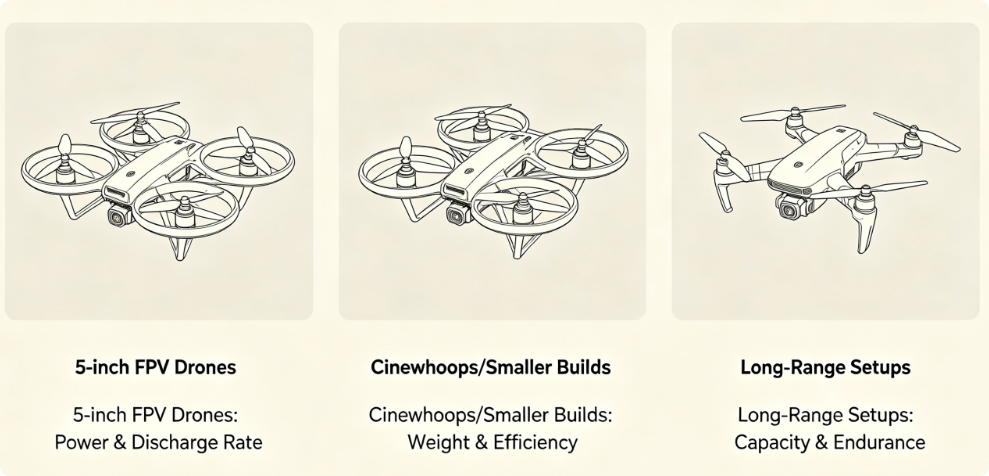
1.5-Inch FPV Drones
A 5-inch FPV drone sits in the most common decision zone. It can be built for racing, freestyle, or mixed use, so the battery choice depends heavily on the target feel. This is where choosing by flying style matters most. On 5-inch builds, even small battery changes can noticeably affect the way the quad accelerates, corners, and recovers.
2.Cinewhoops and Smaller FPV Builds
For cinewhoops and smaller FPV builds, battery weight matters quickly. A pack that looks acceptable on paper can still make the drone feel less efficient or less controlled in the air. In this category, lighter and more practical packs usually work better than oversized ones.
3.Long-Range FPV Setups
Long-range setups can justify more battery because endurance is one of the main goals. Even so, the pack still has to respect the efficiency of the build. The best result usually comes from choosing usable energy without pushing the platform into a heavier and less effective flight profile.
The 3 LiPo Battery Specs That Matter Most for FPV
You do not need to study every battery detail to make a better choice. For most FPV builds, three specs usually matter most: voltage, capacity, and weight. These are the factors that most directly influence how the quad performs in real flight.
1.Voltage
Voltage sets the power platform of the build. It influences how the drone delivers power and how the setup behaves under load. This is why many FPV users focus first on 4S or 6S. The better choice is not simply the higher number, but the voltage that fits your quad and the type of flying you want to do.
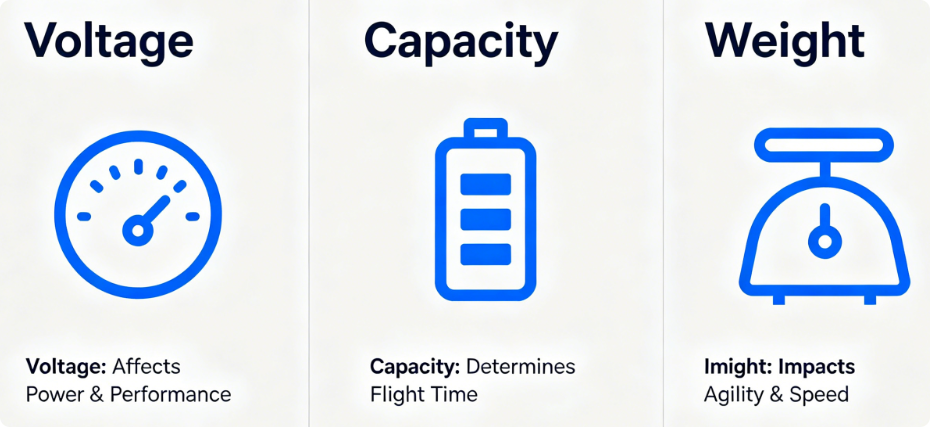
2.Capacity
Capacity mainly affects how much usable flight time the pack can provide. At the same time, it also changes the overall load the quad has to carry. A practical battery choice is usually one that gives enough time in the air without pushing the build too far toward extra mass.
3.Weight
Weight often matters more than many pilots expect. A battery may look right by voltage and capacity, yet still feel wrong in the air if it makes the quad less precise or less efficient. In many cases, the real issue is not the spec itself, but how much weight the pack adds to the full setup.
Why C-Rating in FPV Batteries Should Be Read More Carefully
C-rating matters, but not in the simple way many buyers assume. A higher number does not automatically mean a better FPV drone battery. What really matters is how the pack behaves under real load. If the battery can keep output stable, hold voltage more cleanly, and recover well after throttle changes, that matters more than a dramatic number on the label.
This is why C-rating should be read as part of the full picture, not as the whole decision. A battery with a very high printed rating can still disappoint if it is too heavy, inconsistent, or poorly matched to the quad. In real FPV use, usable output matters more than label appeal.
1.What Higher C-Rating Can Help With
A stronger discharge rating can help with punch, throttle response, and sag control. This is especially relevant for more aggressive FPV use, where the quad is repeatedly pushed hard.
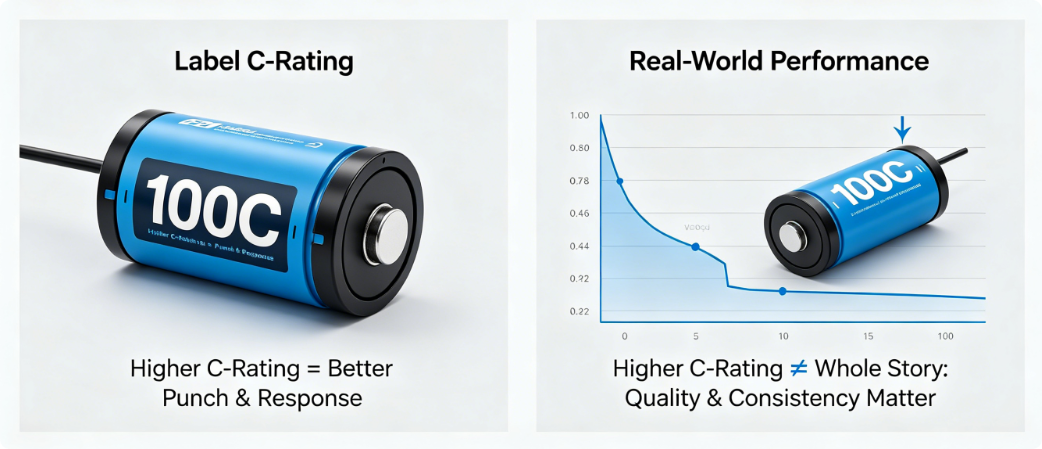
2.Why It Still Does Not Tell the Whole Story
Even with a strong rating, battery quality, pack consistency, and weight still matter. That is why I would never choose a pack by C-rating alone.
How to Balance Flight Time and Flight Feel with an FPV Battery
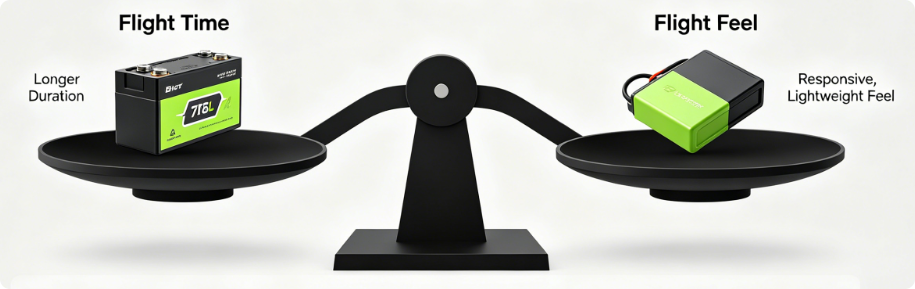
One of the hardest parts of choosing an FPV battery is finding the right balance between usable flight time and the way the quad feels in the air. Most pilots do not want only one or the other. They want enough time to complete the session, but they also want the drone to stay responsive and easy to control. That is why battery choice is often a trade-off, not a simple upgrade.
If your priority is cruising, longer practice sessions, or more relaxed FPV flying, it usually makes sense to lean toward more usable flight time. But if you care more about sharper handling, quicker transitions, and a lighter overall feel, then adding too much battery can start to work against the build. In many cases, the better result comes from choosing the pack that keeps the quad balanced, rather than the one that only promises more time in the air.
Quick FPV LiPo Battery Selection Table for Different Builds
If you want the fastest answer, use this table as a starting point:
FPV Situation | Better Battery Direction | Main Focus |
Racing build | Lighter pack, stronger usable discharge | Response |
Freestyle build | Balanced pack | Punch + control |
Cinematic FPV | Stable and smoother power | Predictability |
Small FPV drone | Lightweight battery | Efficiency |
Long-range FPV | Higher usable energy | Endurance |
This table works because it keeps the decision centered on the flight result. Instead of asking which pack has the biggest number, you are asking which battery direction best fits the way the drone is supposed to fly.
Conclusion
If you are exploring LiPo battery options for FPV builds and want a more suitable battery direction for your application, explore Yattox and find the setup that better matches the way your drone is meant to fly.
FAQs
1.What LiPo battery is best for an FPV drone?
The best LiPo battery depends on your quad size and flying style. A racing build usually needs a lighter, more responsive pack, while a freestyle build often works better with a more balanced setup. For long-range FPV, usable energy and overall efficiency matter more.
2.Is a bigger LiPo battery always better for FPV?
No. A bigger battery may give you more flight time, but it can also add too much weight and make the quad feel less agile. For most FPV builds, the better choice is the pack that matches the way the drone is meant to fly.
3.Should I choose 4S or 6S for an FPV drone?
That depends on the build and the flight style. Many pilots choose 6S for stronger overall efficiency and a different throttle feel, while 4S still works well in many setups. The right option is the one that suits your quad and gives the result you want in the air.
4.How important is C-rating for FPV batteries?
C-rating matters, but it should not be the only thing you look at. A higher printed rating does not always mean better real-world performance. For FPV, usable output, battery quality, and the way the pack behaves under load are just as important.
5.How do I choose the right mAh for an FPV LiPo battery?
Start with your flying goal. If you want longer sessions, you may need more capacity. If you care more about agility and response, a lighter pack may be the better choice. The goal is to choose enough capacity without making the quad feel heavy.