


What Kind Of Battery Is Used In Drones?
May 29, 2026
In this guide, I will walk you through the most common drone battery types, explain how they differ, and show you which option makes more sense for FPV, aerial photography, industrial inspection, agricultural drones, and long-endurance UAVs.
Table of Contents
What Batteries Are Commonly Used in Drones?
When people talk about drone batteries, they usually mean one of a few main types. Each one has a different balance of power, energy, safety, and weight.
1.LiPo Batteries
LiPo batteries are the most familiar choice in many drone categories. They are especially common in FPV, racing drones, and many consumer aircraft because they can deliver high current quickly. That fast output makes them suitable for drones that need strong throttle response, sharp maneuvering, and rapid power changes in flight.
2.Li-ion Batteries
Li-ion batteries are often chosen when flight time matters more than aggressive power delivery. They usually offer better energy density than standard LiPo packs, which makes them attractive for long-range drones and some industrial UAV platforms. If your priority is staying in the air longer, Li-ion is often part of the discussion.
3.LiFePO4 Batteries
LiFePO4 batteries are known for stronger safety characteristics and long cycle life. They are not the most common choice for performance-sensitive drone flight because they generally offer lower energy density than LiPo or Li-ion, but they can still make sense in certain specialized systems where durability and stability matter more than compact high-energy design.
4.Semi-Solid-State Batteries
Semi-solid-state batteries are gaining attention because they aim to improve the balance between energy density and safety. For advanced UAV applications, this technology is often discussed as a next-step option when the aircraft needs better endurance without giving up too much in reliability or structural efficiency.
5.Fuel Cells
Fuel cells are not mainstream in most drones, but they appear in conversations about very long-endurance UAVs. They are usually considered for specialized platforms rather than everyday consumer or FPV drones.
Here is a quick overview:
Battery Type | Main Advantage | Main Limitation | Common Drone Use |
LiPo | High discharge and fast response | Shorter cycle life and more sensitive handling | FPV, racing, many consumer drones |
Li-ion | Higher energy density and longer endurance | Lower discharge capability than LiPo | Long-range drones, some UAVs |
LiFePO4 | Safety and long cycle life | Lower energy density | Specialized industrial systems |
Semi-solid-state | Better energy-density potential with improved safety balance | Higher cost and limited adoption | Advanced UAV platforms |
Fuel cell | Very long endurance potential | Complex system design | Specialized long-endurance UAVs |
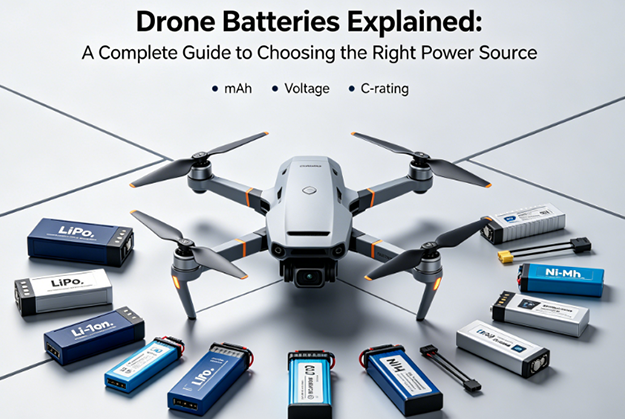
LiPo vs Li-ion vs LiFePO4 vs Semi-Solid-State: What Is the Difference?
If you want to choose the right drone battery, you need to understand how these chemistries differ in practice.
1.Energy Density
Energy density affects how much energy a battery can store for its weight. This matters because drones are highly sensitive to weight. In general, Li-ion is often favored for endurance-focused aircraft because of its stronger energy-density profile, while LiPo is often favored for output-focused applications. Semi-solid-state batteries are attractive because they are being developed to push energy density further while maintaining better safety potential.
2.Discharge Performance
Discharge performance affects how quickly the battery can deliver power. This is one reason LiPo remains dominant in FPV and racing. If your drone needs strong punch, faster acceleration, and quick throttle recovery, discharge behavior matters more than headline endurance.
3.Weight and Flight Time
Battery weight influences both control and endurance. A heavier pack may add flight time, but it can also reduce agility and increase system load. In many drones, the best result does not come from the biggest battery, but from the battery that gives the best balance between usable energy and manageable weight.
4.Safety and Cycle Life
Safety and service life matter more in some applications than others. Industrial and mission-based users often pay closer attention to cycle life, thermal stability, and predictable operation. That is where LiFePO4 or advanced battery systems may become more relevant.
5.Cost and Adoption
Not every battery type is equally practical for every drone. LiPo and Li-ion are still the most familiar choices for most buyers because they are widely used and easier to match to specific aircraft categories. Semi-solid-state batteries are promising, but they are still more of an advanced application topic than a default answer.
What Battery Is Used for Different Types of Drones?
The best way to answer the title question is to stop asking about drones in general and start asking about drone type.
1.FPV Racing Drones
FPV racing drones typically use LiPo packs because they need fast discharge, quick response, and strong power delivery. In racing, the battery has to support aggressive throttle changes and repeated bursts of demand. That is why LiPo is usually the most practical answer for this category.
2.Aerial Photography Drones
Aerial photography drones may use LiPo or Li-ion, depending on the platform. If the aircraft is designed around stable filming and a balanced power profile, either type may make sense. The real choice depends on whether the platform prioritizes stronger response or longer, steadier flight.
3.Long-Range Drones
Long-range drones often lean toward Li-ion because endurance is the main goal. These aircraft are less about instant punch and more about staying in the air efficiently over a longer route.
4.Industrial Inspection UAVs
Inspection drones often need reliable, stable mission performance. In this segment, Li-ion and advanced battery systems are common discussions because they support longer missions and better operational efficiency.
5.Agricultural Drones
Agricultural drones usually need strong output and solid operational stability. Their battery choice depends on platform size, payload, and mission style, but high-power battery systems are often important because these drones work under heavier and more demanding conditions.
6.Advanced UAV Platforms
Higher-end UAVs may move beyond standard LiPo and Li-ion conversations and begin considering semi-solid-state batteries or other advanced energy systems when endurance, safety balance, or mission efficiency becomes more critical.
A helpful comparison looks like this:
Drone Type | Common Battery Choice | Why It Fits |
FPV racing drone | LiPo | High output and fast throttle response |
Aerial photography drone | LiPo / Li-ion | Balance of control and usable flight time |
Long-range drone | Li-ion | Better endurance and energy density |
Industrial UAV | Li-ion / advanced systems | Longer missions and stable operation |
Agricultural drone | High-power battery systems | Strong output and working stability |
Advanced UAV | Semi-solid-state / other advanced options | Next-step endurance and performance goals |
How Battery Specs Affect Drone Performance
Battery chemistry is only part of the story. Specs also decide how the drone actually performs.
1.Voltage
Voltage affects the power platform of the drone. It influences how the aircraft behaves under throttle and must match the electronics and system design.
2.Capacity (mAh)
Capacity tells you how much charge the battery stores. More capacity can improve flight time, but it also adds weight. If the pack becomes too heavy, the drone may lose agility or efficiency.
3.C-Rate
C-rate matters most in output-focused drones. It tells you more about discharge capability, which is especially relevant for FPV and racing aircraft. If you want strong acceleration and quick response, this spec matters.
4.Watt-hours (Wh)
Wh is a useful way to think about total stored energy. It helps you compare how much usable energy a pack provides, especially when you look beyond one chemistry or one capacity number.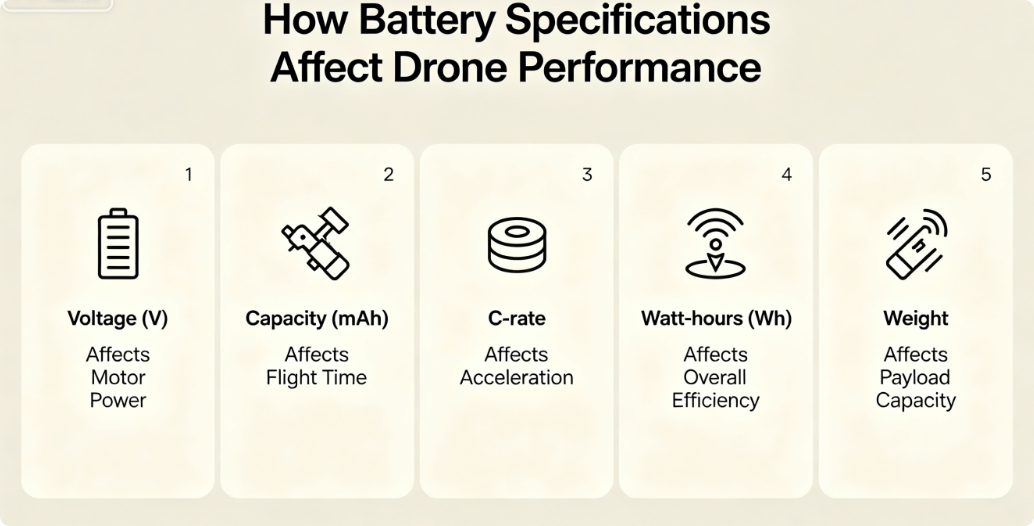
5.Battery Weight
Battery weight changes everything from maneuverability to payload efficiency. In drones, weight is never just a shipping number. It directly affects flight behavior.
Here is a simple performance guide:
Battery Spec | What It Affects | Why It Matters |
Voltage | Power platform | Must match the drone system |
Capacity | Flight time | Adds energy but also weight |
C-rate | Power delivery | Important for FPV and racing |
Wh | Total stored energy | Helps compare endurance potential |
Weight | Handling and efficiency | Affects agility, stability, and runtime |
Which Drone Battery Is Best for Your Application?
If you want the fastest answer, match the battery to the mission.
If you fly FPV or racing, LiPo is usually the better starting point.
If you need longer endurance, Li-ion often makes more sense.
If you care more about durability and safety than compact high energy, LiFePO4 may be worth considering.
If you are looking at advanced UAV performance, semi-solid-state batteries may be more relevant.
The right answer is rarely “the best battery overall.” It is usually “the best battery for the way you fly.”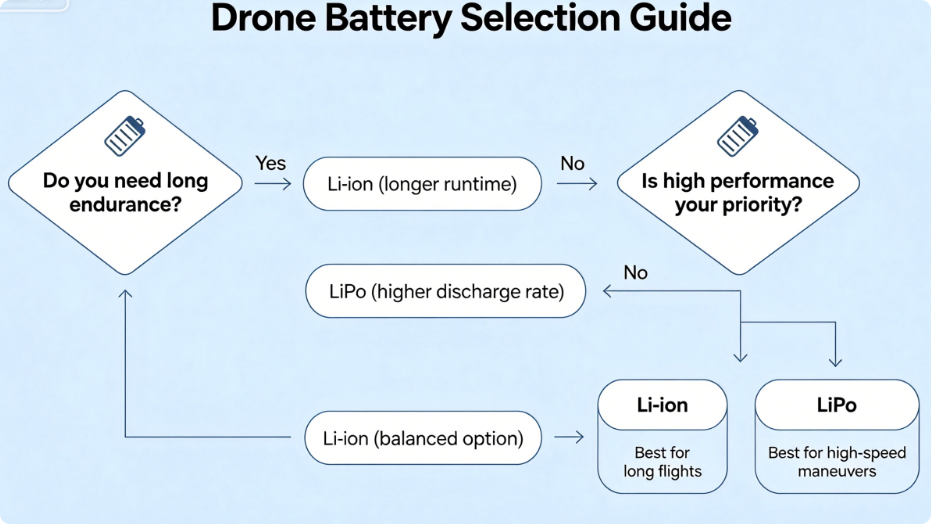
Frequently Asked Questions About Drone Batteries
1.Do drones use LiPo or Li-ion batteries?
They use both. LiPo is common in FPV, racing, and many consumer drones, while Li-ion is often used in long-range or endurance-focused platforms.
2.Is Li-ion better than LiPo for drones?
Not always. Li-ion is often better for endurance, while LiPo is often better for high output and fast response.
3.What battery is best for FPV drones?
For most FPV racing or aggressive FPV flying, LiPo is the more common and practical choice because of its discharge behavior.
4.What battery is best for long-range drones?
Li-ion is often the stronger option for long-range drones because it is better suited to endurance-focused flight.
5.Are semi-solid-state batteries used in drones?
They are part of advanced UAV discussions and are becoming more relevant in next-generation battery planning, especially where energy density and safety balance matter.
Final Thoughts
If you want to choose well, start with the type of drone you have, then look at what matters most in your flight: power, endurance, safety, or weight. Once you do that, the battery choice becomes much clearer. If you are comparing battery options for FPV, UAV, or custom drone projects, explore Yattox to find a more suitable battery solution for your application.