


Why Choose a Custom Drone Battery for Better Flight Performance
April 27, 2026
In this article, I focus on one question: why a custom battery improves real flight performance, not just battery specs on paper. You will see where standard packs usually fall short, who benefits most from custom battery packs for drones, what should be defined before a project starts, and how a better-matched battery can improve stability, efficiency, and usable output in flight.
Table of Contents
Why Choose a Custom Drone Battery?
The short answer is simple: choose a custom drone battery when a standard pack no longer matches your aircraft, payload, or flight goal.
If your drone loses too much performance under load, if the pack wastes valuable space, if flight time drops too quickly, or if the airframe becomes unbalanced after installation, the battery is no longer just a power source. It has become a design constraint. A custom battery solves that by matching voltage, capacity, discharge behavior, structure, connectors, and weight distribution to the aircraft itself. That is where better flight performance starts.
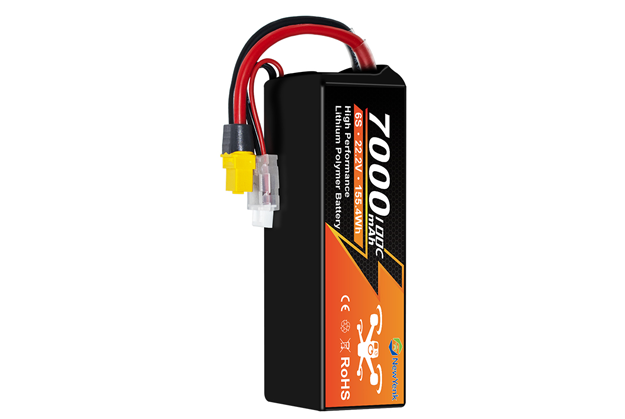
For many projects, the real gain is not one single number. It is a better combination of usable flight time, more stable output, improved fit, cleaner weight balance, and more predictable behavior under demanding conditions. We build for that combination rather than chasing one headline spec.
Where Standard Drone Batteries Usually Limit Flight Performance
They do not fully match the airframe
A standard pack may fit inside the drone, but that does not mean it fits the aircraft well. In many builds, the battery becomes the reason the center of gravity shifts, the available space is used poorly, or the wiring and connector layout become awkward. That kind of mismatch affects more than assembly. It can change handling, vibration behavior, and overall flight efficiency.
They force a compromise between flight time and control
This is one of the most common pain points. A bigger standard pack may extend flight time, but it can also make the drone heavier and less responsive. A smaller pack may reduce weight but leave too little usable time for the mission. When the pack is not built for the actual aircraft, you are forced into a compromise that often feels wrong in the air.
They may not deliver stable power under real load
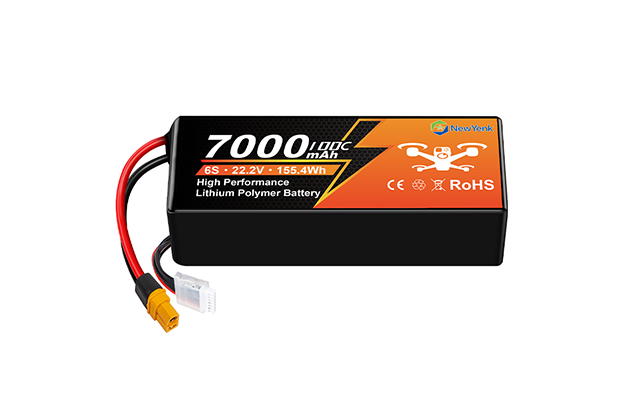
Many drones do not fly in ideal lab conditions. They climb, carry payload, resist wind, accelerate, hover, and repeat that behavior across multiple missions. If the battery cannot maintain stable output in real operating conditions, the result is sag, reduced thrust consistency, and weaker overall control. High-rate, low-temperature-rise behavior matters much more in practice than an attractive label. In our low-altitude battery work, the target is not just high discharge on paper. It is sustained high-rate behavior, controlled temperature rise, and usable power under demanding load. At 25°C, our high-rate cell system is designed around continuous high-discharge use with capacity retention of at least 90% and cell temperature rise below 25°C.
They rarely optimize for the full mission profile
A long-range drone, a heavy-lift platform, a mapping UAV, and a performance-sensitive aerial system do not need the same battery logic. Standard packs are built for broader compatibility. That is useful for convenience, but not for extracting the best result from one specific platform.
How a Custom Drone Battery Improves Real Flight Performance
Better fit means better weight distribution
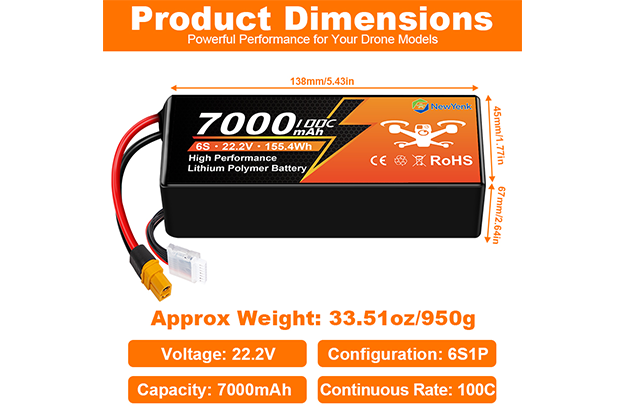
A drone battery for custom projects can be designed around available space rather than forcing the airframe to adapt. That gives you more control over length, width, thickness, layout, and pack form factor. Weight can also be balanced according to the aircraft’s application instead of left as an afterthought. Better fit usually leads to better stability and a cleaner integration outcome. Our custom options are built exactly around this idea: structure, size, and weight optimization are all part of the design stage.
Power delivery can be built around real load requirements
Custom design lets you specify the discharge behavior the drone actually needs. That matters because real flight performance depends on how the pack behaves under load, not how the label looks. We engineer continuous and burst discharge around real application demand rather than inflated ratings, which is especially important when the aircraft must accelerate, hover with payload, or maintain stable output across repeated duty cycles.
Energy and weight can be balanced more intelligently
A custom battery is useful when your project needs more than “more capacity.” Sometimes the better answer is not a bigger pack. It is a pack with a better energy-to-weight balance, a more efficient internal structure, or a chemistry choice better suited to runtime and operating conditions. Our broader battery development direction also reflects this balance: lightweight design, higher energy density, and high reliability remain core goals because low-altitude aircraft need both energy and reduced weight at the same time. The development roadmap includes higher-performance semi-solid-state cell work targeting energy density around 350 Wh/kg for advanced applications.
Thermal behavior becomes easier to control
Flight performance is not only about thrust and time. It is also about consistency. If the battery heats too quickly, performance becomes less predictable over repeated missions. A custom design makes it easier to plan for load profile, pack layout, current path, and environmental conditions. That is especially important in demanding or variable climates. Our low-altitude battery system is designed for wide-temperature operation from -40°C to 60°C, with capacity retention of at least 90% even at -20°C in the relevant system description.
The battery becomes part of the aircraft design, not a compromise
This is the real performance advantage. A custom battery is not simply “made to order.” It becomes part of the system design. That changes the result from a forced fit to an integrated solution.
If your current pack is limiting payload, stability, or usable flight time, you do not need another generic replacement. You need a battery direction built around the way your aircraft actually flies.
Who Benefits Most from Custom Battery Packs for Drones
Industrial and mission-based UAV projects
Mapping, inspection, agriculture, security, logistics, and payload-carrying platforms usually operate with stronger constraints than hobby aircraft. Payload, mission duration, recharge rhythm, and environmental conditions all affect the battery decision. These projects benefit more from battery engineering than from a one-size-fits-all pack.
Performance-sensitive builds
Some aircraft are highly sensitive to power delivery and balance. In these cases, even small battery mismatches can change the way the aircraft responds in flight. If the project depends on stable output, repeatable behavior, and a tighter link between power demand and flight control, a custom solution becomes easier to justify.
Projects with difficult operating environments
When the drone must work in colder, hotter, or more variable environments, battery performance is not just a convenience factor. It becomes a reliability question. Wide-temperature capability, cycle life planning, and consistent output matter more here than marketing-friendly generic battery specs. Our broader engineering system is built around high safety, high energy density, high-rate charge and discharge, wide-temperature operation, long cycle life, and high manufacturing standards as a complete low-altitude battery framework.
Off-the-Shelf vs Custom Drone Battery: A Quick Comparison
Priority | Standard Battery | Custom Drone Battery |
Airframe fit | General-purpose dimensions | Built around available space |
Weight balance | Fixed by available SKU | Adjusted to application needs |
Discharge design | Generic rating approach | Engineered to real load demand |
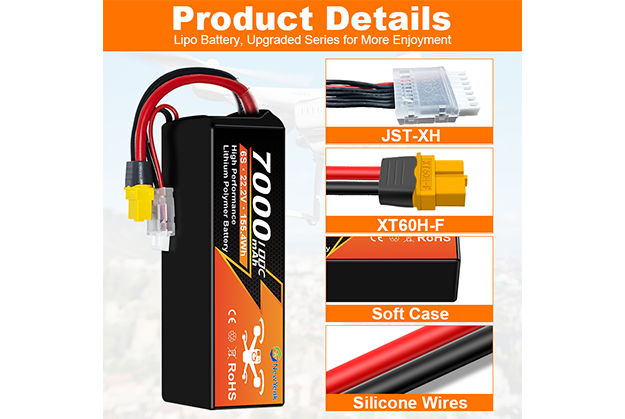
Connector options | Limited standard choices | Matched to integration needs |
Mission fit | Broad compatibility | Application-specific |
Flight performance outcome | Acceptable compromise | Better-matched system behavior |
Why Engineering and Validation Matter in Custom Battery Development
A custom pack is only useful if it is backed by real engineering and validation. This is where many projects rise or fail.
Our development and manufacturing system is built around cell-to-pack design, application-driven engineering, and process control. The technical team includes 40+ members with 20+ years of industry expertise, and the production system includes 100% OCV/IR testing, batch sampling inspection, and cycle-life evaluation. The manufacturing environment is controlled at 22–25°C and up to 1% RH, with dry-environment control down to DP ≤ -40°C to reduce moisture-related defect risk from the source.
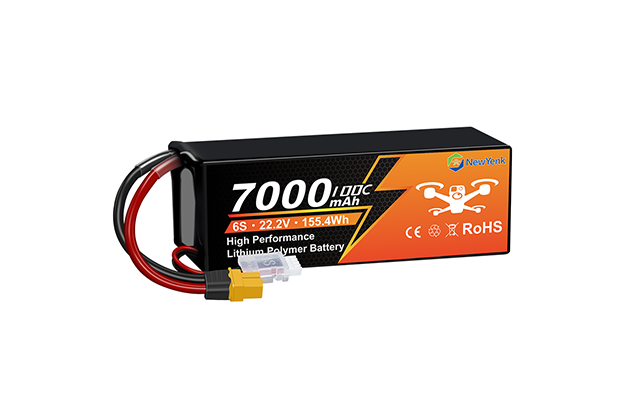
That matters because battery performance is not only decided by chemistry. It is also decided by consistency, matching, welding quality, pack assembly, traceability, and final inspection. In the broader low-altitude battery framework, process discipline is reinforced by PPM-level manufacturing quality control and PPB-level process precision control.
When your project needs more than an off-the-shelf pack, send your voltage target, payload, installation space, and mission profile to Yattox so we can translate them into a workable custom battery path.
Final Takeaway
Choose a custom drone battery when you need better flight performance because the aircraft is already telling you a standard pack is not enough. If the drone feels limited by weight balance, voltage behavior, thermal consistency, payload efficiency, or awkward integration, the battery is no longer a purchasing detail. It is a system design issue.
Ready to improve real flight performance, not just battery specs on paper? Share your drone type, payload, target runtime, discharge demand, connector needs, and installation space with Yattox, and let us help you define a custom battery solution built for the way your aircraft actually flies.