


High Discharge Rate LiPo Battery: Does a Higher C-Rating Matter?
September 23, 2026
A high discharge rate LiPo battery supplies the current an FPV drone needs without excessive voltage sag or heat. This guide explains what C-rating really means, why a bigger number is not automatically better, and how to size a pack from measured current.
Table of Contents
High Discharge Rate LiPo Battery: Does a Higher C-Rating Matter?
A high discharge rate LiPo battery is designed to supply the current required by an FPV drone, RC aircraft or another high-power system without unacceptable voltage sag, temperature rise or cell damage under its specified operating conditions.
Its C-rating provides a useful starting point, but a larger number on the label does not automatically mean more thrust, longer flight time or better battery quality.
The practical question is whether the battery can support the aircraft’s sustained current and short power peaks while maintaining acceptable loaded voltage, temperature and weight. Answering that requires the battery capacity, measured current demand and representative-load performance—not the printed C-rating alone.
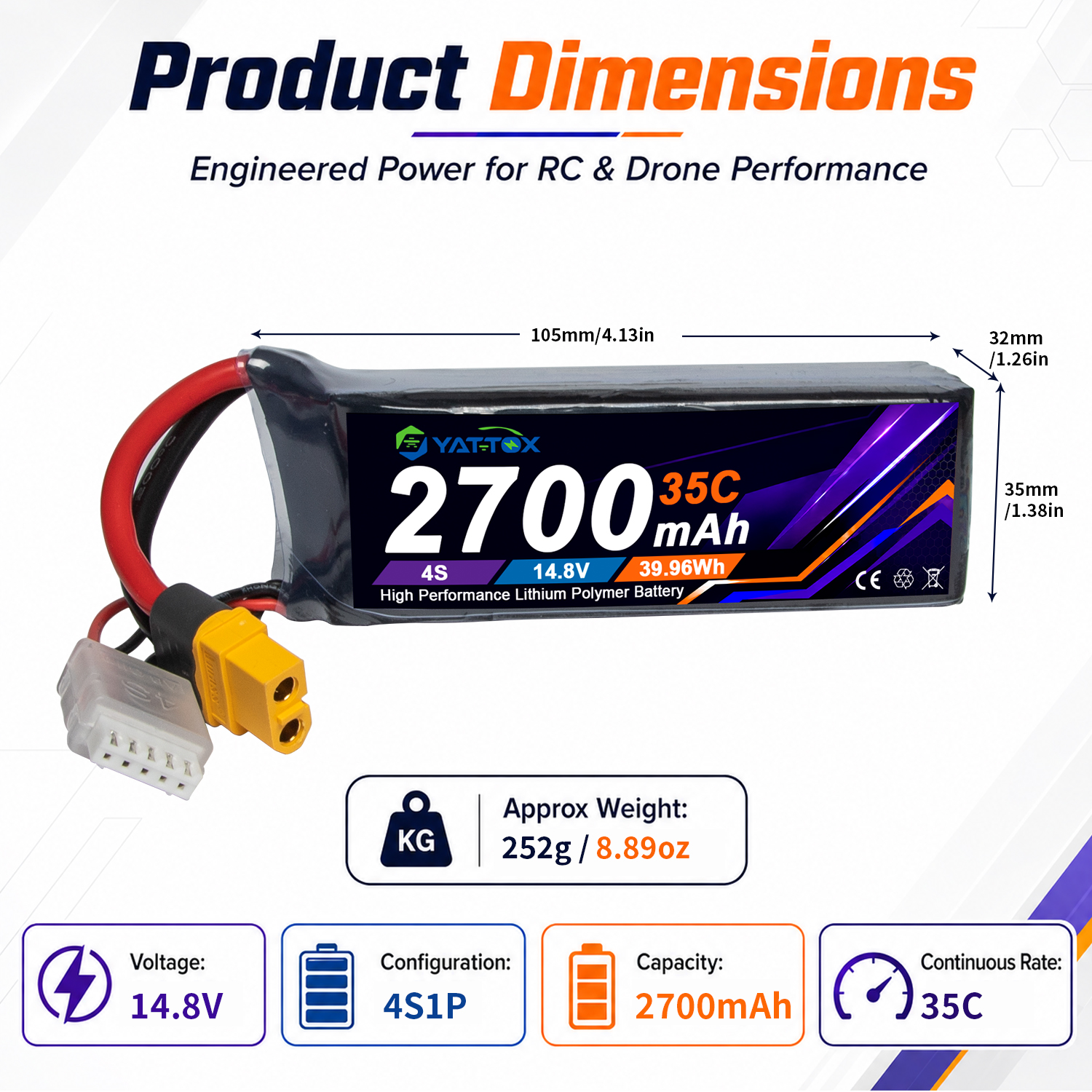
A Yattox 2700mAh 4S 35C LiPo pack—a typical FPV drone battery where the C-rating sets the sustainable current ceiling.
What Does the C-Rating of a LiPo Battery Mean?
C-rate expresses current relative to battery capacity. The basic calculation is:
Claimed current capability (A) = capacity (Ah) × C-rating
Battery capacity must first be converted from milliamp-hours to amp-hours. For example, a 1500mAh battery has a capacity of 1.5Ah. If the pack carries a 50C rating, the calculated current is:
1.5Ah × 50C = 75A
A larger battery can produce a higher calculated current even when its C-rating is lower. A 5000mAh, or 5Ah, battery rated at 20C gives:
5Ah × 20C = 100A
This is why C-rating should not be evaluated without capacity. A small 100C battery does not necessarily have a higher calculated current capability than a much larger 30C battery.
The general C-rate definition is well established: 1C represents a current numerically equal to the rated capacity in amp-hours. However, this multiplication is only a specification-screening calculation. It does not show how much voltage the battery will maintain under load, how hot the pack will become or how long the stated current can be sustained. The underlying terminology is explained in Battery University’s C-rate reference.
For example, a 1500mAh battery marked 100C produces a theoretical label value of 150A. That calculation does not prove that the complete battery can deliver 150A continuously inside an FPV drone. Wires, connectors, cell temperature, state of charge, discharge cutoff and test duration all affect real performance.
Continuous and Burst Ratings Are Not Interchangeable
Some LiPo batteries publish both a continuous C-rating and a higher burst rating. The continuous value is intended to describe sustained loading, while the burst value applies only to a shorter current event.
A burst rating should not be used to size a battery for sustained climbing, repeated freestyle maneuvers or another prolonged high-load condition. “100C burst,” for example, does not explain whether the current was maintained for one second or several seconds, what discharge cutoff was applied or how much temperature rise was permitted.
For a meaningful comparison, the supplier should define:
- Continuous discharge current in amperes;
- Peak current and permitted peak duration;
- Discharge cutoff voltage;
- Starting state of charge and battery temperature;
- Maximum permitted temperature during the test;
- Whether the rating applies to an individual cell or the complete pack.
Without these conditions, two batteries displaying the same burst C-rating cannot be assumed to provide equivalent loaded-voltage or thermal performance.
Does a Higher C-Rating Improve FPV Drone Performance?
Not necessarily.
A higher credible C-rating can matter when the existing battery is limiting the power system. If a pack shows excessive voltage sag or temperature rise during a correctly configured flight, a suitable replacement with lower effective resistance and sufficient current capability may maintain voltage more effectively under the same load.
This can be relevant during racing launches, freestyle punch-outs, rapid recoveries and other maneuvers that repeatedly create high-current demand. A battery that maintains a higher loaded voltage may provide more consistent motor response than one that experiences severe sag.
However, moving from a 60C label to a 120C label does not automatically double current, motor speed or thrust. The battery does not force its full rated current into the aircraft. The motor, propeller, ESC, voltage, throttle command and mechanical load determine how much current the system draws.
A higher printed C-rating may provide little benefit when the existing pack already supports the required load. It also cannot correct an unsuitable propeller, an overloaded motor, a damaged bearing, an overheating ESC, a poor solder joint or an undersized connector.
Weight must also be considered. A battery with greater capacity or heavier conductors may maintain voltage well but add enough mass to reduce acceleration, affect handling or increase hover power.
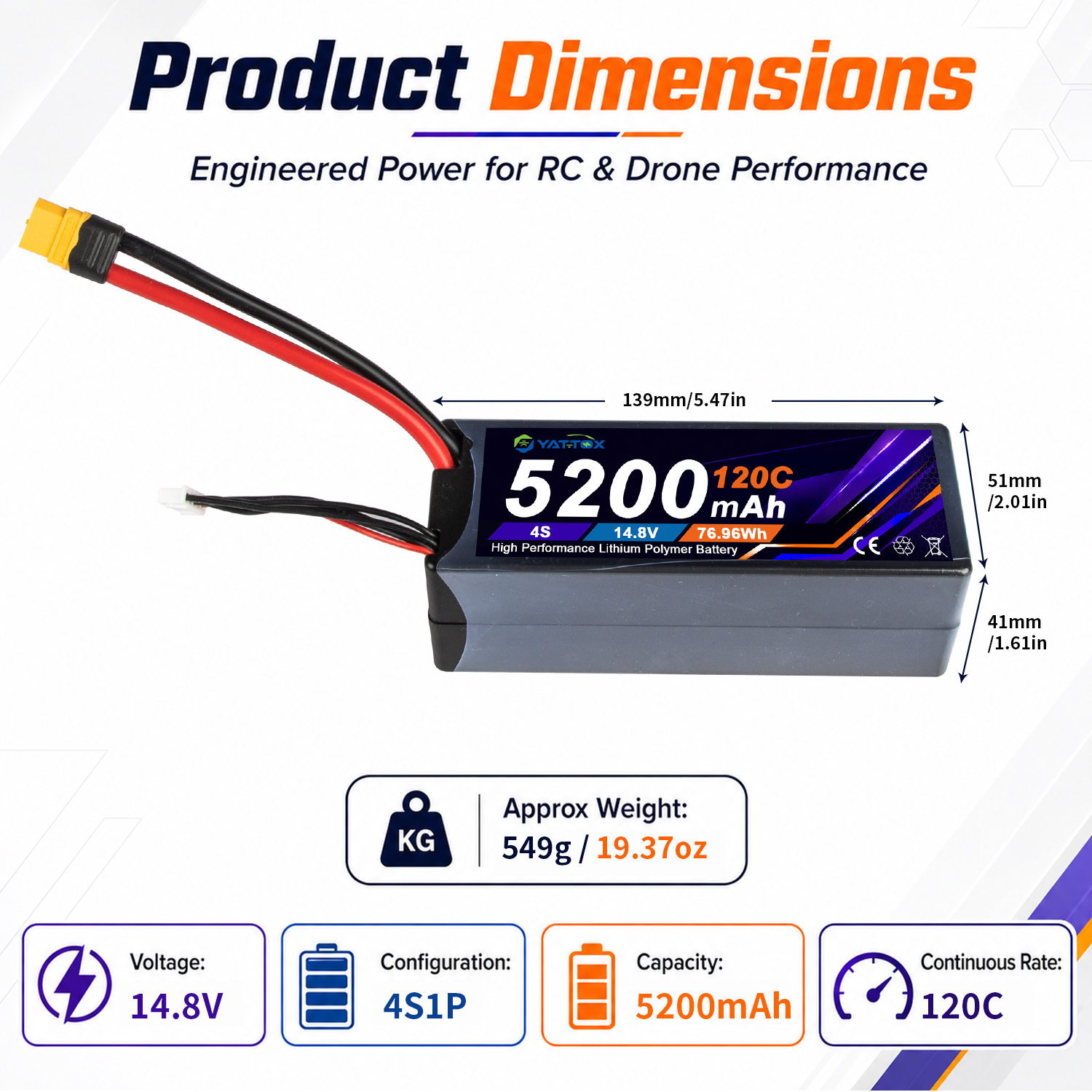
A Yattox 5200mAh 4S 120C pack built for high-current FPV and RC loads—higher C supports repeated punch-outs without severe sag.
Flight profile changes the trade-off:
- Racing and aggressive freestyle emphasize repeated power peaks and low weight.
- Cinematic FPV emphasizes smooth output, predictable behavior and flight balance.
- Long-range flight gives more importance to usable energy, cruise efficiency and total pack mass.
The better battery is therefore not the one carrying the largest number. It is the one that meets the aircraft’s actual power requirement with suitable electrical, thermal and weight margins.
Why Internal Resistance, Voltage Sag and Heat Matter
Every real battery has resistance and electrochemical limitations. When current flows, terminal voltage falls below the battery’s resting voltage. A simplified first approximation is:
Voltage drop = current × resistance
If a complete battery pack has an effective resistance of 0.020Ω and the aircraft draws 80A, the simplified resistive voltage drop is:
80A × 0.020Ω = 1.6V
This is an illustrative calculation, not a complete battery model. Actual voltage behavior also depends on cell chemistry, temperature, state of charge and electrochemical polarization.
Controlled research into high-rate battery discharge has found that increasing the discharge rate can produce a larger initial voltage drop and shorten the usable middle-voltage region. At very high loads, voltage deterioration is affected not only by ohmic resistance but also by charge-transfer behavior, ion transport and temperature-dependent electrochemical kinetics. These effects are discussed in a high-rate battery-system study published in Batteries.
For an FPV aircraft, voltage sag may appear as:
- Reduced thrust during a punch-out;
- Inconsistent throttle response;
- An early low-voltage warning;
- Rapid voltage collapse near the end of a flight;
- Unstable performance during repeated high-load maneuvers.
The aircraft operates from loaded voltage, not the resting voltage measured before takeoff. Resting voltage after landing cannot fully explain what happened under load. Flight-log data that records current and voltage at the same moment is more useful.
Heat provides another important signal. A simplified expression for resistive heating is:
Resistive heating ∝ current² × resistance
If resistance remains similar, increasing current can produce a much larger increase in internal heat generation. The measured surface temperature also depends on flight duration, cooling airflow, ambient temperature, pack construction and installation position.
Experimental studies of pouch-type lithium cells have reported sharper voltage drop and increased thermal stress at higher discharge rates. These findings explain the mechanism, but they do not establish one universal temperature limit for every FPV battery. The permitted current, voltage and temperature ranges must come from the documentation for the specific battery.
General UL lithium-ion battery safety guidance also warns that operating cells outside their specified charging or discharging limits can lead to internal damage and overheating.
How to Compare Internal Resistance Readings
Many hobby chargers display internal resistance, but the reading is not an absolute measure of battery quality when test conditions are inconsistent.
Internal resistance changes with temperature, state of charge, aging and measurement method. A cold battery may show a different value from the same battery at room temperature, while a nearly discharged pack may behave differently from a charged pack.
Internal-resistance readings are most useful for monitoring one battery over time or comparing similar batteries under controlled conditions. For a more meaningful comparison:
- Use the same charger or measuring device;
- Use the same test leads and connectors;
- Compare batteries at similar temperatures and states of charge;
- Record individual cell values, not only total pack resistance.
A growing difference between cells can indicate that pack consistency is changing. However, an isolated charger reading should not be converted directly into a “true C-rating.” Loaded voltage, temperature and delivered capacity provide necessary context.
How Much Discharge Rate Does Your Drone Actually Need?
The best starting point is measured current from the target aircraft. A current sensor, flight controller or suitable data logger can provide average current, sustained high current, short peaks and peak duration.
These values serve different purposes. Average current helps explain energy use and flight time. Sustained high current relates to continuous battery loading, while peak current helps evaluate takeoff, recovery and punch-out requirements.
When direct measurement is unavailable, motor, ESC and propeller documentation can provide a preliminary estimate. However, an ESC’s advertised maximum current should not automatically be treated as the aircraft’s continuous current. The ESC rating describes an equipment limit under stated conditions; actual flight current depends on the complete propulsion system.
A C-Rating Calculation Example
Consider an FPV drone using a 1500mAh battery. Representative flight data shows 45A during an aggressive sustained section and a short peak of 80A.
First, convert capacity:
1500mAh = 1.5Ah
The sustained load corresponds to:
45A ÷ 1.5Ah = 30C
The peak load corresponds to:
80A ÷ 1.5Ah = 53.3C
These calculations describe the load in C-rate terms. They do not prove that a battery marked “30C continuous and 60C burst” is automatically suitable.
The peak duration must still be compared with the battery’s permitted burst duration. Loaded voltage must remain compatible with the aircraft, and temperature should stay within the battery manufacturer’s limits. Battery weight, connector capability, cooling and pack condition also affect the decision.
Engineering margin is necessary because battery performance changes with temperature, use and aging. However, there is no universal margin percentage for every FPV drone. The appropriate margin depends on duty cycle, operating environment, measurement uncertainty and the consequences of voltage loss.
How to Compare High-Discharge LiPo Batteries
A useful battery comparison controls as many variables as practical. Testing two packs on different aircraft or under different temperature and flight conditions can create a result that is difficult to interpret.
A more disciplined comparison follows five steps:
- Confirm that voltage, cell count, dimensions, weight, connector and polarity are compatible.
- Bring both batteries to similar states of charge and starting temperatures.
- Use the same aircraft, propeller, flight profile and environmental conditions.
- Record current, minimum loaded voltage, consumed capacity, flight time and battery temperature.
- Repeat the test before drawing a conclusion from one flight.
The complete current path should also be inspected. A worn connector, undersized adapter, long cable or poor solder joint can introduce resistance outside the cells. Installing a higher-C battery will not repair that problem.
Physical battery condition matters as well. A swollen, damaged or abnormally heating LiPo battery should not be used as a performance baseline. Follow the manufacturer’s handling, charging and disposal instructions for any pack showing signs of damage.
For technical purchasing, the printed C-rating should be supported by operating conditions.
These parameters are more useful than comparing two isolated C numbers.
A multi-cell pack should also be evaluated for cell consistency. If cells differ noticeably in capacity or internal resistance, one weaker or higher-resistance cell may experience greater voltage sag and affect the behavior of the complete battery. Yattox FPV LiPo batteries use capacity and internal-resistance matching before PACK assembly to reduce avoidable cell-to-cell variation. This process does not prove a particular C-rating by itself, but it supports more consistent pack behavior during repeated high-load operation.
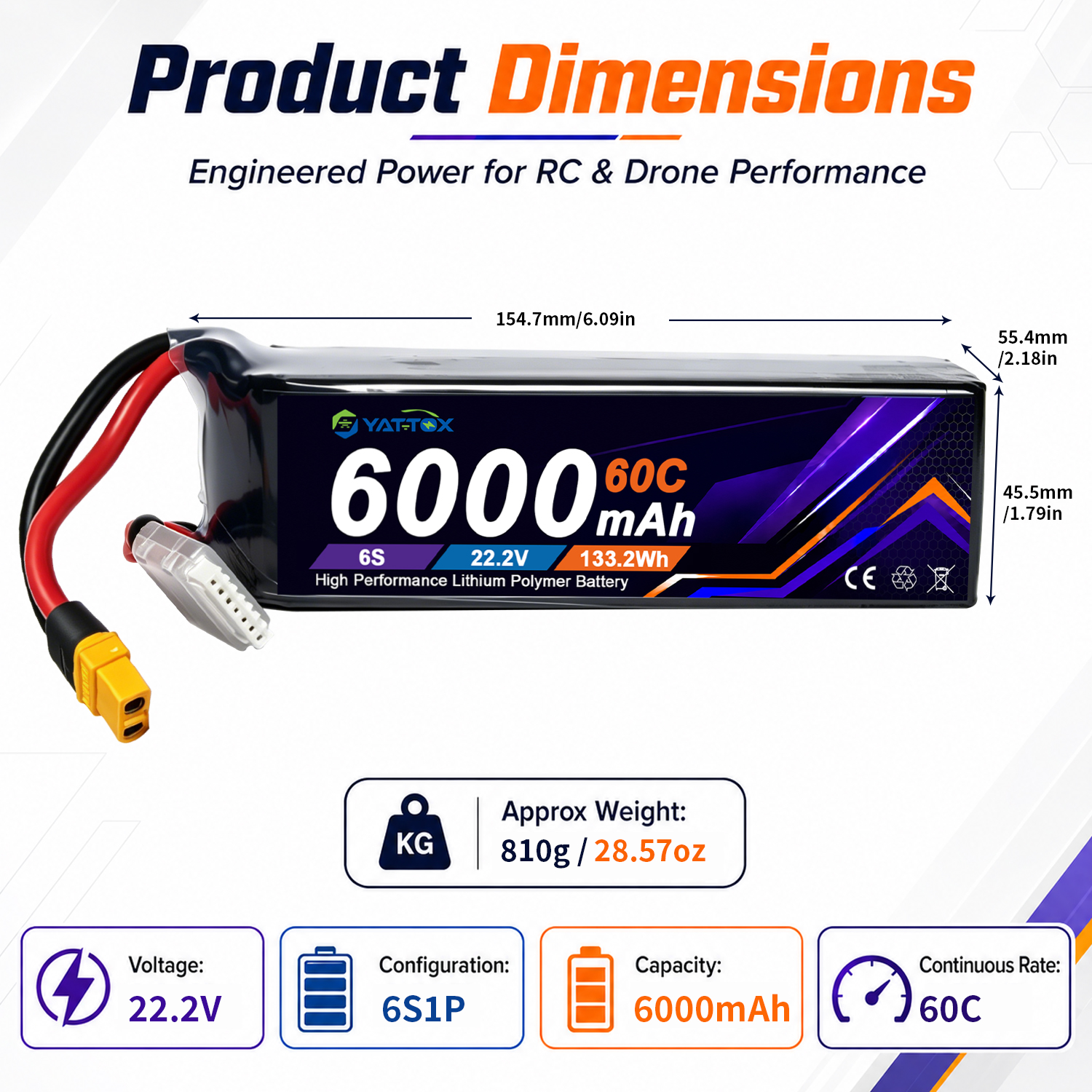
A Yattox 6000mAh 6S 60C high-discharge LiPo pack—sized for high-load RC and drone applications where sag must stay small.
Choose the Battery from the Flight Requirement
A higher C-rating matters when the current battery cannot support the aircraft’s real demand without excessive voltage sag or temperature rise. Once a pack already supplies that load with suitable margin, increasing the printed C number may produce little practical improvement.
Battery selection should begin with the aircraft. Determine the required voltage, usable capacity, sustained current, peak current and peak duration. Then define the maximum battery weight, available installation space, connector and acceptable loaded-voltage behavior.
For an FPV battery project, provide the measured or estimated continuous current, peak current, peak duration, voltage, capacity range, installation dimensions and target weight. If measured current data is not yet available, the motor, ESC, propeller and flight profile can provide preliminary inputs, but the final battery should still be validated under a representative load on the target aircraft.
The objective is not to choose the largest number on the label. It is to select a battery that meets the actual load while maintaining appropriate voltage, temperature, weight and pack consistency.
Explore matched Yattox FPV drone LiPo batteries and high-discharge packs such as the 6000mAh 6S 60C LiPo battery to match a pack to your aircraft’s measured current profile.
Information to Confirm Before Choosing a Pack
| Information to confirm | Why it matters |
|---|---|
| Continuous discharge current | Connects C-rating to an actual current value |
| Peak current and duration | Separates transient output from sustained loading |
| Loaded-voltage curve | Shows voltage behavior under current |
| Discharge cutoff voltage | Defines where the test ended |
| Starting temperature and SOC | Makes test results more comparable |
| Maximum test temperature | Provides thermal context |
| Cell or complete-pack test | Shows whether wires and connectors were included |
| Internal-resistance method | Prevents comparison of incompatible readings |