


Drone battery life can mean two different things: how long a drone can stay in the air on one charge, and how long the drone battery itself remains useful before aging noticeably affects performance.
There is no single flight-time number that applies to every drone.
A lightweight FPV aircraft, a camera drone, an inspection UAV, and a payload-carrying industrial multirotor can all place very different demands on their batteries.
Flight time depends on how much usable energy the battery can provide and how quickly the aircraft consumes that energy. Aircraft weight, payload, propulsion efficiency, flight conditions, and battery condition all influence the result. Research on multirotor UAV endurance similarly shows that weight, payload, drag, propulsion requirements, and battery discharge behavior need to be evaluated together rather than treating battery capacity as the only variable.
So instead of asking only:
“How many minutes will this battery last?”
a more useful question is:
What is consuming the energy, and is the battery actually the factor limiting flight time?
What Does Drone Battery Life Actually Mean?
The phrase drone battery life commonly describes two different measurements.
| Meaning | What It Describes | Main Question |
|---|---|---|
| Flight time per charge | How long the aircraft can operate from one charge | How long can the drone stay in the air? |
| Battery service life | How long the battery remains useful as it ages | How long before battery performance noticeably declines? |
These two measurements should not be confused.
A drone can have short flight time even when the battery is healthy. High aircraft weight, a demanding payload, inefficient propulsion, strong wind, or an aggressive mission profile can all increase power consumption.
Likewise, an older battery may still charge normally but provide less usable performance under load.
Flight Time Per Charge
Drone flight time is the usable operating time obtained from a battery under a defined aircraft configuration and mission.
At a first-order engineering level:
Estimated flight time ≈ usable battery energy ÷ average mission power
This relationship is useful for understanding endurance, but it is not a guaranteed flight-time formula.
Real aircraft also need to account for battery reserve, changing power demand, propulsion efficiency, voltage behavior under load, aircraft weight, and operating conditions.
Multirotor endurance research uses the same basic relationship between available battery energy and required propulsion power while also accounting for weight, drag, and payload.
For high-payload aircraft, measured mission power and usable battery energy are therefore more useful than assuming that a certain mAh rating will automatically produce a certain number of flight minutes.
Battery Service Life
Battery service life describes how battery performance changes through repeated use and storage.
Rechargeable lithium batteries gradually age. Depending on chemistry and operating conditions, drone battery types can experience capacity loss and changes in internal resistance, which may reduce usable performance over time.
Research on lithium-ion aging identifies factors such as temperature, charge and discharge rate, depth of discharge, and state of charge among the conditions that can influence degradation.
There is therefore no responsible universal rule such as:
“Every drone battery lasts X cycles.”
Cycle life depends on battery chemistry, pack design, operating profile, charging and storage conditions, and how end of life is defined.
For a specific battery, its own technical documentation and inspection criteria should take priority over a generic cycle-life number found online.
How Long Does a Drone Battery Last on One Charge?
The reliable answer depends on the specific drone, battery, payload, and operating conditions.
Different classes of aircraft place very different demands on their batteries.
This is why a generic “drone batteries last X minutes” figure is often less useful than it appears.
| Drone Type | Main Flight-Time Consideration |
|---|---|
| FPV drone | High power demand, rapid throttle changes, and strict weight limits |
| Camera / cinematography drone | Balance between endurance, payload, and stable flight |
| Inspection / mapping UAV | Efficient continuous operation over a planned mission |
| Agricultural / payload UAV | High takeoff mass and changing payload |
| Long-endurance UAV | Stored energy, aircraft efficiency, and sustained power requirement |
A more meaningful comparison includes:
- aircraft takeoff weight;
- battery weight;
- payload;
- battery voltage;
- usable stored energy;
- average mission power;
- peak power requirement;
- propulsion efficiency;
- flight profile;
- wind and environment;
- battery condition.
Field guidance for spray-drone operations shows how battery size and age, aircraft weight, load, route design, and weather can all affect practical endurance. Heavier working loads also increase the energy required to remain airborne and complete the mission.
For FPV aircraft, FPV drone battery life should be evaluated with particular attention to power demand, aircraft weight, flight style, and battery-aircraft matching.
What Affects Drone Battery Life?
Battery Capacity and Usable Energy
Capacity matters, but mAh alone does not determine flight time.
Battery capacity is normally stated in amp-hours or milliamp-hours, while total nominal stored energy also depends on voltage.
This means comparing two batteries only by mAh can be misleading, especially if they use different voltage configurations.
More importantly, the aircraft may not be able to use every unit of nominal stored energy under every operating condition.
For endurance planning, a more useful question is:
How much usable energy can this battery provide within the aircraft’s voltage, weight, current, and installation limits?
Battery Weight and Takeoff Weight
The battery contributes to the aircraft’s total takeoff mass.
A larger battery may store more energy, but it normally also adds mass. More mass requires additional thrust, which changes the aircraft’s power requirement.
Multirotor endurance research explicitly includes vehicle weight, battery weight, and payload when calculating required propulsion power and endurance.
The endurance problem is therefore a balance between:
stored energy → battery mass → required power → practical flight time
The highest-capacity pack that physically fits is not automatically the most efficient endurance solution.
Payload
Cameras, sensors, spraying systems, cargo, and mounting hardware can all increase takeoff mass.
When payload increases, a multirotor generally requires more thrust and therefore more energy to remain airborne.
Field guidance for spray drones provides a practical example: heavier operating loads increase battery consumption because the aircraft must expend more energy to stay aloft and complete the mission.
For this reason, endurance should be tested using a representative mission configuration whenever possible.
An unloaded hover test may not accurately represent real working flight time.
Motors and Propulsion Efficiency
The battery stores energy, but the propulsion system determines how efficiently that energy becomes useful flight.
Motor performance, propellers, aircraft geometry, drag, and operating point can all affect how much power is required for the same mission.
Academic multirotor endurance models therefore evaluate propulsion power and system efficiency together with battery discharge rather than estimating endurance from battery capacity alone.
If an aircraft is consuming more power than expected because of its propulsion setup, simply installing a larger battery may not solve the underlying problem.
Flight Style and Mission Profile
How the aircraft flies changes how quickly it consumes energy.
Smooth, efficient flight does not create the same power profile as repeated acceleration, aggressive climbing, frequent turns, or extended hovering.
For working UAVs, route design can matter as well. Field guidance for spray-drone operations notes that repeated turns, hovering, speed changes, and other mission characteristics can alter battery consumption.
This helps explain why real-world flight time can differ from a number measured under another flight profile.
Wind and Operating Conditions
Wind can increase the power required to maintain position or follow a route.
Environmental conditions can also affect battery behavior.
For field UAV operations, wind and temperature are among the conditions that can influence practical endurance.
Battery-aging research also identifies temperature as an important factor in LiPo or lithium-ion for drones degradation.
However, exact operating-temperature limits are battery-specific.
Do not apply one generic temperature range to every drone battery. Use the operating limits specified for the actual battery.
Battery Age and Internal Resistance
Internal resistance is one useful indicator when evaluating changing battery performance.
Battery research identifies internal resistance and impedance as important indicators related to lithium-ion battery condition, performance, and aging. Changes in resistance can occur alongside capacity degradation.
As battery condition changes, users may observe:
- greater voltage drop during demanding loads;
- less usable flight time;
- less consistent output;
- earlier low-voltage behavior under high-power operation.
These symptoms are not enough to diagnose a battery by themselves.
They should be interpreted together with aircraft current demand, battery history, operating conditions, and the manufacturer’s inspection criteria.
Does a Bigger Battery Always Mean Longer Flight Time?
No—not automatically.
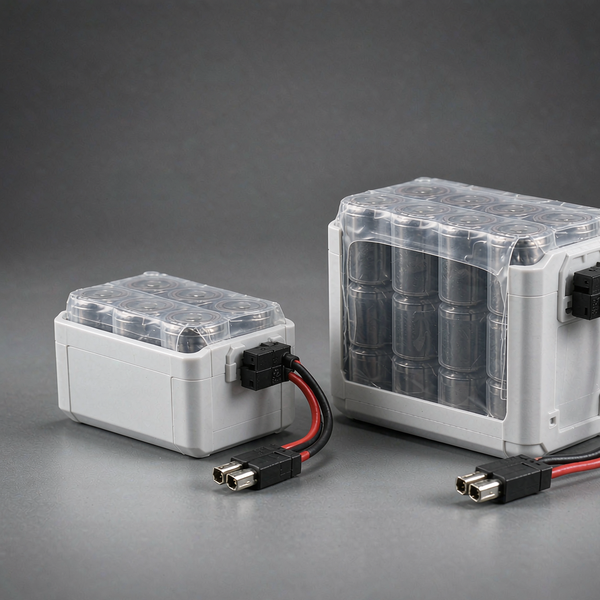
A bigger battery may store more energy, but it also increases aircraft mass.
Consider two possible battery packs:
Battery A: less stored energy, lower mass;
Battery B: more stored energy, higher mass.
Battery B gives the aircraft more energy to use.
However, the aircraft must also expend additional power carrying that extra mass.
If the additional usable energy more than offsets the higher power requirement, endurance may improve.
If the added mass consumes too much of the benefit, the flight-time gain may be much smaller than expected.
This is the energy-versus-weight trade-off.
For UAV applications, flight time should therefore be evaluated together with battery weight, payload, and current demand rather than battery capacity alone.
For high-payload aircraft, heavy-lift drone battery sizing should consider measured power demand, usable energy, aircraft weight, and mission reserve instead of relying only on nominal battery capacity.
Why Is My Drone Battery Life Getting Shorter?
When flight time used to be acceptable but has gradually or suddenly become shorter, first ask what changed.
| Symptom | Possible Cause | What to Check |
|---|---|---|
| Short runtime from the first flight | Battery-aircraft mismatch or high system demand | Voltage, total weight, current demand, aircraft setup |
| Runtime gradually declines | Changing battery condition | Capacity behavior, voltage sag, battery history |
| Larger pack adds little endurance | Added mass offsets part of the extra energy | Total takeoff weight and energy-to-weight trade-off |
| Runtime drops after adding equipment | Increased payload and power requirement | Payload mass and mission configuration |
| Runtime varies significantly by flight | Mission or environmental differences | Wind, route, hovering, climbing, acceleration |
| Voltage falls rapidly during demanding maneuvers | High current demand, battery condition, or pack mismatch | Load behavior and battery suitability |
If the Decline Happened Gradually
Battery condition deserves closer attention.
Rechargeable lithium batteries experience degradation during use and storage. Research associates aging with capacity fade and changes in internal resistance, while operating factors such as temperature, charge and discharge rate, depth of discharge, and state of charge can influence the degradation process.
Look for a consistent trend rather than judging the battery from one flight.
If the Decline Happened Suddenly
Check whether something changed in the aircraft or mission:
- new payload or equipment;
- different propellers or propulsion settings;
- higher takeoff mass;
- a more demanding route;
- stronger wind;
- more hovering or climbing;
- a different battery-aircraft combination.
A sudden change after modifying the aircraft does not automatically indicate battery aging.
If Performance Changes Mainly Under High Load
Investigate whether the aircraft’s power demand and the battery are properly matched.
A battery may appear normal in a low-load condition but behave differently when the aircraft requires substantially more current.
The useful question is therefore not just:
“Is the battery old?”
but:
“What changed between the flights that performed normally and the flights that did not?”
Is Short Flight Time Always a Battery Problem?
No.
Short flight time should be treated as a system-level symptom, not an automatic battery diagnosis.
For payload-carrying or high-power UAVs, measured current and representative mission testing are usually more useful than a UAV battery label alone.
When the aircraft carries substantial payload or operates close to its power limits, heavy-lift drone battery sizing can help translate actual mission demand into a more appropriate battery requirement.
How Can You Extend Drone Battery Life?
“Extend battery life” can mean two things:
- getting more flight time from each charge;
- helping the battery remain useful for longer.
Those require slightly different actions.
Get More Flight Time per Charge
- Match the battery to the aircraft.
Evaluate voltage, usable energy, battery mass, current requirement, and installation constraints together. - Control unnecessary weight.
Additional mass increases the propulsion requirement. - Evaluate the real mission profile.
A battery selected from an unloaded hover test may perform differently during climbs, payload operation, or repeated maneuvers. - Review propulsion efficiency.
More battery capacity cannot indefinitely compensate for an inefficient aircraft. - Plan payload deliberately.
When endurance matters, battery, payload, and airframe should be evaluated as one system. - Test under representative conditions.
Actual mission testing is more useful than assuming nominal capacity translates directly into a specific flight time.
Help the Battery Stay Useful Longer
- Follow the battery manufacturer’s charging instructions.
Charging requirements depend on the actual battery chemistry and pack configuration. - Use a charger and settings appropriate for the battery.
- Follow the manufacturer’s storage recommendations.
Do not assume one generic storage voltage or storage procedure applies to every battery system. - Operate within the battery’s specified conditions.
Temperature and charging/discharging conditions can influence lithium-ion aging. - Inspect the pack before use.
Swelling, physical damage, abnormal heat, or other signs of deterioration should not be ignored. FAA guidance identifies swelling, overheating, and physical damage among warning signs associated with problematic lithium batteries. - Follow the battery manufacturer’s safety instructions if any abnormal condition is found.
- Track performance over time.
Keeping a consistent record of aircraft configuration, payload, operating conditions, and runtime can make gradual degradation easier to distinguish from normal mission variation.
What Should UAV Developers Check When Flight Time Is a Design Target?
For most users, flight-time troubleshooting starts with the complete battery-aircraft system.
For a UAV development project, however, a target flight time eventually needs to become a set of engineering requirements.
Instead of starting with:
“We need a battery that flies longer.”
define:
- target mission duration;
- voltage platform;
- total takeoff mass;
- maximum battery weight;
- payload;
- continuous current requirement;
- peak current requirement;
- installation dimensions;
- connector and wiring requirements;
- mission profile;
- operating conditions;
- required landing reserve.
This makes it easier to determine whether the project needs more usable energy, lower battery mass, different power-delivery characteristics, or an aircraft-level efficiency improvement.
For UAV battery development, Yattox can support customization of parameters including voltage, discharge requirements, pack dimensions, wire length, connectors, labeling, and packaging.
These parameters should be matched to the actual aircraft and mission rather than treated as universal performance specifications.
Industrial UAV projects with defined electrical, mechanical, and mission requirements can then move into more detailed UAV battery evaluation.
FAQ About Drone Battery Life
1. How long does a drone battery last on one charge?
There is no universal flight-time number that applies to every drone.
The reliable figure depends on the particular aircraft, battery, payload, and test conditions. In general, endurance is influenced by usable battery energy, average aircraft power demand, total weight, payload, propulsion efficiency, mission profile, environment, and battery condition.
2. How many charge cycles does a drone battery last?
There is no single cycle count that applies to every drone battery.
Battery service life varies with chemistry, pack design, charge and discharge conditions, storage, temperature, and the definition used for end of life.
Battery-aging research identifies temperature, charge/discharge rate, depth of discharge, and state of charge among the factors that can influence degradation.
Use the specification and inspection guidance for the actual battery rather than assuming a generic cycle number.
3. Why is my drone battery life getting shorter?
If flight time is gradually declining, battery aging may be one factor.
If the change happened suddenly, also check payload, total takeoff mass, propulsion changes, mission profile, wind, and whether the battery is properly matched to the aircraft.
The timing of the change is often an important troubleshooting clue.
4. Does a bigger battery always increase drone flight time?
No.
A larger battery may provide more stored energy, but it also adds mass.
The aircraft then needs more power to carry the additional weight.
The best endurance result comes from balancing usable energy, battery mass, and aircraft power demand rather than simply choosing the highest capacity.
5. How can I make a drone battery last longer?
For more flight time per charge, focus on battery-aircraft matching, total weight, payload, propulsion efficiency, and mission planning.
For longer battery service life, follow the battery manufacturer’s charging, storage, operating, and inspection requirements.
Do not apply one universal voltage, temperature, or cycle rule to every drone battery.
Need More Flight Time From a Specific UAV Platform?
Start with the aircraft requirements rather than simply increasing battery capacity.
Define the voltage platform, payload, battery weight limit, continuous and peak current demand, installation space, and mission profile first.
Yattox supports custom drone and UAV battery configurations involving voltage, discharge requirements, pack dimensions, wiring, connectors, labeling, and packaging.
Share the actual platform requirements to evaluate a battery configuration that fits the mission.