


18650 vs 21700 Battery Cells: What Is the Difference?
July 27, 2026
This guide compares 18650 and 21700 battery cells and explains how these differences affect real battery pack performance.
Table of Contents
What Do 18650 and 21700 Battery Cell Numbers Mean?
An 18650 cell is approximately 18 mm in diameter and 65 mm long. A 21700 cell is approximately 21 mm in diameter and 70 mm long. Official Murata specifications, for example, list its cylindrical 18650 models at approximately φ18 × 65 mm and its 21700 models at approximately φ21 × 70 mm.
Cell Type | Approximate Diameter | Approximate Length | Format |
18650 battery cell | 18 mm | 65 mm | Cylindrical Li-ion cell |
21700 battery cell | 21 mm | 70 mm | Cylindrical Li-ion cell |
These numbers refer only to the approximate physical dimensions of each cylindrical cell. Actual capacity, voltage, discharge performance, cycle life, and thermal characteristics vary by cell chemistry, design, and manufacturer.
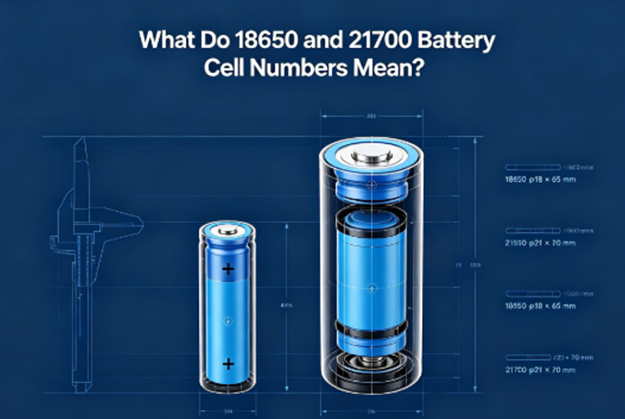
At the battery pack level, cell size affects how the pack is arranged, enclosed, wired, cooled, and balanced for weight and available installation space.
18650 vs 21700 Battery Cells: Quick Comparison
Comparison Factor | 18650 Battery Cell | 21700 Battery Cell |
Physical size | Smaller and more compact | Larger cylindrical format |
Capacity potential | Generally lower per cell | Generally higher per cell |
Weight per cell | Usually lighter | Usually heavier |
Installation space | Easier to fit into compact products | Requires more internal space |
Product compatibility | Common in established devices | Often used in newer designs |
Pack cell count | May require more cells for high capacity | May achieve the target capacity with fewer cells |
Typical design priority | Compact size and compatibility | Higher capacity and longer runtime |
Capacity and discharge performance can vary within both 18650 and 21700 formats. Some cells are optimized for higher power output, while others prioritize capacity and runtime, so cell size alone does not determine overall performance.
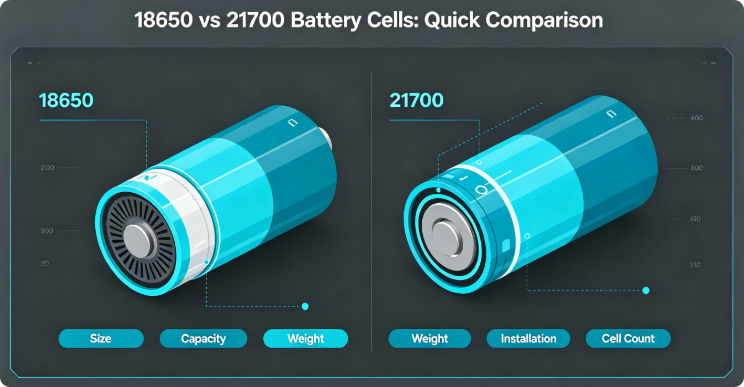
In Yattox battery development projects, 18650 cells are often considered for compact or space-limited designs, while 21700 cells are typically evaluated when higher capacity and longer operating time are more important.
Size Difference: Why Can a 21700 Cell Store More Energy?
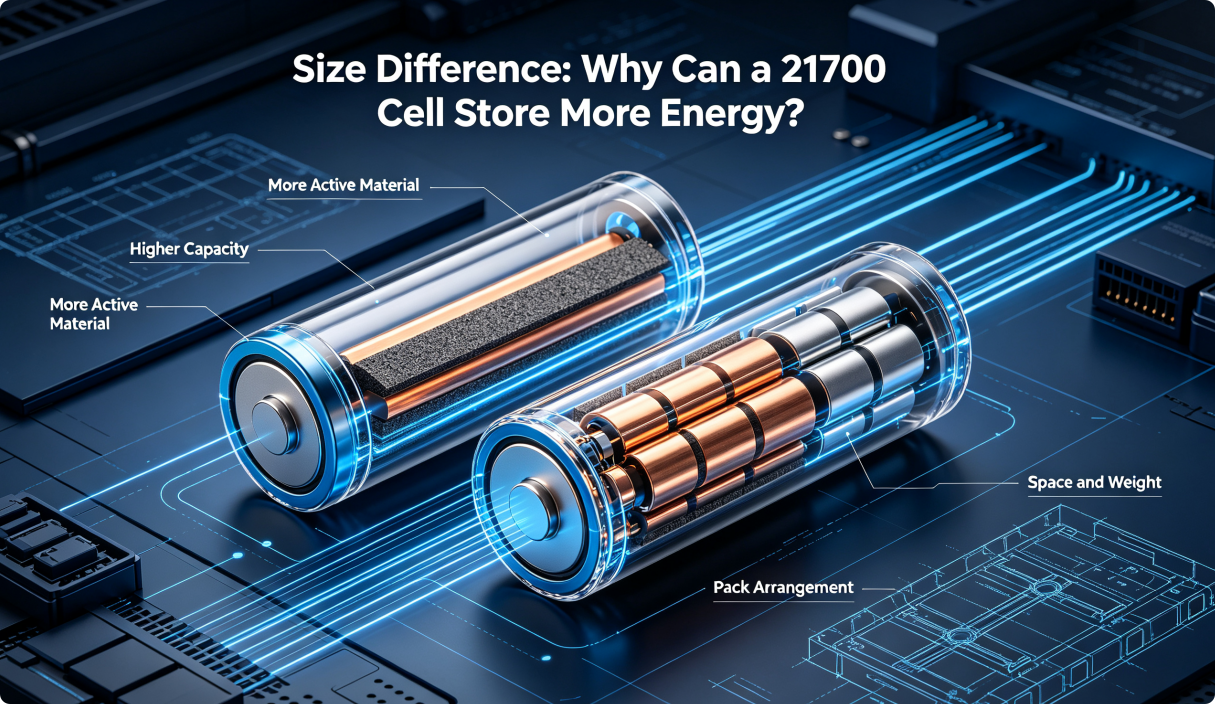
A 21700 cell has more internal space than an 18650 cell, so it can accommodate more active material and usually deliver higher capacity per cell. This makes it attractive for products that need longer operating time, provided the larger cell can be integrated without compromising weight, space, or system performance.
1.Space and Configuration
Replacing 18650 cells with 21700 cells is rarely a direct swap. The battery compartment, cell holders, enclosure, and connection layout may all need to be adjusted. In some cases, the higher capacity of each 21700 cell allows fewer parallel cells to be used, while the required voltage still determines how many cells are connected in series.
2.Pack Size and Weight
The final battery dimensions are shaped by the complete electrical configuration rather than cell size alone. Yattox’s 14.4V 25000mAh 5P4S battery, for example, measures approximately 110 × 89 × 80mm and weighs about 1600g. A 21.6V 20000mAh 4P6S version measures approximately 132 × 89 × 80mm and weighs about 1920g.
These examples show how changes in voltage, capacity, and cell arrangement can affect the finished battery, even when the same 21700 cell format is used.
3.Practical Design Value
The real advantage of the 21700 format is not simply its larger size, but the additional energy it can provide from each cell. When capacity, weight, voltage, and available space are carefully balanced, it can support longer runtime without making the battery structure unnecessarily complicated.
Capacity and Runtime: Does a 21700 Battery Always Last Longer?
Because of its larger internal volume, a 21700 cell can usually store more energy than an 18650 cell. That extra capacity may extend operating time, but in drone applications, endurance is shaped by the entire aircraft system rather than battery capacity alone.
1.Total Flight Weight
More capacity usually comes with added mass. The aircraft must carry not only the battery, but also cameras, sensors, spraying equipment, and other payloads. Once total takeoff weight rises, part of the available energy is used simply to maintain lift, reducing the expected gain in flight time.
2.Propulsion Efficiency
Motor, ESC, propeller, and airframe performance all influence how efficiently electrical energy is converted into thrust. Propeller diameter, pitch, rotational speed, and motor matching can significantly change current draw. As a result, two UAVs using batteries with similar energy capacity may achieve very different endurance.
3.Flight Conditions
Real-world operation rarely matches laboratory conditions. Wind, temperature, altitude, flight speed, and maneuvering style can all increase power consumption. Strong headwinds, cold weather, repeated acceleration, or aggressive flight will shorten runtime, which is why rated capacity should not be treated as a guaranteed flight-time figure.
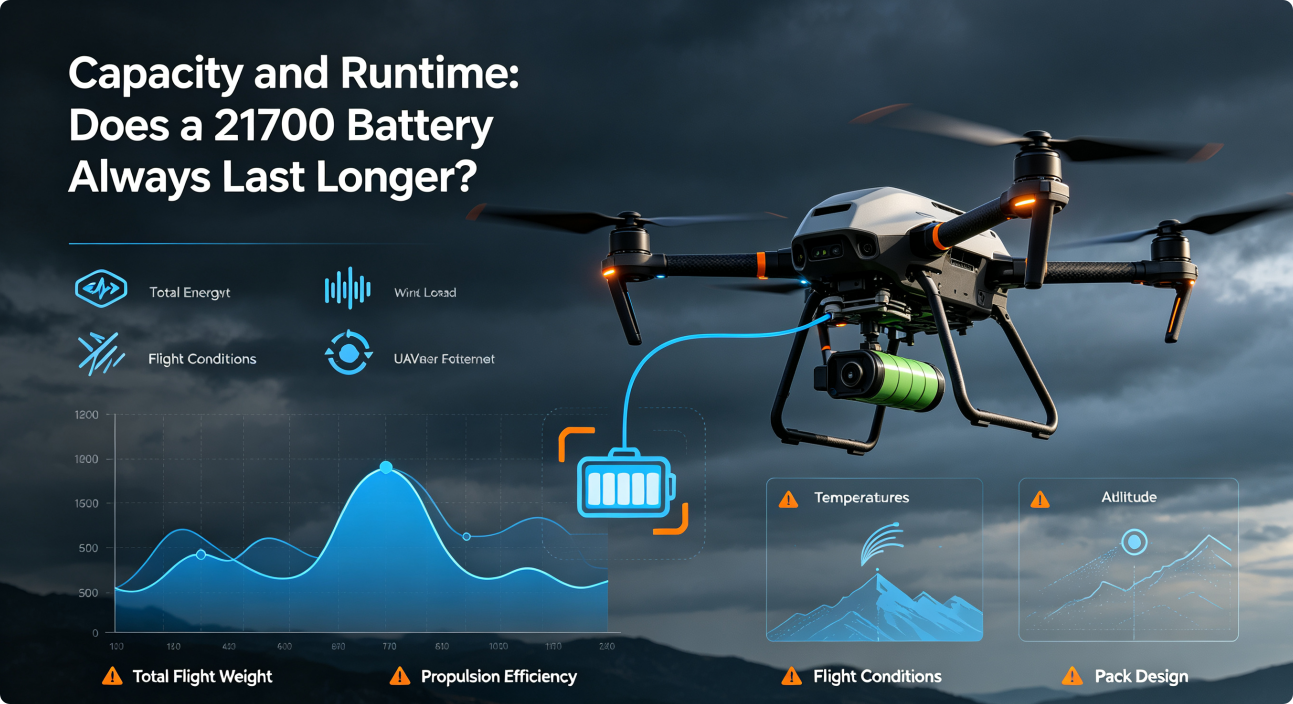
4.Battery Pack Design
How the cells are assembled also affects usable energy. Cell consistency, conductor resistance, cable size, connector quality, thermal control, and internal layout can influence voltage drop and energy loss during discharge.
A 21700 cell provides a stronger energy base, but longer UAV flight time ultimately depends on how well the battery, propulsion system, payload, and operating conditions are matched.
Discharge Performance: 18650 vs 21700 Under Continuous Load
Cell size alone does not determine discharge performance. Both 18650 and 21700 cells are available in capacity-focused and power-focused designs, so the specific cell model and chemistry matter more than the format itself.
For power-system selection, the most relevant factors are continuous current capability, internal resistance, voltage stability under load, and temperature rise. These characteristics determine whether the battery can maintain reliable output without excessive voltage drop or heat buildup.
The required performance also depends on the application. FPV racing drones need strong burst output and rapid throttle response, while endurance-focused UAVs benefit more from stable current delivery and predictable voltage throughout longer flight cycles.
The better choice is therefore the cell that matches the equipment’s actual load profile, rather than simply the larger 21700 or smaller 18650 format.
Weight and Space: When Is 18650 Still the Better Choice?
The higher capacity of a 21700 cell does not automatically make it the better option for every product. Available space, total battery weight, system compatibility, and target runtime all shape the final decision.
1.18650 for Compact and Established Designs
The smaller 18650 format remains practical when battery space is limited or the equipment already uses compatible holders, enclosures, and charging systems. It is also well suited to lightweight products where the existing battery configuration already provides sufficient capacity and output without requiring structural changes.
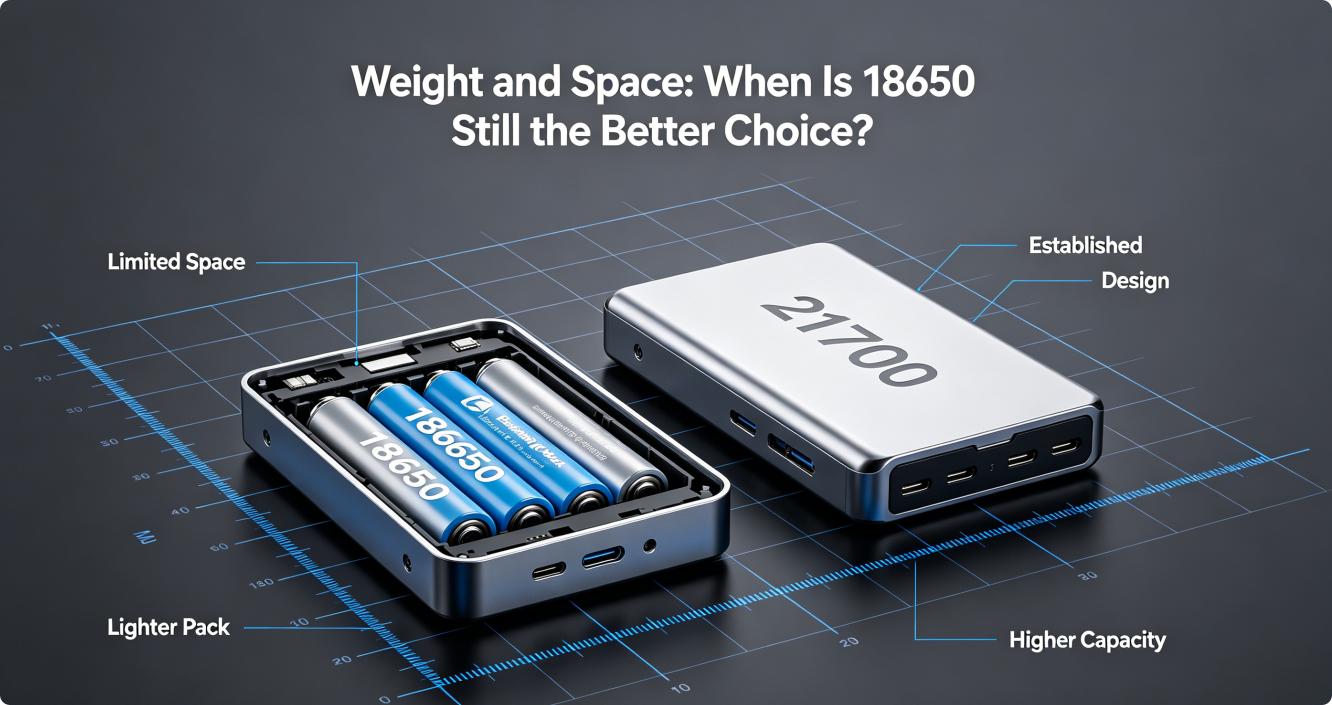
2.21700 for Higher-Capacity Systems
When longer runtime is the priority and the equipment can accommodate a larger battery, 21700 cells provide more capacity per cell. Yattox’s 14.4V 25000mAh 5P4S model, for example, delivers a high-capacity configuration within an approximately 110 × 89 × 80mm structure and weighs about 1600g, making it suitable for power systems designed around extended operation.
Ultimately, the better format is the one that fits the product as a whole. A 21700 configuration may offer more stored energy, while an 18650 design can provide a more compact, lightweight, and straightforward solution for existing equipment.
Are 18650 and 21700 Batteries Interchangeable?
Generally, no. A 21700 cell is larger than an 18650 cell, so it will not fit most holders or enclosures built for the smaller format.
Although their nominal voltage may be similar, differences in capacity, current capability, terminal structure, weight, and charging requirements can affect compatibility.
In custom battery systems, switching cell formats usually calls for a new layout, enclosure, protection design, and validation process rather than a direct replacement.
18650 vs 21700 for Drone and UAV Battery Packs
UAV Requirement | Better Choice | Why |
Limited battery compartment | 18650 | Smaller dimensions make integration easier |
Existing 18650-based aircraft | 18650 | Better compatibility with the current structure |
Lightweight compact drone | Depends on the design | Capacity, weight, and flight efficiency must be balanced |
Longer flight-time target | 21700 | Higher capacity per cell can support extended operation |
Industrial inspection UAV | 21700 | Better suited to endurance-focused missions |
Mapping and survey UAV | 21700 | Can support longer routes and wider coverage |
New custom UAV platform | Depends on project requirements | Allows the cell format and battery layout to be evaluated together |
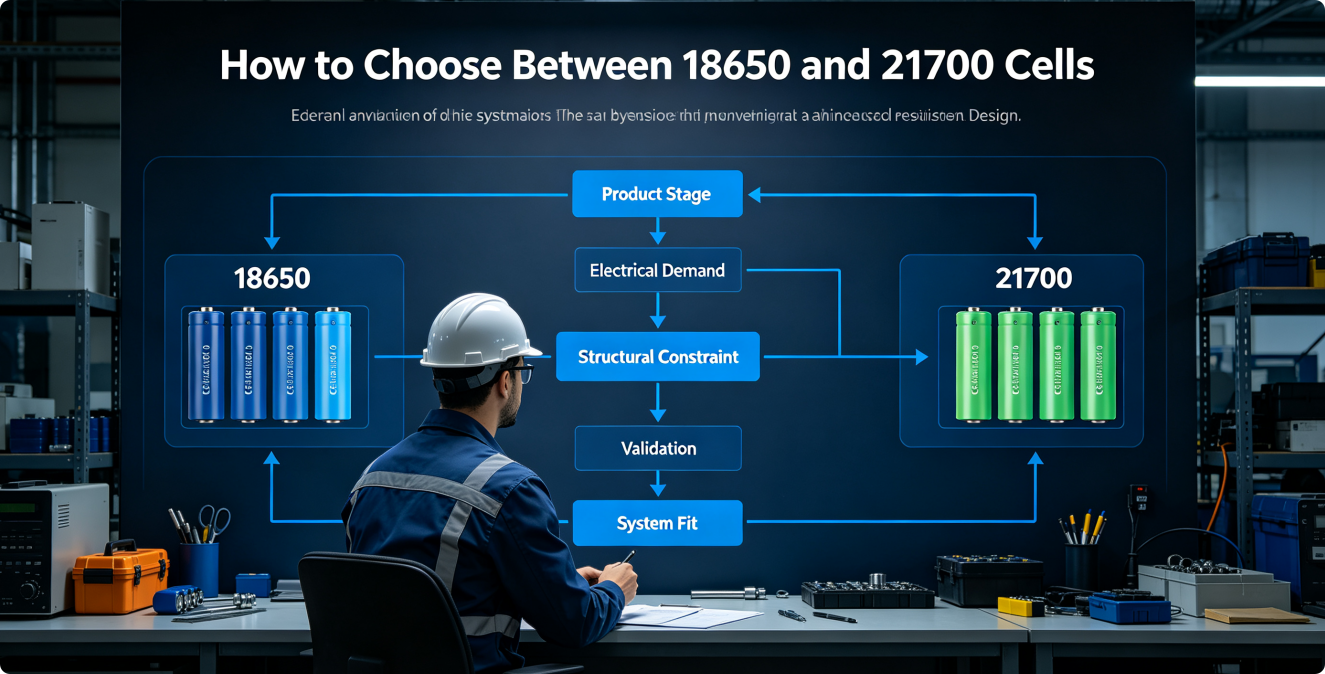
How to Choose Between 18650 and 21700 Cells
The choice between 18650 and 21700 cells should follow the product’s development stage, electrical demand, structural constraints, and validation requirements. Rather than selecting a format from one specification, the aim is to identify which option can be integrated with fewer compromises across the complete battery system.
1.When 18650 Cells Make More Sense
The 18650 format is often the safer engineering choice for an established product. Existing holders, enclosures, charging systems, protection circuits, assembly fixtures, and qualification records can usually remain unchanged, reducing redevelopment work and technical risk.
It may also be preferable when replacement availability and long-term serviceability are important. Products already built around 18650 cells can continue using a familiar supply and maintenance structure without introducing a new mechanical platform.
If the current battery already meets the equipment’s runtime, output, and reliability targets, changing to a larger format may add complexity without producing enough practical value.
2.When 21700 Cells Offer Greater Value
The 21700 format is more relevant when a new product is being designed around higher energy requirements from the beginning. Its greater capacity per cell can create more options for reaching the target energy with a different cell count and internal arrangement.
This can be useful for UAVs, industrial equipment, mobile power systems, and other applications expected to operate for extended periods. Because the structure is still under development, the enclosure, electrical connections, thermal path, and weight distribution can be planned around the selected 21700 configuration rather than adapted later.
The final decision should still account for the intended load profile, discharge stability, operating temperature, cycle-life target, supply consistency, and certification requirements.
A sound selection is therefore based on system fit. The 18650 format is often more practical for proven and compatibility-sensitive designs, while the 21700 format offers greater flexibility for new projects built around higher energy demand and longer duty cycles.
How Yattox Supports 21700 Li-ion Battery Development
Yattox provides 21700 Li-ion battery development support for drones, UAVs, RC models, and other power systems. By reviewing the application’s voltage, capacity, current demand, installation space, weight limit, and runtime target, the team can recommend a suitable cell configuration, connector, cable layout, and battery structure. Support is available throughout specification review, sample development, testing, and production.
FAQs About 18650 vs 21700 Battery Cells
Q1: Can I use a 21700 battery instead of an 18650?
Not as a direct replacement in most devices. A 21700 cell is wider and longer than an 18650, so it usually cannot fit into the same holder or enclosure. Differences in capacity, discharge current, terminal structure, and charging requirements may also affect compatibility. For a custom battery system, changing cell formats requires a revised layout and performance validation.
Q2: What are the pros and cons of 21700 batteries?
The main advantages of 21700 batteries are higher capacity per cell, greater energy storage, and longer potential runtime. In some battery designs, fewer parallel cells may be needed to reach the required capacity.
The trade-offs are larger dimensions and higher individual cell weight. Products originally designed for 18650 cells may also require changes to the enclosure, cell holders, electrical connections, and thermal structure.
Q3: What is better than 18650 batteries?
No cylindrical battery format is better for every application. A 21700 cell can outperform an 18650 when higher capacity and longer operating time are the main goals. An 18650 may remain the better choice for compact, lightweight, or established products.
The right format is the one that meets the application’s energy, current, size, weight, safety, and cost requirements with the fewest design compromises.
Q4: Do 21700 batteries last longer than 18650 batteries?
Usually, a 21700 cell can run longer because it holds more energy than a comparable 18650 cell. The actual improvement varies with the device’s power consumption, operating temperature, discharge load, and battery efficiency.
For drones, the heavier cell may increase the power needed for lift, so higher capacity does not translate directly into a fixed increase in flight time.
Q5: Are 18650 and 21700 batteries the same voltage?
Many 18650 and 21700 lithium-ion cells have a nominal voltage of approximately 3.6V or 3.7V. However, the exact voltage range depends on the cell chemistry and model.
Similar voltage does not make the cells interchangeable. Capacity, current rating, charging limits, dimensions, and protection requirements must also match the equipment.
Q6: Which battery cell is better for drones and UAVs?
For compact drones with limited battery space, 18650 cells may provide a more practical balance of size and weight. For long-endurance UAVs, 21700 cells can offer a stronger capacity foundation when the aircraft can accommodate their larger dimensions and added mass.
Flight mission, payload, motor current, maximum takeoff weight, battery compartment size, and target endurance should guide the final selection.
Q7: What should I compare before choosing 18650 or 21700 cells?
Start with the device’s required voltage, continuous current, peak current, runtime target, available space, and weight limit. Operating temperature, cycle-life expectations, charging system, cell availability, and battery structure should also be reviewed.
For custom battery projects, these factors need to be evaluated together. Selecting a cell by capacity or size alone can lead to poor fit, excessive weight, voltage drop, or insufficient output.