


How Long Does an FPV Drone Battery Last
June 29, 2026
In this guide, we will explain how long an FPV drone battery usually lasts, why FPV flight time is shorter than camera drones, what factors affect battery life, and how to choose and use batteries more safely and efficiently.
Table of Contents
In this guide, we will explain how long an FPV drone battery usually lasts, why FPV flight time is shorter than camera drones, what factors affect battery life, and how to choose and use batteries more safely and efficiently.
How Long Does an FPV Drone Battery Usually Last?
A typical FPV drone battery usually lasts 3 to 10 minutes per flight. For many 5-inch FPV racing or freestyle drones, the real flight time is often around 3 to 6 minutes, while cinewhoops and long-range FPV drones may last longer with a more efficient setup.
The exact flight time depends on the drone size, battery capacity, voltage platform, total weight, flying style, and battery condition. FPV drones are built for fast response and high power output, so their batteries are usually drained much faster than standard camera drone batteries.
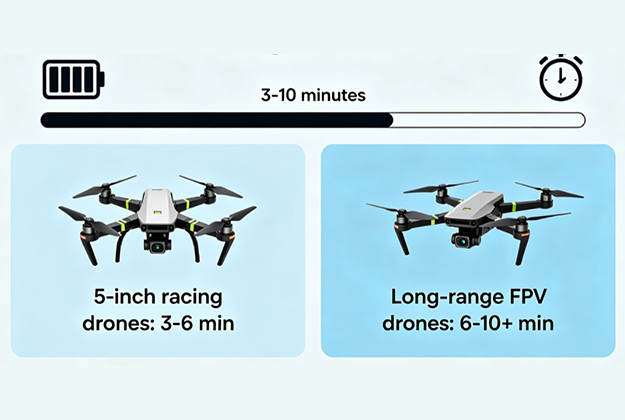
In simple terms, aggressive flying will shorten the flight time, while smoother cruising can help the same battery last longer.
Why Is FPV Flight Time Shorter Than Camera Drones?
FPV drones usually have shorter flight time than camera drones because they are built for speed, agility, and instant control response rather than long endurance.
Camera drones are designed for stable hovering, smooth filming, and efficient cruising. FPV drones, by contrast, often use high-power motors, aggressive propellers, and high-discharge LiPo batteries to support fast acceleration, sharp turns, and acrobatic flight.
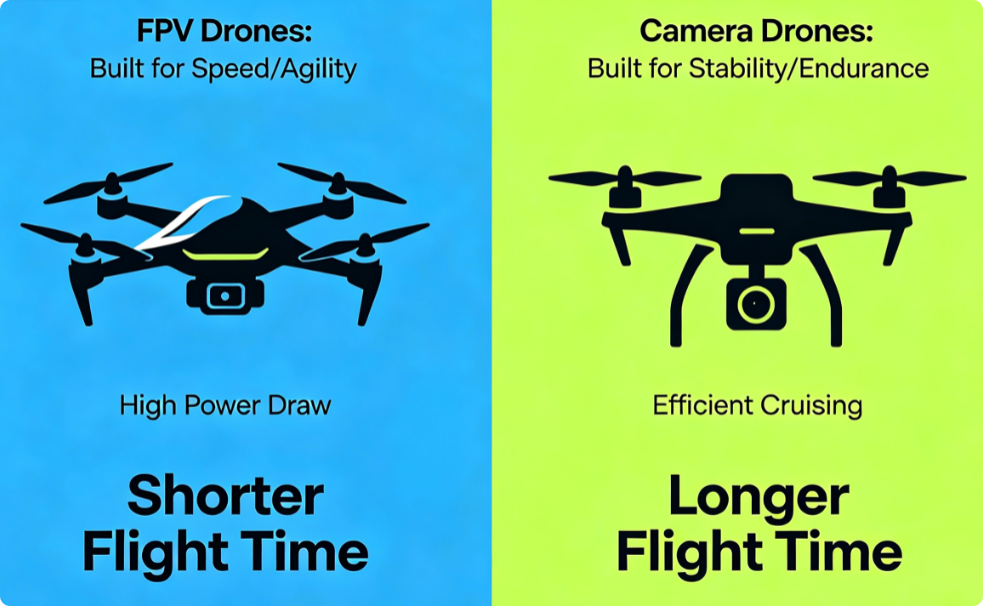
This performance-focused design draws more current from the battery. As a result, a camera drone may fly for 20–30 minutes or more, while many FPV drones only last a few minutes per battery, especially during racing or freestyle flying.
Key Factors That Affect FPV Battery Life
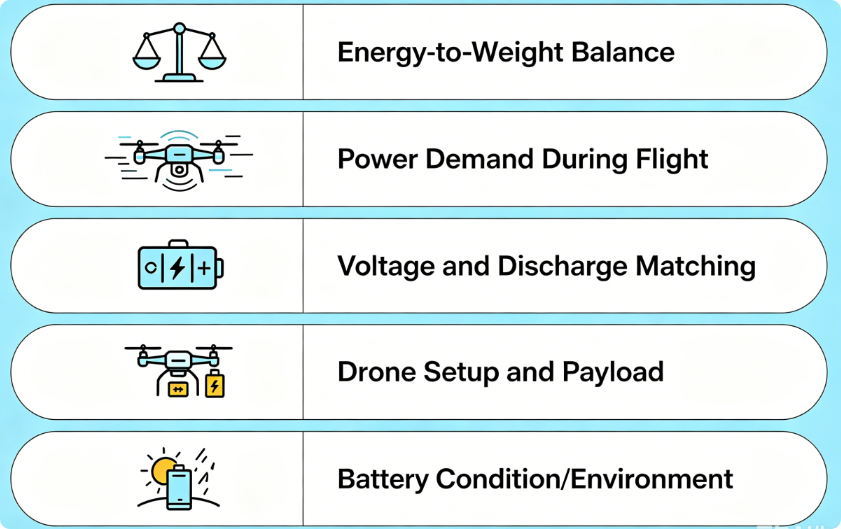
FPV battery life is not decided by capacity alone. A battery with a higher mAh rating may store more energy, but the final flight time still depends on how efficiently the drone uses that energy. For FPV drones, battery performance is usually affected by the balance between power demand, total weight, system matching, and flying conditions.
1.Energy-to-Weight Balance
A larger battery can provide more stored energy, but it also adds weight to the drone. When the battery becomes too heavy, the motors need more power to keep the drone in the air. This can reduce the actual benefit of the higher capacity.
For this reason, FPV battery selection is not simply about choosing the largest mAh value. A well-matched battery should provide enough runtime while keeping the drone responsive and efficient.
2.Power Demand During Flight
FPV drones often draw high current during takeoff, acceleration, climbing, and sharp maneuvers. The more power the drone requires, the faster the battery voltage drops.
This is why two drones using the same battery may have very different flight times. A racing setup, a heavy cinematic build, and a long-range cruising drone all place different loads on the battery.
3.Voltage and Discharge Matching
The battery voltage, such as 4S or 6S, must match the drone’s motor, ESC, and flight controller system. A higher-voltage battery can support stronger power output and may improve efficiency in some setups, but only when the whole power system is designed for it.
Discharge capability is also important. If the battery cannot provide enough current, the drone may experience voltage sag, weak throttle response, overheating, or reduced battery life.
4.Drone Setup and Payload
Frame size, motor KV, propeller design, camera weight, GPS module, antenna, and protective parts all affect power consumption. Even small changes in payload or propeller choice can influence flight time.
5.Battery Condition and Environment
A new, healthy battery usually delivers more stable power than an older pack. As the battery ages, it may show shorter runtime, stronger voltage sag, swelling, or higher internal resistance.
Weather also matters. Cold temperatures can reduce battery output, while strong wind forces the drone to use more throttle. Proper storage, charging, and voltage management help keep FPV battery performance more consistent.
Flight Time Examples for Different FPV Drones
FPV flight time varies because different drones are designed for different missions. Instead of looking only at battery capacity, it is better to understand what the drone is built to do.
FPV Drone Type | Typical Flight Time | Main Reason |
Tinywhoop or micro FPV drone | 2–5 minutes | Small battery size limits stored energy |
5-inch racing FPV drone | 2–5 minutes | High-speed flight and strong current draw |
5-inch freestyle FPV drone | 3–6 minutes | Balanced for power, control, and agility |
Cinewhoop FPV drone | 5–10 minutes | Slower flight, but ducts and camera payload add load |
Long-range FPV drone | 10–30 minutes | Built for efficient cruising with larger LiPo or Li-ion packs |
How to Extend FPV Drone Flight Time
Extending FPV drone flight time is not only about using a larger battery. The better approach is to reduce unnecessary power loss and make the whole drone setup work more efficiently.
Start with the battery match. The battery should provide enough capacity and discharge capability without making the drone too heavy. For many 5-inch FPV drones, a 1300mAh to 1500mAh LiPo battery is commonly used because it offers a practical balance between flight time, weight, and response. For long-range FPV drones, larger LiPo or Li-ion battery packs may be more suitable if the drone is designed for steady cruising.
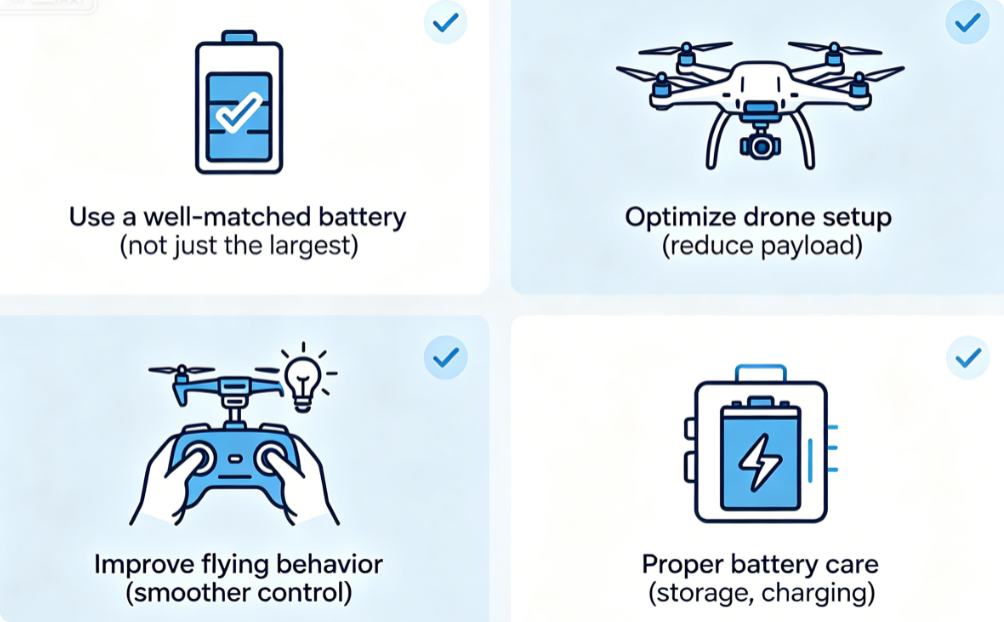
The drone setup also matters. Extra camera mounts, heavy propeller guards, oversized antennas, or unnecessary accessories can reduce flight time. Propeller choice can also change power consumption. A more efficient propeller may help the drone cruise longer, while an aggressive propeller may provide stronger response but drain the battery faster.
Flying behavior is another key point. Fast climbs, repeated throttle punches, sharp turns, and aggressive freestyle movements all increase current draw. If the goal is longer flight time, smoother throttle control and steady cruising can make the same FPV battery last longer.
Battery care should not be ignored. Avoid over-discharging the pack, do not store LiPo batteries fully charged for long periods, and allow the battery to cool before charging. A healthy battery usually gives more stable voltage, less sag, and more consistent flight time.
Finally, monitor voltage during every flight. Landing at the right voltage protects the battery and reduces the risk of sudden power loss. For FPV drones, good voltage management is often just as important as choosing the right battery capacity.
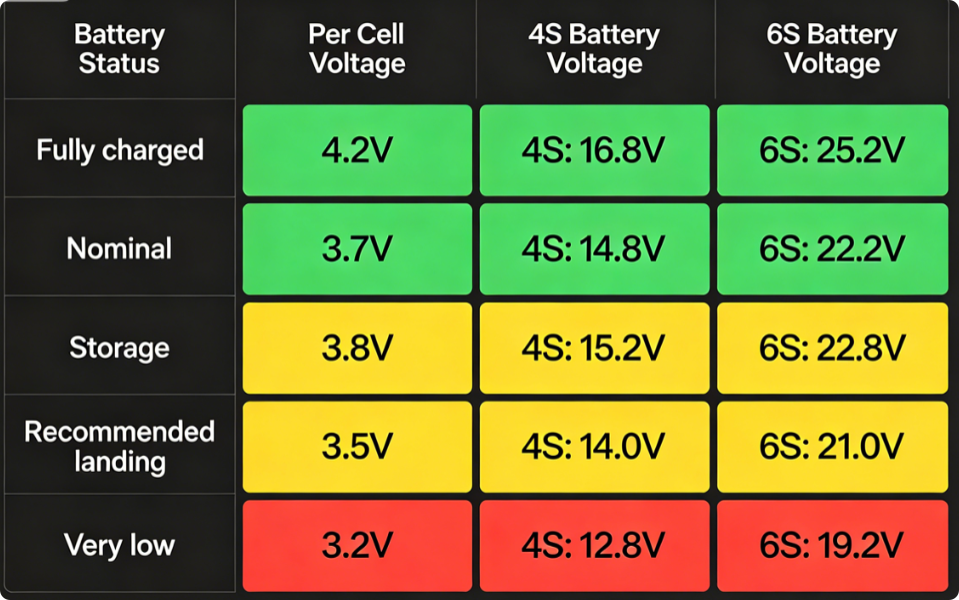
When Should You Land? Safe Voltage Guide
Battery Status | Per Cell Voltage | 4S Battery | 6S Battery |
Fully charged | 4.20V | 16.8V | 25.2V |
Nominal voltage | 3.70V | 14.8V | 22.2V |
Storage voltage | 3.80–3.85V | 15.2–15.4V | 22.8–23.1V |
Recommended landing range under load | 3.50–3.60V | 14.0–14.4V | 21.0–21.6V |
Very low / avoid continued flight | Around 3.30V or lower | Around 13.2V or lower | Around 19.8V or lower |
These values are general references. Always follow the battery manufacturer’s instructions, charger settings, and drone system requirements.
Conclusion
Yattox provides FPV and UAV battery pack solutions for longer usable flight time, stable power output, and reliable drone operation. By matching capacity, voltage, discharge rate, weight, and pack design to real flight conditions, Yattox helps drones fly longer and perform more consistently.
Contact Yattox to find the right FPV drone battery solution for your project.