


2S vs 3S LiPo for RC Cars: Speed, Runtime, Heat and ESC Compatibility
August 12, 2026
Compare 2S and 3S LiPo batteries for RC cars by voltage, speed, runtime, heat, gearing, battery-tray fit, and ESC compatibility.
Table of Contents
The 2S vs 3S LiPo decision for an RC car is not simply choosing “less power” or “more power.” The correct answer depends on the voltage range of the ESC and motor, the gearing, the available cooling, the battery-tray dimensions, and how the car will actually be driven. A 3S pack can raise motor speed and power potential substantially, but it can also expose a marginal connector, aggressive gear ratio, or undersized ESC very quickly.
For most stock 1/10-scale vehicles designed around 2S, a quality 2S LiPo battery remains the predictable choice for controllable acceleration, manageable temperature, and component life. A 3S LiPo battery makes sense when the complete power system is explicitly rated for 3S and the driver is prepared to verify temperatures rather than assuming compatibility.
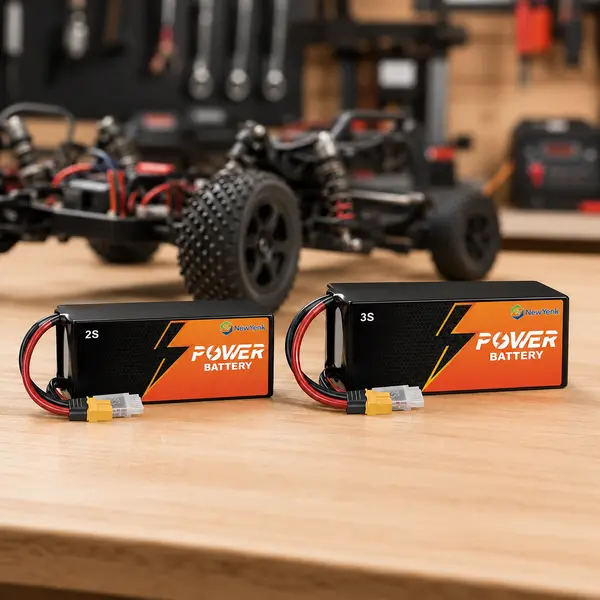
2S vs 3S LiPo: The Short Answer
A 2S LiPo has two cells in series: 7.4V nominal and 8.4V when fully charged. A 3S LiPo has three cells in series: 11.1V nominal and 12.6V fully charged. Moving from 2S to 3S therefore increases nominal voltage by 50%. With the same motor KV, gearing, tire diameter, and load, that extra voltage raises theoretical no-load motor speed by roughly the same proportion.
That does not guarantee 50% more real-world top speed. Aerodynamic drag, tire growth, drivetrain losses, ESC limits, motor loading, battery voltage sag, and traction all reduce the result. The important point is that a 3S upgrade changes the electrical and thermal operating point of the whole car—not just the battery.
| Comparison | 2S LiPo | 3S LiPo |
|---|---|---|
| Nominal voltage | 7.4V | 11.1V |
| Full-charge voltage | 8.4V | 12.6V |
| Typical driving character | Smoother, easier to control | Faster response and greater power potential |
| Thermal margin | Usually easier to manage | Requires closer checks of motor, ESC, gearing, wiring, and cooling |
| Best first question | Is the vehicle designed for 2S? | Are the ESC and motor both explicitly rated for 3S? |
How RC Car Battery Voltage Changes Speed and Acceleration
Higher voltage lets a compatible power system reach a higher motor speed and can deliver more power without requiring proportionally more current for the same wattage. Motor KV describes approximate no-load revolutions per minute per volt, so a 3300KV motor has a theoretical no-load speed of about 24,420rpm at 7.4V and 36,630rpm at 11.1V. Those figures are not predictions of loaded wheel speed, but they show why a cell-count change is significant.
On loose dirt, a 3S setup may turn extra power into wheelspin rather than faster laps. On a high-grip surface, it may increase acceleration while raising drivetrain stress. Differentials, drive shafts, tires, slipper settings, and gear mesh must therefore be considered alongside electrical compatibility. For racing classes governed by 2S rules, the decision is already made; usable speed then comes from voltage stability, low resistance, sensible gearing, and consistent pack condition.
Does 3S Automatically Provide Longer Runtime?
No. Runtime depends more directly on usable energy in watt-hours and the average power consumed during the run. Watt-hours are calculated as nominal voltage multiplied by amp-hours. A 5000mAh 2S pack stores about 37Wh, while a 5000mAh 3S pack stores about 55.5Wh. The 3S pack contains more energy, but drivers often use the additional voltage to accelerate harder and run faster, which raises average power consumption.
Pack weight also matters. A 3S pack normally adds one cell layer and can be heavier or thicker than a comparable 2S battery. That changes handling, landing loads, and battery-tray fit. If runtime is the priority, compare watt-hours, physical dimensions, weight, discharge performance, and the actual duty cycle rather than capacity in mAh alone.
Why Heat Often Appears After a 3S Upgrade
Heat is usually a system signal. It may come from excessive motor load, tall gearing, restricted cooling, high resistance in a connector, undersized wire, repeated hard launches, or a pack with elevated internal resistance. A 3S battery can reveal these weaknesses because the motor is able to spin faster and the driver can demand more power.
Check the battery, connector, ESC, motor, and wiring separately after a short run. A warm motor with a relatively cool battery suggests a different problem from a hot connector or a battery that heats rapidly under moderate load. Do not continue driving a swollen, damaged, unusually hot, or physically compromised LiPo pack. Follow the battery and vehicle manufacturers’ charging, storage, handling, and disposal instructions.
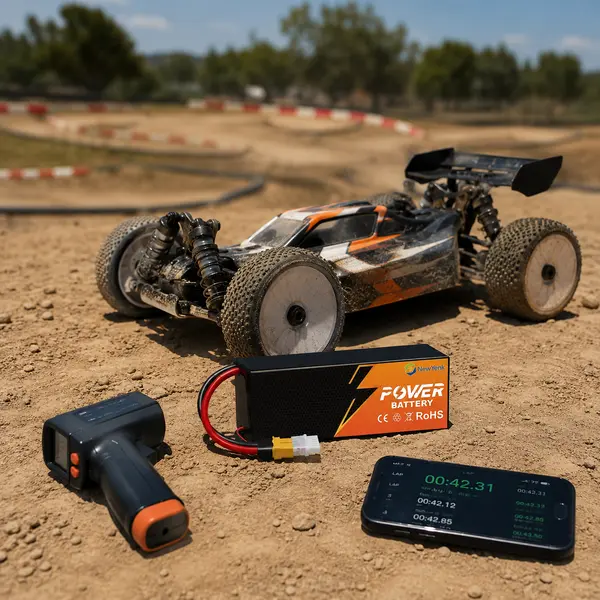
ESC Compatibility Comes Before the Battery Upgrade
The ESC must support the battery’s maximum fully charged voltage, not only its nominal voltage. A “3S-compatible” marking should be confirmed in the exact model manual because versions that look similar can have different cell-count and current limits. The motor must also be approved for the intended voltage and gearing. An ESC rated for 3S does not automatically make every attached motor suitable for 3S.
Low-voltage cutoff must be configured for LiPo use and the correct cell count. As one practical example, a Horizon Hobby vehicle manual specifies cutoff by individual cell voltage and gives different pack thresholds for 2S and 3S. The exact value and behavior vary by ESC, so use the instructions for the installed unit rather than copying a setting from another car.
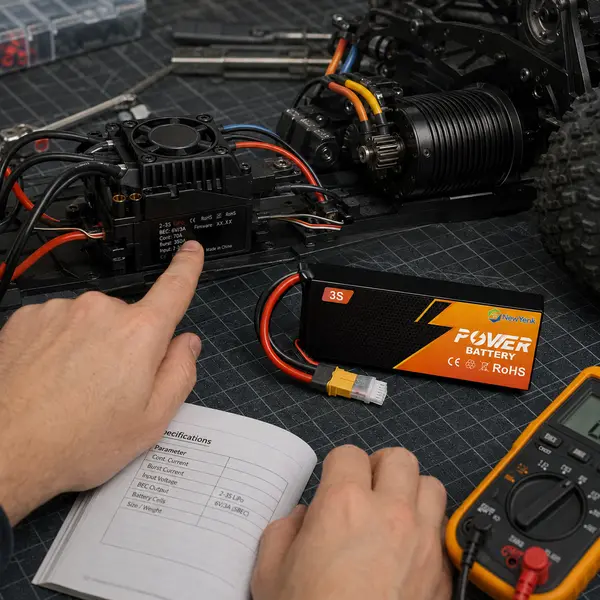
Compatibility checklist before connecting a 3S pack
- Confirm the ESC input range includes 3S and 12.6V fully charged.
- Confirm the motor is approved for 3S at the selected gear ratio and tire diameter.
- Verify LiPo low-voltage cutoff and automatic cell-count detection.
- Check connector type, polarity, contact condition, and wire gauge.
- Measure the battery tray; allow space for straps, wires, and cooling airflow.
- Inspect drivetrain condition and tire speed rating.
- Begin with conservative gearing and a short temperature-controlled test.
When a 2S LiPo Battery Is the Better Choice
Choose 2S when the vehicle is designed for 2S only, when track rules require it, or when control and consistency matter more than maximum speed. It is also the safer starting point for a new build, a small chassis with limited cooling, or a vehicle used by a less experienced driver. A well-matched high-discharge 2S pack can outperform a poorly matched 3S setup in repeatability because voltage sag, temperature, traction, and component stress remain under control.
For bashing, 2S can reduce broken drivetrain parts and make the car easier to drive in a smaller area. For technical tracks, smoother power delivery may also translate into faster laps even if straight-line speed is lower.
When a 3S LiPo Battery Makes Sense
Choose 3S when the ESC, motor, drivetrain, and chassis are designed for it and the application benefits from higher voltage. Suitable examples include a manufacturer-approved speed setup, a large open bashing area, or a build where lower motor KV and appropriate gearing are selected around 3S from the beginning.
A 3S RC car battery should fit securely without being compressed by the body or strap. Do not force a thicker pack into a tray, route wires against rotating parts, or rely on an adapter that becomes hot. If a connector change is needed, the RC battery connector guide explains the practical differences among XT60, Deans, EC/IC, and TRX systems.
A Controlled Way to Test 2S vs 3S
- Record the current 2S setup: pinion and spur, tire size, pack weight, ambient temperature, and run time.
- Inspect the ESC and motor manuals and confirm 3S approval.
- Install the 3S pack with conservative gearing and full wire clearance.
- Run for one to two minutes at moderate load, then stop and check the battery, connector, ESC, and motor individually.
- Increase load gradually only if temperatures and behavior remain normal.
- Compare lap time, controllability, voltage sag, and temperature—not top speed alone.
This method separates a useful upgrade from a setup that merely feels dramatic for the first minute. If temperature rises sharply, the connector discolors, or the ESC repeatedly cuts power, stop and diagnose the cause before another run.
Specifying a Custom 2S or 3S RC Battery Pack
For RC brands, distributors, and vehicle developers, battery selection should start with the load profile and the available installation envelope. Cell count sets the voltage platform, but capacity, C-rate, internal resistance, pack dimensions, weight, wire gauge, connector, balance lead, cell matching, and mechanical protection determine whether the pack works reliably in the vehicle.
Yattox’s RC battery range provides a basis for matching voltage, discharge demand, size, and connector configuration. Projects that need a specific 2S or 3S format can also use the company’s battery customization options to define series configuration, dimensions, cable gauge, connector type, and verification requirements around the target vehicle rather than choosing from voltage alone.
Questions Drivers Ask Before Switching Cell Count
Can I use a 2S battery in a 3S RC car?
Often yes, if the ESC supports 2S and its low-voltage cutoff can detect or be set for two cells. Performance will be lower, and some high-voltage systems may have minimum-voltage or gearing considerations. Confirm the exact ESC and vehicle manual.
Will a 3S battery damage a 2S ESC?
It can. A fully charged 3S pack reaches 12.6V, which exceeds the input range of a 2S-only ESC. Do not connect 3S unless both the ESC and motor documentation explicitly approve it.
Is 3S always faster than 2S?
It has greater speed potential with the same motor KV and gearing, but usable speed depends on traction, drag, temperature, voltage sag, drivetrain limits, and setup. More voltage does not guarantee a faster lap.
Should I change gearing when moving from 2S to 3S?
Frequently, yes. Starting with a smaller pinion or otherwise conservative ratio reduces motor load while the system is tested. Follow the vehicle or motor maker’s gearing guidance and verify temperatures after short runs.