


RC Car Battery Connector Types: Choosing XT60, Deans, EC/IC or TRX
August 11, 2026
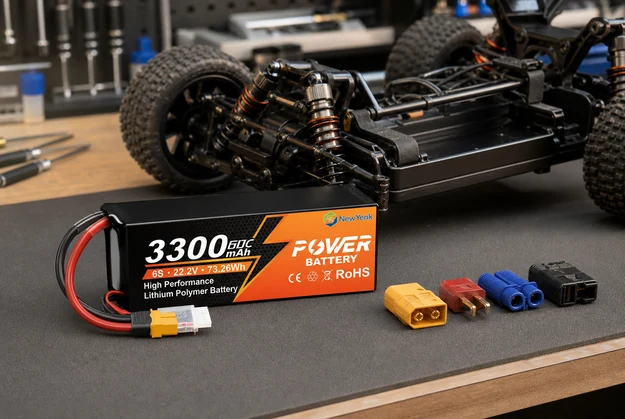
Compare RC battery connector types including XT60, Deans, EC/IC and TRX by compatibility, current draw, wire size, heat and charging needs.
Table of Contents
Choosing among RC battery connector types starts with one rule: match the battery to the connector already fitted to the ESC, then confirm that the connector, wire, solder joints and charger lead can carry the model’s real current. XT60, Deans/T-plug, EC/IC and TRX connectors can all work well in the right system, but they are not universal substitutes. The best choice is the one that fits physically, mates with the correct polarity, supports the measured load and is available across your batteries and charging equipment.
Quick answer: which RC car battery connector should you choose?
- XT60: a practical general-purpose choice for many hobby setups when its genuine rating, wire size and measured current match the application.
- Deans or T-plug: compact and common on older or space-constrained models, but the small housing can be harder to grip and solder quality matters.
- EC3/EC5 or IC3/IC5: useful when the vehicle already uses the EC/IC ecosystem; choose the size for the actual current and verify the exact battery, ESC and charger combination.
- TRX: normally the simplest choice for a Traxxas vehicle that still uses its factory connector and charging ecosystem.
Do not select a plug by color alone. Similar-looking housings may use different contact sizes, keying or signal arrangements. Photograph both sides, read the vehicle manual, and check the molded name before ordering an RC car battery connector or adapter.
How to identify the main RC battery plug types
An XT60 connector has a yellow keyed nylon housing and two recessed bullet-style contacts. A Deans plug, also called a T-plug, usually has a compact red T-shaped housing with flat contacts. EC connectors normally use blue housings with round bullet contacts, while Spektrum IC connectors are usually orange and add Smart-data capability on supported equipment. TRX connectors use a proprietary keyed housing associated with Traxxas vehicles and chargers.
The names describe connector families, not a guaranteed current limit for every copy. Contact material, molding quality, wire gauge, soldering and ventilation all affect temperature. The original manufacturer of the XT family, AMASS, lists multiple XT sizes and wire-type variants; that range is one reason “XT” alone is not a complete specification.
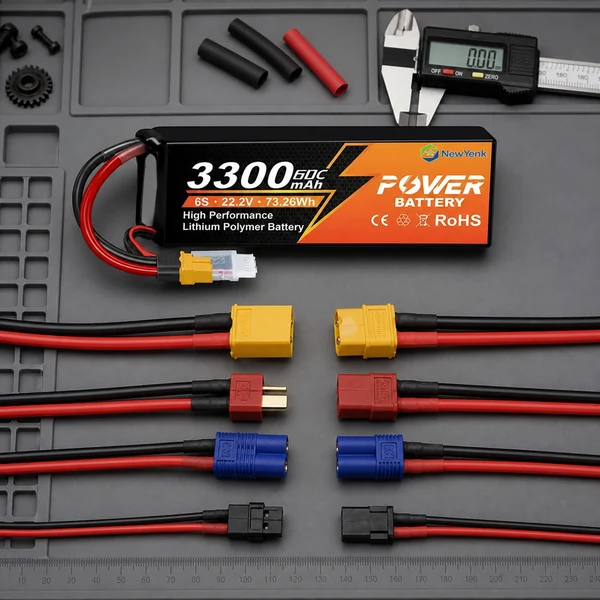
XT60 connector: the balanced general-purpose option
The XT60 connector is popular because it is keyed, polarized, widely stocked and large enough to grip without pulling on the wires. Genuine parts are commonly paired with substantial silicone cable, and the recessed contacts reduce the chance of an accidental short when the correct battery-side housing is used.
Current figures on store listings often conflict. For example, a technical integration guide using a genuine XT60 and 12 AWG lead specifies 30 A continuous and 60 A short-duration current, while other sellers advertise higher numbers under different assumptions. Treat the manufacturer or equipment documentation as the starting point, then validate the assembled connector at the vehicle’s continuous and peak load. A counterfeit housing, weak spring contact or poor solder joint can run hot well below an optimistic catalog claim.
XT60 is a strong candidate when you want a broadly available plug for a moderate-power build and are willing to standardize the ESC, charger leads and battery fleet. For higher sustained current, do not simply assume the familiar yellow plug is sufficient; calculate and test the complete current path.
Deans plug: compact, proven and sensitive to assembly quality
A Deans plug or T-plug saves space and has a long history in RC cars. Its flat contacts create a compact package, making it attractive for tight battery bays and existing fleets that already use the format. The tradeoff is handling: the small housing can be difficult to separate, especially when hot or recessed, and pulling on the cable can damage the joint.
When comparing XT60 vs Deans, focus less on internet maximum-current claims and more on the installation. Check whether the housing can be gripped, whether the solder tabs accept the intended cable without a bulky joint, and whether the plug remains cool during repeated acceleration. A high-quality T-plug with a clean joint can outperform a poor XT60 assembly, but changing an entire fleet only makes sense when compatibility, heat or serviceability creates a real problem.
EC and IC connectors: understand size and Smart compatibility
EC3 and EC5 connectors use different contact sizes and should be chosen as distinct products. The larger number does not mean that every vehicle should use the larger connector; it indicates a different family size. Match the actual ESC plug and use the current requirement, cable size and available space to verify the choice.
Spektrum’s IC3 and IC5 families add a data contact for compatible Smart systems. Spektrum states on its product pages that IC3 and IC5 connectors are compatible with corresponding EC3 and EC5 power connectors. That physical power compatibility does not automatically provide Smart telemetry or charging features. Also check whether a battery has a separate balance lead; some Smart configurations handle balance information differently and require compatible charging equipment.
TRX connector: best when preserving the factory ecosystem
A TRX connector is normally the lowest-friction choice for a Traxxas vehicle that remains in factory configuration. It avoids extra adapters and preserves the expected fit between the vehicle, battery and supported charger. Before buying, identify which Traxxas connector generation the model uses and follow its manual, because product age and charging system matter.
Changing the ESC connector may be reasonable for an experienced owner standardizing a mixed fleet, but it can affect warranty, weather sealing and resale. It also creates a permanent polarity and workmanship responsibility. If the only problem is battery availability, compare a correctly engineered pack with the required connector against the cost and risk of modifying the vehicle. Yattox’s RC battery range provides a starting point for discussing pack dimensions, voltage, discharge demand and connector customization together.
Match the connector to current draw, not C-rating alone
The battery’s C-rating does not tell you how much current the vehicle will draw. It expresses a claimed battery capability relative to capacity. Actual connector load is set by the motor, ESC, gearing, tire diameter, vehicle mass, surface, driving style and mechanical condition. Measure current with suitable logging equipment or use ESC data under representative acceleration and load.
Size the current path for both sustained demand and short peaks. Then check the weakest element: battery tabs, pack leads, connector contacts, solder joints, adapters, ESC leads and charger cable. Increasing connector size while leaving a thin lead or long adapter in place does not solve the system bottleneck.
A practical validation sequence
- Confirm battery voltage and cell count are approved for the ESC and motor.
- Record peak current during hard acceleration and sustained current during the most demanding normal use.
- Compare those values with documented connector and cable limits, applying a sensible design margin.
- After a controlled run, inspect the plug and measure temperature immediately with an appropriate instrument.
- Repeat when gearing, tires, motor timing, vehicle weight or ambient temperature changes.
Why adapters can overheat even when both connectors are adequate
An adapter adds two more contact interfaces, extra wire and extra solder joints. Each has resistance, and heating rises with the square of current. A compact adapter may also trap heat inside the battery compartment or force a tight bend that stresses the joint. This is why an adapter that works during gentle testing can become hot during repeated launches, tall grass or high-load bashing.
Use an adapter only when its connector family, polarity, wire gauge, insulation and assembly quality are suitable for the load. Keep it short without putting tension on either socket. For a permanent high-current setup, a correctly terminated direct connector is usually cleaner than stacking adapters, but soldering should be done only by someone who can prevent reverse polarity, cold joints and heat damage to the cells or ESC.
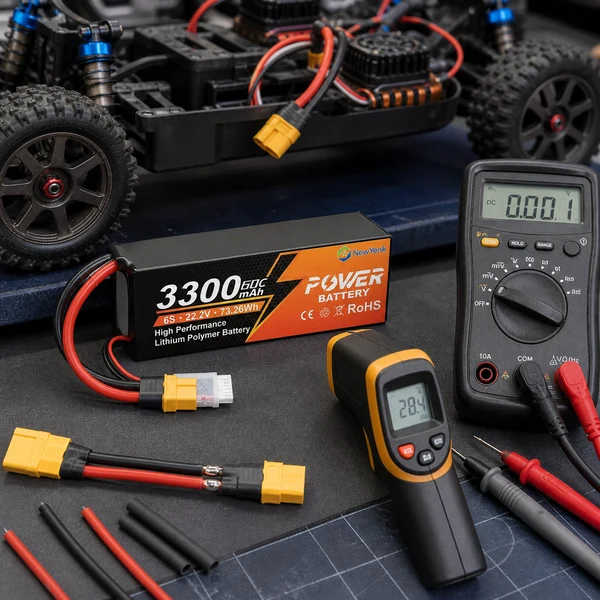
Check wire gauge, solder joints and strain relief
The connector is only one component. Cable must be sized for current, length, insulation temperature and installation conditions. Very flexible silicone wire is common in RC applications, but the printed gauge still needs to be verified. Long leads add resistance and voltage drop, so avoid unnecessary length.
A good solder joint wets the contact and conductor without a large dull blob, loose strands or melted housing. Heat-shrink should insulate every exposed conductive surface, and strain relief should prevent repeated flexing at the joint. Never hold the male and female plug by their wires when disconnecting them.
Discoloration, softened plastic, loss of contact tension, intermittent power, arcing marks or a connector that becomes noticeably hotter than the cable are reasons to stop using the pack until the cause is found. The diagnostic process should consider gearing and mechanical drag as well as the connector, because an overloaded drivetrain can turn a sound electrical system into an overheating one.
Charging compatibility is part of connector selection
A battery can fit the vehicle yet still be awkward or unsafe to charge. Confirm that the charger supports the battery chemistry, cell count and charge current. The main charge lead needs the correct mating connector and polarity, while a conventional multi-cell LiPo normally also needs its balance connector connected to the correct balance port.
Do not assume that a power-plug adapter makes an incompatible charger suitable. Smart functions, balance wiring and charger firmware are separate compatibility questions. Charge on a nonflammable surface, inspect the leads before every session and follow the battery and charger manuals.
Should you standardize all RC car battery connectors?
Standardizing can reduce the number of charging leads and accidental mismatches, but it is worthwhile only after the fleet’s highest continuous and peak current are known. Inventory every vehicle, ESC, battery and charger first. Select a connector that fits the tightest battery bay and supports the most demanding validated load, or keep two clearly separated standards when small and large models have very different needs.
For commercial or OEM projects, define connector manufacturer, exact part number, battery-side gender, polarity, wire gauge, lead length, balance connector and strain-relief requirements on the drawing. Yattox can review these fields alongside pack voltage, capacity, dimensions and discharge profile through its custom battery inquiry. A photo of the ESC connector and battery compartment reduces identification errors.
RC battery connector selection checklist
- Identify the exact ESC connector family and generation.
- Verify polarity on both battery and vehicle; never rely only on wire color.
- Confirm battery voltage, cell count, dimensions and discharge capability.
- Measure or obtain realistic continuous and peak vehicle current.
- Check connector documentation, contact size, cable gauge and lead length.
- Avoid unnecessary adapters and inspect every solder joint and heat-shrink sleeve.
- Confirm charger, main lead and balance-lead compatibility.
- Run a controlled temperature and voltage-drop check before full-load use.
Frequently asked questions
Can I connect an XT60 battery to a Deans ESC with an adapter?
Yes, if the adapter has the correct polarity and is rated and assembled for the vehicle’s real current. Check temperature after a controlled run. For repeated high-current use, the extra interfaces may make a direct, professionally terminated connector preferable.
Are EC5 and IC5 connectors compatible?
Spektrum documents power compatibility between IC5 and EC5, but Smart data features depend on the complete supported system. Verify the exact battery and charger instructions, especially the balance connection.
Is XT60 better than Deans for every RC car?
No. XT60 is easier for many users to grip and standardize, while a quality Deans plug can be useful where space is tight or an established fleet already uses it. Current, assembly quality, battery-bay fit and charger compatibility decide the better option.
Why does my RC battery connector get hot?
Common causes include excessive current, a loose or worn contact, a poor solder joint, undersized or long wire, a high-resistance adapter, reverse-polarity damage, or drivetrain overload. Stop using the setup until the plug, wiring and vehicle load have been checked.
Can a battery manufacturer install my required connector?
Many custom pack projects can specify the connector, wire gauge, lead length and balance plug. Provide the exact mating part, polarity drawing, operating current, peak duration and mechanical constraints rather than only a connector nickname.