


How to Size a Heavy-Lift Drone Battery for Payload, Current Draw and Flight Time
August 11, 2026
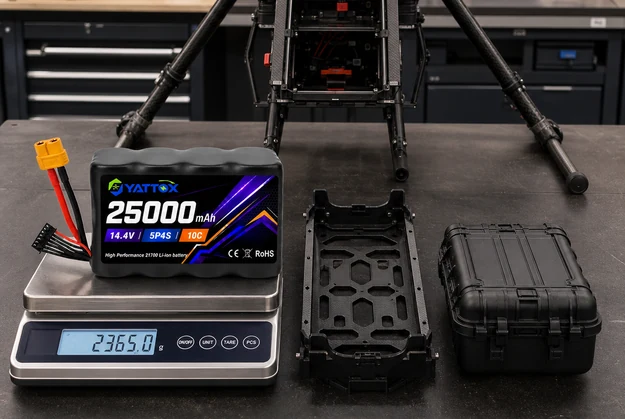
Learn how to size a heavy-lift drone battery from payload, measured current, usable energy, voltage, reserve and real-load testing.
Table of Contents
A heavy lift drone battery should be sized from measured power demand, not from payload mass or capacity alone. The practical sequence is to define the complete takeoff mass, estimate voltage and current across the mission, calculate usable energy with a reserve, and then validate the result under real load. A pack that looks large enough in amp-hours can still be unsuitable if it is too heavy, sags at takeoff, overheats, or cannot deliver the required peak current.
Key takeaways
- Size the battery against all-up weight and the complete mission profile, including takeoff, climb, hover, cruise, payload work, wind correction, and landing reserve.
- Use watt-hours for endurance and amperes for power delivery. Amp-hours alone cannot compare packs on different voltage platforms.
- Check continuous current, short-duration peak current, voltage sag, connector and cable limits, thermal rise, and pack mass together.
- Treat every calculation as a starting point. Instrumented ground and flight tests are required before operational use.
Why payload changes battery sizing so quickly
Payload affects more than the number printed on a cargo specification. Adding mass increases the thrust needed to hover, and producing that thrust increases electrical power demand. The larger battery selected to supply that energy then adds still more mass. This feedback loop is why doubling capacity rarely doubles the flight time of a multirotor.
Start with all-up weight: airframe, propulsion system, landing gear, avionics, payload mounting hardware, payload, battery, cables, connectors, and any required protective enclosure. Battery mass must be included in every iteration. Center-of-gravity position and payload drag also matter because an unbalanced or aerodynamically awkward aircraft may require unequal motor output and more corrective power.
Research on multicopter range and endurance models likewise treats aerodynamics, motors, and the battery as a coupled system rather than independent specifications. The practical lesson is simple: a heavy payload drone battery cannot be selected accurately from a generic flight-time chart.
Build a mission power profile before choosing capacity
A useful battery estimate begins with current or power across each mission segment. At minimum, record or estimate takeoff and climb, loaded hover, forward flight, payload operation, maneuvering, descent, and reserve. The highest current often occurs during takeoff, climb, gust response, or an aborted approach, while the longest segment may be loaded hover or cruise.
Bench thrust data can provide an early estimate, but it should be corrected for the actual propeller, motor, ESC, air density, temperature, wiring, and aircraft geometry. For an existing prototype, logged voltage and current from representative flights are more valuable than catalog figures. Measure at the battery output so the data includes the demand of the whole aircraft, not just one motor.
Average current and peak current answer different questions
Average current determines how quickly usable capacity is consumed. Peak current determines whether the pack, leads, connector, power distribution, and cells can support the most demanding moment without excessive voltage sag or heat. Both limits must pass.
For a multi-pack system, do not assume current sharing will be perfectly equal. Differences in state of charge, resistance, temperature, cable length, and connector condition can make one pack carry more load. Parallel configurations require compatible packs and an engineered current-sharing and fault strategy.
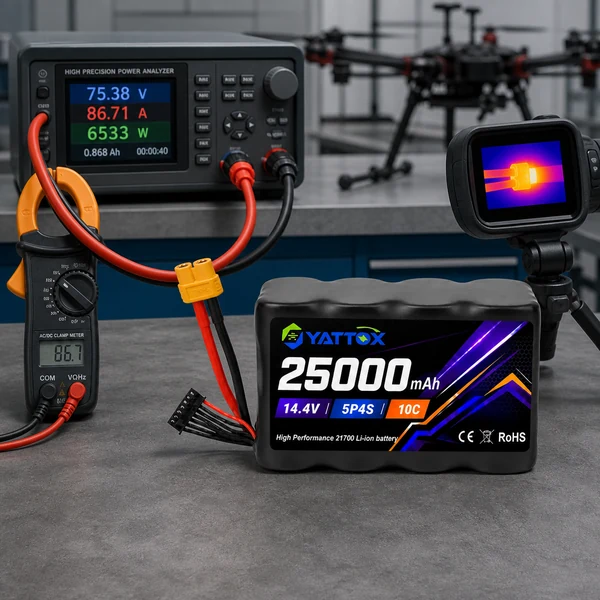
How to calculate heavy lift drone battery energy in watt-hours
Energy is the correct basis for flight-time sizing. Convert a candidate pack to nominal watt-hours with:
Nominal energy (Wh) = nominal voltage (V) × rated capacity (Ah)
For a first estimate using measured average power:
Required usable energy (Wh) = average mission power (W) × target flight time (hours)
If current is used instead:
Required capacity (Ah) = average current (A) × target flight time (hours)
These equations are only the starting point. Rated capacity is normally measured under defined conditions that may not match a high-discharge UAV mission. Usable energy is reduced by reserve policy, voltage cutoff, temperature, aging, current-related voltage drop, and conversion losses. A high capacity drone battery therefore needs to be compared by installed usable energy, not by the largest mAh figure. Do not plan to consume the full nameplate capacity in normal flight.
A worked sizing example
Suppose instrumented tests indicate that a loaded aircraft averages 4.8 kW during its representative mission and the target airborne time is 18 minutes. The ideal energy calculation is 4.8 kW × 0.30 h = 1.44 kWh. If the operating plan allows only 80% of nominal energy to be used, the initial nominal requirement becomes 1.44 ÷ 0.80 = 1.80 kWh before other project-specific derating.
At a nominal 44.4 V platform, 1.80 kWh corresponds to roughly 40.5 Ah. That number is not yet a battery specification. The engineering team must add the proposed pack mass to the aircraft model, recalculate power demand, verify maximum current and voltage limits, and repeat until the result converges. The example illustrates the method; it is not a universal recommendation.
Choose voltage to control current and system losses
For the same electrical power, a higher voltage reduces current because power is approximately voltage multiplied by current. Lower current can reduce resistive loss and ease the burden on cables and connectors, but only when the motors, ESCs, flight controller power supply, charger, contactors, insulation, and monitoring hardware are rated for that voltage.
Voltage should therefore be chosen at the propulsion-system level, not changed simply to make the battery calculation look better. Confirm the fully charged voltage, not only nominal voltage. A 12S lithium-polymer platform, for example, reaches a higher voltage at full charge than its nominal figure suggests, and every component must tolerate that maximum.
Yattox lists multiple voltage platforms and customizable cable, connector, capacity, and discharge options in its drone battery solutions. Those options are most useful after the aircraft team has established its real voltage window and load profile.
Verify discharge capability without relying on C-rating alone
A high discharge drone battery must supply continuous and transient current while maintaining acceptable terminal voltage and temperature. The familiar estimate is:
Current capability (A) = capacity (Ah) × C-rating
However, the calculated result should not be treated as proof. C-rating test methods and practical conditions vary, while connector resistance, cell matching, pack temperature, state of charge, and aging all influence delivered power. Ask for the conditions behind the rating and validate the complete pack at realistic current.
Inspect the entire current path: cell tabs, busbars, protection devices, cable gauge and length, solder or crimp joints, connectors, and power distribution. A high-discharge drone battery can still be limited by a warm connector or an undersized lead. Temperature should be logged at several locations during a representative duty cycle, not checked only by touch after landing.
Why the largest battery may shorten flight time
Increasing capacity helps only while the additional usable energy is worth more than the extra mass and volume. Once the pack forces higher hover thrust, changes the center of gravity, blocks airflow, or requires stronger mounting structure, the gain can become small or negative.
Compare candidate packs by installed usable energy, not nameplate capacity alone. For each option, update takeoff mass, estimate the new hover and mission power, apply the same reserve and derating assumptions, then compare predicted flight time. Packaging should also leave secure restraint, cable bend radius, cooling, inspection access, and safe separation from moving parts.
The existing Yattox guide on choosing batteries for different UAV applications explains the broader chemistry and mission-selection context. Heavy-lift sizing narrows that decision to the coupled mass, current, and endurance problem.
Validate the battery under the real payload
Calculation should be followed by staged validation. Begin with inspection and electrical checks, continue with restrained propulsion or approved ground testing, and then expand the flight envelope gradually under controlled conditions. A published heavy-lifting UAV design methodology provides further context for treating current draw, capacity, payload and aircraft design as connected inputs. The exact test process must follow the aircraft manufacturer's procedures, applicable regulations, test-site rules, and the engineering team's risk assessment.
- Confirm pack dimensions, mass, mounting, center of gravity, polarity, connector engagement, cable routing, and full-charge voltage.
- Verify telemetry calibration against independent voltage and current measurements.
- Test representative sustained current and short peaks while logging pack voltage, cell behavior where available, and temperature.
- Conduct low-risk flights with incremental payload and duration increases rather than immediately attempting the target mission.
- Review remaining energy, voltage sag, temperature, motor and ESC margins, and pack-to-pack consistency after every test.
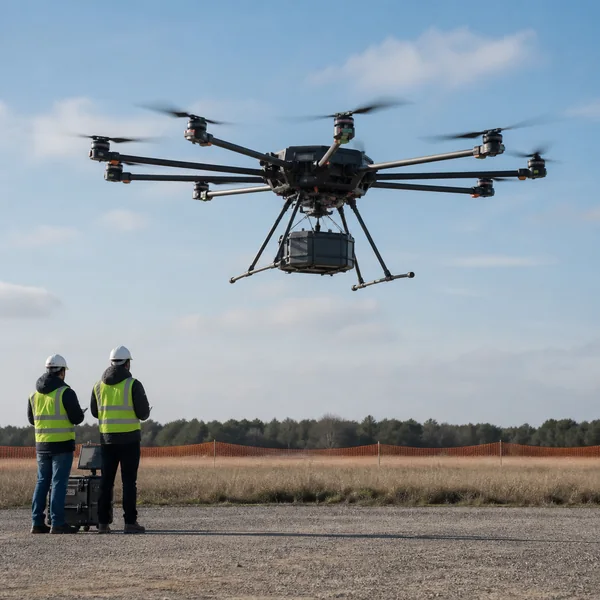
Set return-to-home and landing thresholds from tested behavior under load, not from an unloaded bench voltage. Wind, temperature, battery age, route changes, and a go-around can all consume the planned margin. The battery is acceptable only when it meets endurance and power requirements repeatedly, not when one best-case flight reaches the target.
Information to prepare for a custom heavy-lift drone battery
A productive supplier review starts with engineering inputs: aircraft type, takeoff mass range, payload range, target flight time, motor and ESC limits, nominal and maximum voltage, measured average and peak current, duty cycle, available battery envelope, maximum pack mass, connector, cable length and gauge, operating temperature, charging workflow, expected cycle frequency, and applicable transport or certification requirements.
Yattox's UAV battery application capabilities include configurable voltage, capacity, discharge rate, dimensions, structural design, cable gauge, cable length, and connector type. Matching those parameters to measured aircraft data is more reliable than selecting a large drone battery or industrial drone battery from capacity alone.
FAQ
How much reserve should a heavy-lift drone carry?
There is no universal percentage. Reserve must reflect aircraft behavior, battery chemistry, payload, weather, route, battery age, operating procedures, and regulatory requirements. Define it through risk assessment and validated flight data, then apply it consistently to usable-energy calculations.
Should flight time be calculated with nominal or loaded voltage?
Nominal voltage is useful for comparing nameplate energy, but performance modeling should include the voltage actually observed under load. Loaded voltage changes with current, state of charge, temperature, internal resistance, and aging, and it determines whether the propulsion system can maintain required power.
Can two smaller packs replace one large pack?
They can when the aircraft electrical architecture supports the intended series or parallel configuration. The design must address matched state of charge, current sharing, wiring and connector ratings, pack isolation, fault behavior, monitoring, mounting, and the effect on center of gravity. Do not combine packs casually.
Final selection rule
The right heavy-lift drone battery is the lightest practical pack that meets the verified energy, continuous current, peak current, voltage, thermal, packaging, and reserve requirements of the complete mission. Calculate with watt-hours, iterate with battery mass included, and approve the result only after controlled testing with the real payload.