


How to Choose the Right Drone Battery for Different UAV Applications?
July 28, 2026
This guide explains how to match battery chemistry and pack specifications to the UAV’s actual mission. It also covers capacity calculation, current demand, installation limits, real-load performance, safety, and shipping requirements to support a more reliable battery selection process.
Table of Contents
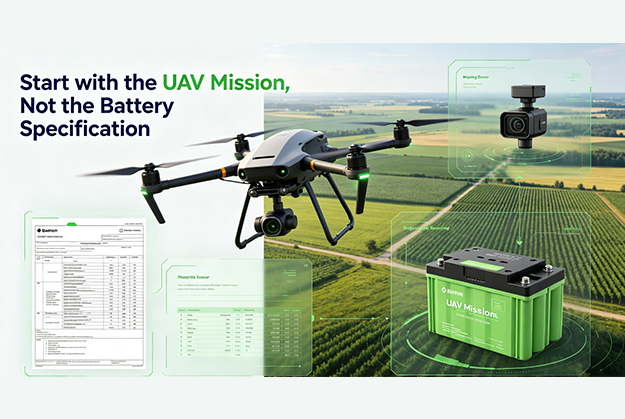
Start with the UAV Mission, Not the Battery Specification
A suitable drone battery should be selected around the UAV’s actual mission rather than the highest capacity or C-rate shown on a datasheet. FPV racing, inspection, mapping, agriculture, and heavy-lift operations place very different demands on the battery, so the same specification will not perform equally well across every platform.
1.Flight Profile
The way a UAV flies has a direct effect on current demand. Fixed-wing cruising generally favors efficient energy use, while hovering requires steady power over a longer period. Vertical takeoff, rapid acceleration, heavy-load climbing, and operation in strong winds place greater stress on the battery and may call for stronger continuous and peak discharge performance.
Defining the flight profile first helps narrow down the appropriate voltage, chemistry, capacity, and C-rate.
2.Payload and Required Endurance
Cameras, LiDAR sensors, spraying systems, communication equipment, and cargo all increase takeoff weight and motor demand. As the payload rises, more energy is needed to maintain lift, leaving less available for useful flight time.
Increasing battery capacity can extend endurance, but the added weight may offset part of that benefit. The aim is to select a UAV battery that meets the required flight time without exceeding the aircraft’s weight limit or reducing overall efficiency.
3.Operating Conditions and Duty Cycle
Battery behavior also changes with the working environment. Cold temperatures can reduce usable capacity, high altitude may increase propulsion demand, and repeated missions place greater emphasis on cycle life, charging time, and cell consistency.
These conditions should be considered before finalizing the battery pack. A drone battery matched to the real operating environment will usually perform more reliably than one selected from nominal specifications alone.
Five Key Drone Battery Specifications for UAV Selection
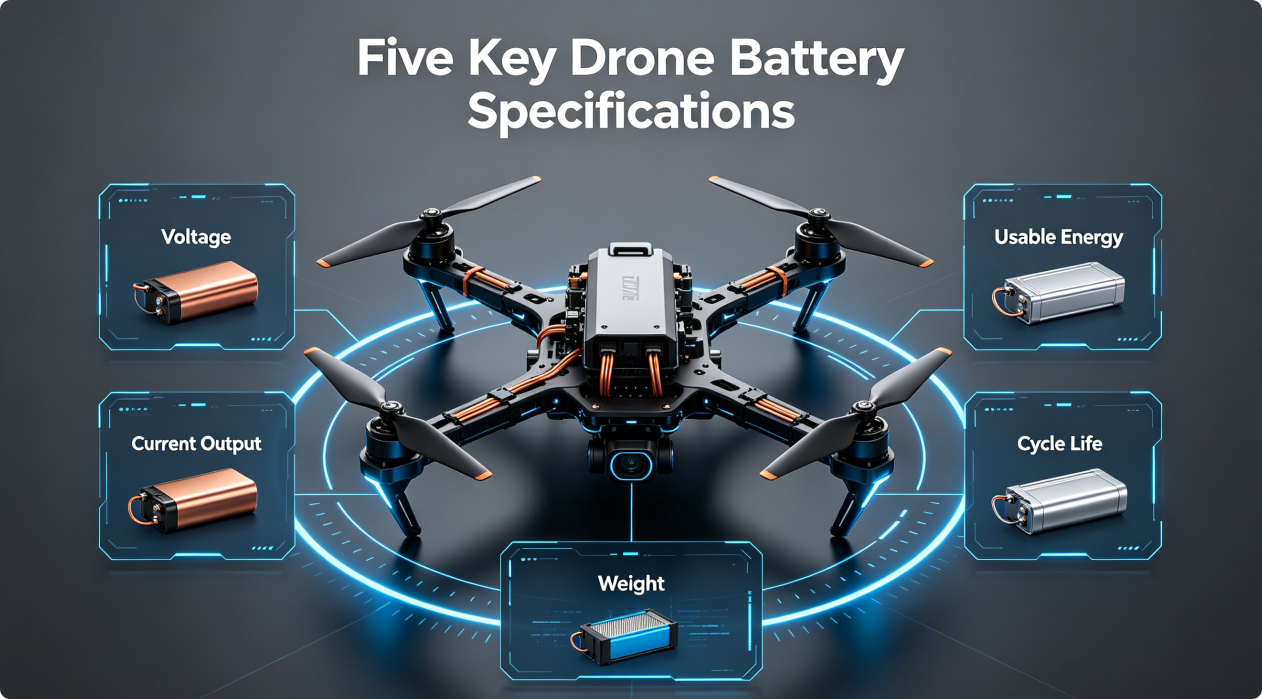
Choosing a UAV battery is not about finding the highest number on a datasheet. Voltage, usable energy, current output, weight, and service life all need to work together with the aircraft’s propulsion system and mission requirements.
1.Voltage and Cell Count
The battery voltage must be compatible with the motor, ESC, flight controller, and other onboard electronics. Increasing the number of cells in series may support a higher-voltage propulsion system, but it also changes the charger, wiring, component limits, and overall pack design.
An unsuitable voltage can cause poor thrust, excessive current draw, overheating, or electrical damage. For this reason, the required series count should come from the UAV power-system design rather than from battery capacity alone.
2.Capacity and Usable Energy
The mAh rating shows stored charge, but it is not enough to compare drone batteries operating at different voltages. Watt-hours provide a clearer picture of total energy because they combine voltage and capacity.
More capacity can extend endurance, although the additional cells also add weight. Once the pack becomes too heavy, part of the extra energy is spent carrying the battery itself. The better choice is the capacity that meets the mission duration while keeping the aircraft within its efficient operating range.
3.Continuous and Peak Discharge Current
Hovering, cruising, and long-duration operation depend mainly on continuous current capability. Takeoff, rapid climbing, sudden acceleration, strong winds, and heavy payloads create short periods of much higher demand.
A large C-rate printed on the label does not tell the whole story. Internal resistance, voltage stability, temperature rise, cable size, and connector capacity determine how well the complete UAV battery pack performs under load.
4.Energy Density and Complete Pack Weight
Energy density is particularly important for inspection, mapping, fixed-wing, and long-endurance UAVs, where every gram affects range and useful payload. A higher-energy cell can store more power within a limited weight or volume, but cell-level figures do not represent the finished battery.
Wiring, connectors, insulation, protection components, enclosures, and structural reinforcement all contribute to pack weight. Comparing complete battery specifications gives a more realistic view of what the aircraft will actually carry.
5.Cycle Life and Long-Term Operating Cost
Industrial drone batteries are used repeatedly, so purchase price is only one part of their cost. As a battery ages, capacity may decline, internal resistance can rise, and voltage under load may become less stable.
For UAVs operating several missions each day, capacity retention and replacement frequency can matter more than a lower initial price. A battery that maintains consistent output over more working cycles may reduce downtime and provide better value across the life of the aircraft.
How to Calculate UAV Battery Requirements from Aircraft Data
A reliable UAV battery specification should come from measured aircraft data rather than a general product label. The most useful inputs are system voltage, average power demand, short-term load peaks, mission duration, and the physical limits of the airframe.
Step 1: Set the Voltage Platform
The motor and ESC determine the battery’s basic voltage range, while the flight controller and onboard equipment must also remain within their rated limits. Once the voltage platform is fixed, the required series configuration becomes clear.
This step should be completed before the battery enclosure is finalized, since adapting the electrical system to an existing battery shape often leads to unnecessary compromises.
Step 2: Use Real Flight Current
Normal operating current is best taken from hover or cruise tests rather than from the maximum motor specification. Sensor systems, cameras, communication equipment, and other auxiliary loads should be included in the total.
For multirotor UAVs, hover data often provides the most practical baseline because it reflects the current the aircraft will draw through a large part of the mission.
Step 3: Record Short-Term Power Peaks
Maximum demand usually appears during takeoff, rapid ascent, strong wind correction, or full-payload operation. Although these peaks are brief, they reveal whether the battery can maintain stable output when the propulsion system is under the greatest stress.
Measured peak current should be used to review the complete power path, including the cells, internal conductors, cable, and connector.
Step 4: Calculate an Initial Capacity
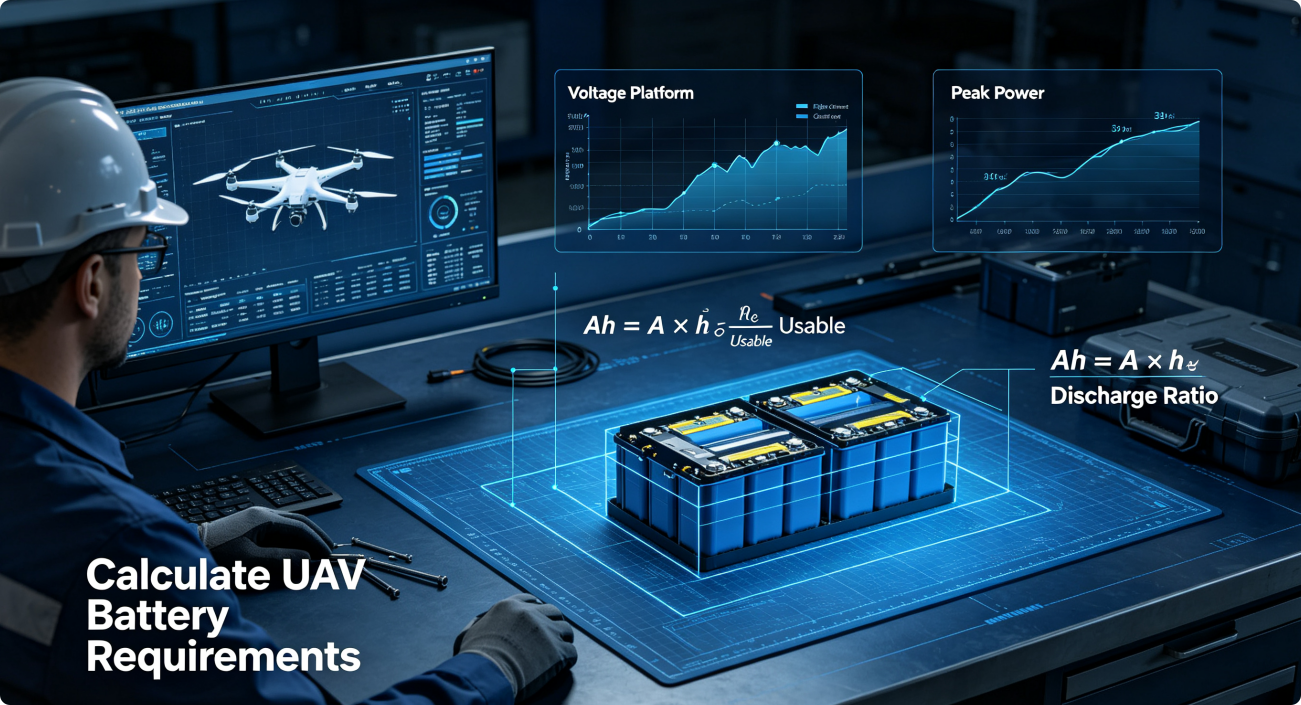
A starting capacity can be estimated with the following formula:
Estimated Capacity (Ah) = Average Current (A) × Flight Time (h) ÷ Usable Discharge Ratio
The usable discharge ratio keeps a reserve for safe landing and unexpected load changes. The result is a planning value, so it should be adjusted after actual mission tests rather than treated as a guaranteed flight-time figure.
Step 5: Confirm the Pack Can Be Integrated
Electrical performance alone does not determine whether a battery is suitable. The finished pack must also fit the battery bay, stay within the aircraft’s weight budget, and maintain an acceptable center of gravity.
Yattox’s 14.4V 25000mAh 5P4S battery is approximately 110 × 89 × 80mm and 1600g, while its 21.6V 20000mAh 4P6S configuration is approximately 132 × 89 × 80mm and 1920g. These figures illustrate how a different series-parallel arrangement changes the final dimensions and mass of the battery, even within the same product family.
Step 6: Size the Power Connection
Cable gauge and connector selection should be based on current, cable length, and expected temperature rise. A connection that is physically compatible may still create excessive resistance under load.
Both continuous operation and brief current peaks need to remain within the safe capability of the connection system.
The final specification should be validated through bench testing, hover testing, temperature checks, and representative mission flights before moving to production.
Match Drone Battery Chemistry to UAV Power Demand
Drone Battery Type | Main Strength | Main Limitation | Best-Suited UAV Applications |
LiPo Battery | Delivers high discharge current and rapid power response | Lower energy density and faster performance decline under demanding use | FPV racing, freestyle drones, rapid acceleration, and heavy-load takeoff |
Cylindrical Li-ion Battery | Provides higher capacity and efficient energy storage for extended operation | Capacity-focused cells may offer lower burst output than high-rate LiPo batteries | Inspection drones, mapping UAVs, fixed-wing aircraft, and long-range missions |
Semi-Solid-State Battery | Offers higher energy-density potential and improved thermal stability | Higher cost and discharge capability that varies by cell design | Long-endurance UAVs, high-value industrial platforms, and weight-sensitive missions |
Why a Larger Drone Battery May Not Deliver Longer Flight Time
More battery capacity does not always produce a matching increase in UAV endurance. As the pack becomes larger, the aircraft must carry additional mass throughout the entire mission, and part of the stored energy is consumed simply to support that extra weight.
Every UAV therefore has an efficient battery range. Below that range, capacity may be insufficient for the required mission. Above it, the added energy may bring only a small endurance gain while reducing payload allowance, affecting balance, or making the aircraft less responsive.
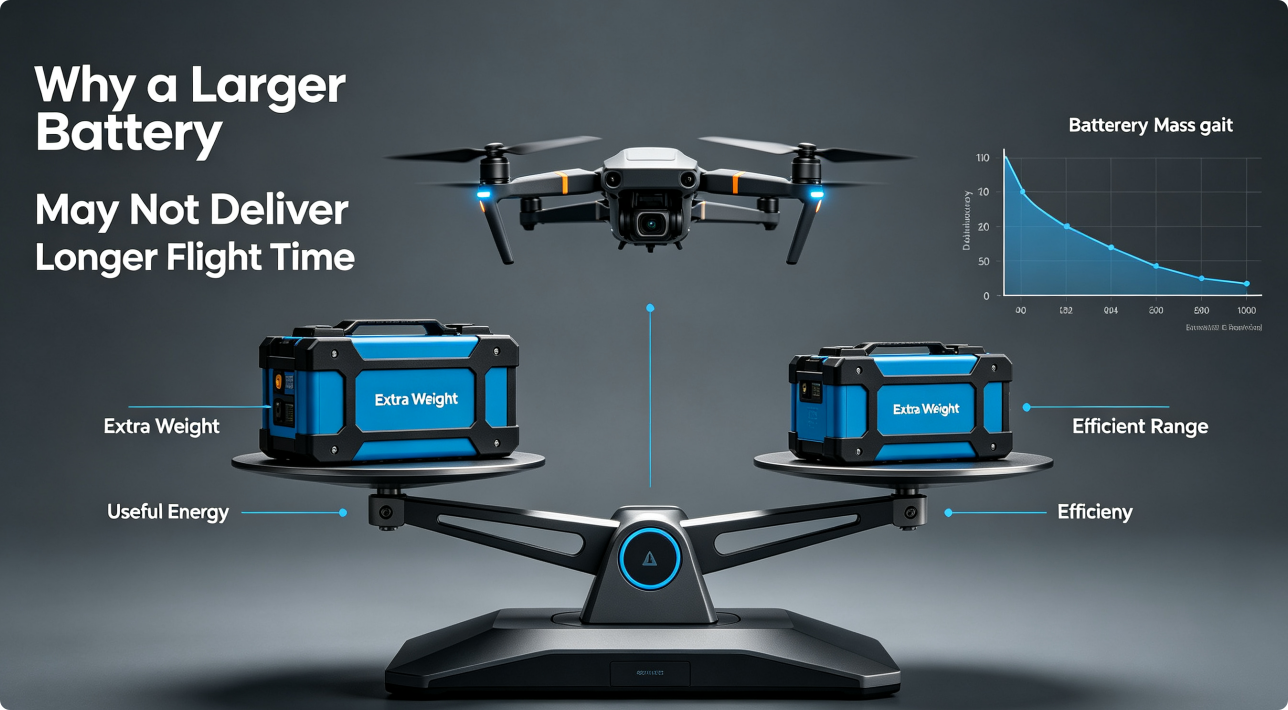
This is why drone batteries should be evaluated by actual mission performance rather than mAh alone. Comparing complete pack weight, usable energy, and tested flight duration provides a clearer picture of which configuration works best for the aircraft.
The right drone battery is the one that meets the required flight time with the least unnecessary weight and the fewest compromises to overall UAV performance.
Check Drone Battery Stability Under Real Load
A drone battery may appear suitable on paper but behave very differently once the UAV reaches takeoff, climb, hover, or full-payload conditions. Real-load testing helps reveal problems that nominal voltage, capacity, and C-rate figures cannot show on their own.
1.Voltage Sag
When current demand rises, resistance inside the battery pack causes the output voltage to drop. If the drop is too large, the UAV may trigger a low-voltage warning earlier than expected, even when some capacity remains available. Severe voltage sag can also reduce motor response during takeoff or rapid climbing.
2.Temperature Rise
Heat builds up when a battery operates under sustained load. Moderate warming is normal, but a rapid or excessive temperature increase may indicate high resistance, insufficient current capability, or poor heat dissipation. Repeated overheating can accelerate aging and reduce the stability of future flights.
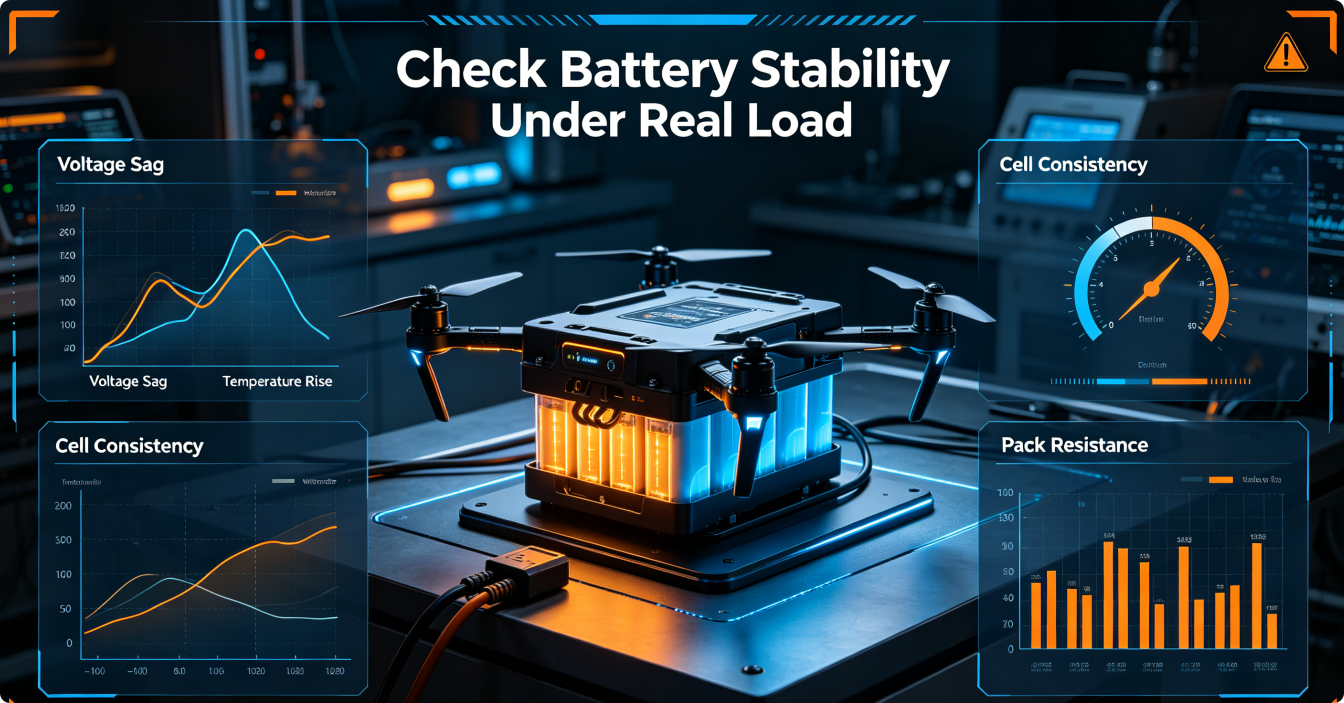
3.Cell Consistency
Cells connected in series do not always discharge at exactly the same rate. A weaker cell may reach its lower voltage limit before the others, restricting the usable energy of the entire pack. Good cell matching helps keep voltage differences under control and supports more predictable performance across repeated missions.
4.Pack-Level Resistance
Battery performance depends on the complete current path, not only the selected cells. Nickel or copper connections, weld points, cables, terminals, and connectors all add resistance. Evaluating the finished drone battery pack under load provides a more accurate result than relying on cell specifications alone.
Drone Battery Safety, Certification, and Shipping Requirements
Safety and compliance should be addressed before a UAV battery design is finalized. Depending on the pack architecture and application, the protection system may need to cover overcharge, over-discharge, overcurrent, and short-circuit conditions.
International transport normally requires UN38.3 test documentation together with an SDS or MSDS covering battery chemistry, handling, storage, and emergency response. Yattox can provide relevant UN38.3 support for qualified products, helping customers prepare lithium batteries for air, sea, or land transportation. High-capacity drone batteries may also be treated as dangerous goods, which affects packaging, labeling, carrier acceptance, and shipping documents.
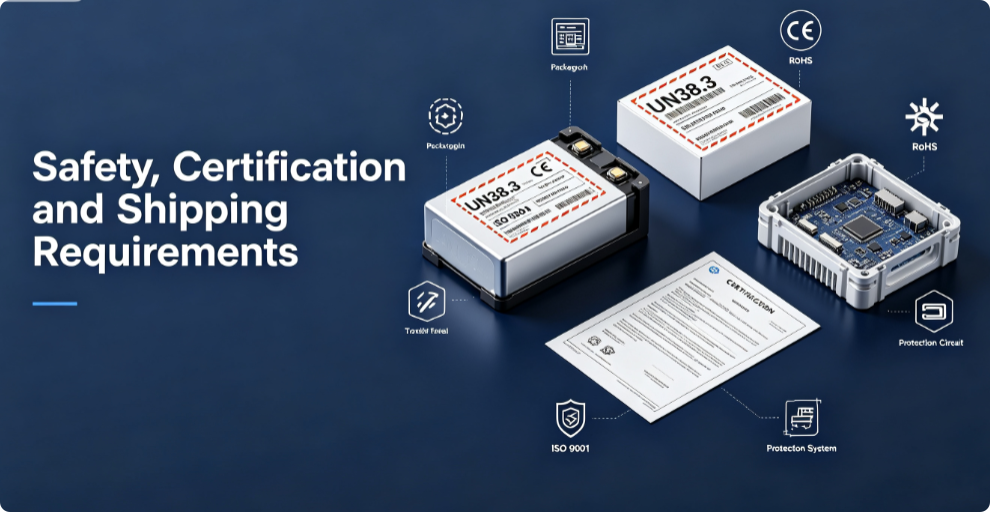
Market-entry requirements vary by region. CE and RoHS documentation can support access to selected overseas markets, while product labels, specifications, and test reports need to remain consistent throughout customs and logistics procedures. Yattox’s production and quality processes are managed under ISO 9001, ISO 14001, and ISO 45001 systems, providing additional control over product quality, environmental responsibility, and workplace safety.
Conclusion
The right drone battery is the one that fits the aircraft’s mission, propulsion system, available space, and operating conditions. Voltage, usable energy, discharge capability, pack weight, cell consistency, and cycle life must be evaluated together rather than treated as separate specifications.
Contact Yattox to discuss a drone battery solution tailored to your UAV platform and mission needs.