


Which Battery Should I Get for My Drone?
June 29, 2026
This guide provides a complete FPV drone battery selection framework, helping you choose the most suitable battery based on drone type, usage scenario, and performance requirements.
Table of Contents
Battery Types Comparison: LiPo vs Li-ion vs LiHV vs Solid-state
Battery Type | Key Feature | Best For | Advantages | Limitations |
LiPo | High power output | FPV racing & freestyle drones | High discharge rate, strong burst power, widely used standard | Shorter flight time, requires careful handling |
Li-ion | Energy density focused | Long-range & endurance drones | Longer flight time, lighter discharge stress, stable performance | Lower burst power, not ideal for aggressive flying |
LiHV | Higher voltage per cell | Performance-optimized FPV drones | Slightly higher voltage, improved efficiency and power output | Requires compatible charger, slightly reduced cycle life |
Solid-state | Emerging high-safety tech | Future drone systems | Higher safety, potential higher energy density, better stability | Still not widely available, higher cost, limited adoption |
Voltage Guide: 1S, 2S, 4S, 6S Explained
1S and 2S batteries are used in small drones and toy-class models, where low power output and simple indoor flying are the main requirements.
4S batteries are widely used in beginner FPV drones and light builds. They offer a balanced mix of power and control, making them a common entry-level choice.
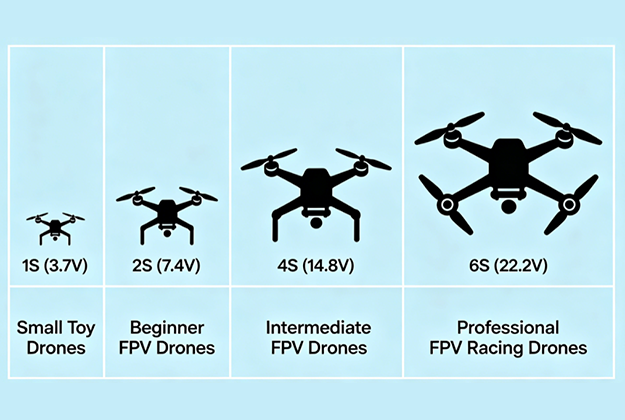
6S batteries are the standard for professional FPV drones. They provide higher voltage, better efficiency, and more stable power delivery, making them ideal for racing and freestyle flying.
In general, higher voltage systems deliver stronger performance and improved energy efficiency for demanding flight conditions.
What Does C Rating Mean?
The C rating indicates how quickly a battery can safely discharge energy during use.
A higher C rating provides stronger burst power, which is important for racing and aggressive FPV flying.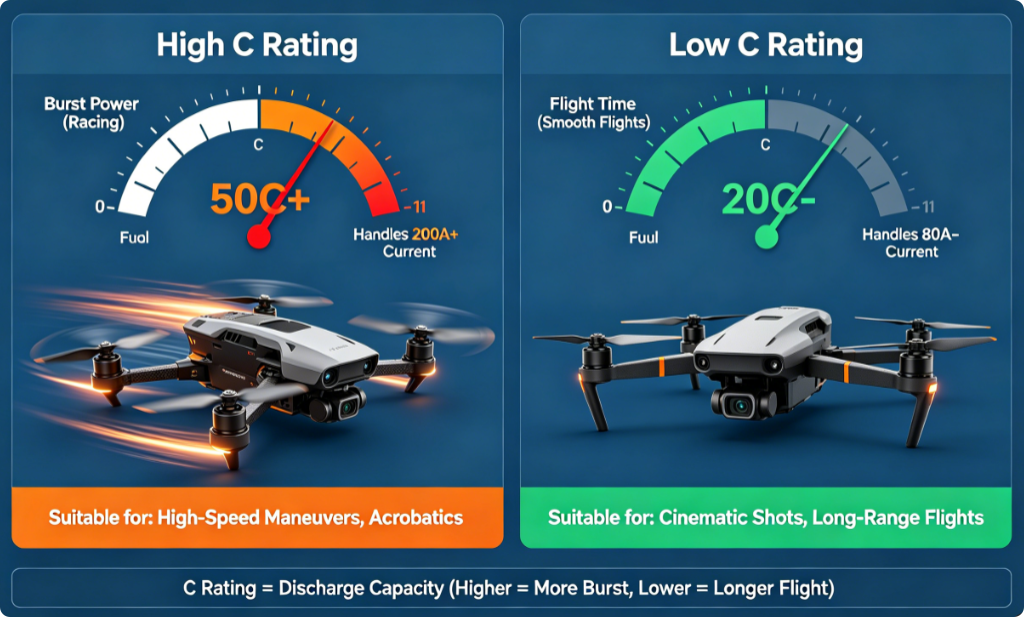
A lower C rating focuses on efficiency and longer flight time, making it better for smooth and stable flights.
The right C rating depends on your drone type and flying style, helping you balance power output and battery endurance.
FPV Drone Battery Capacity: Is Higher mAh Always Better?
Higher mAh means a larger FPV drone battery capacity, which can extend flight time by storing more energy. However, a higher capacity battery also increases overall weight, which can reduce flight agility and responsiveness, especially in racing or freestyle FPV drones.
In FPV drone battery selection, an oversized high-mAh battery may also reduce overall efficiency because the drone needs more power to carry the extra weight. In some cases, this can offset the expected flight time gains.
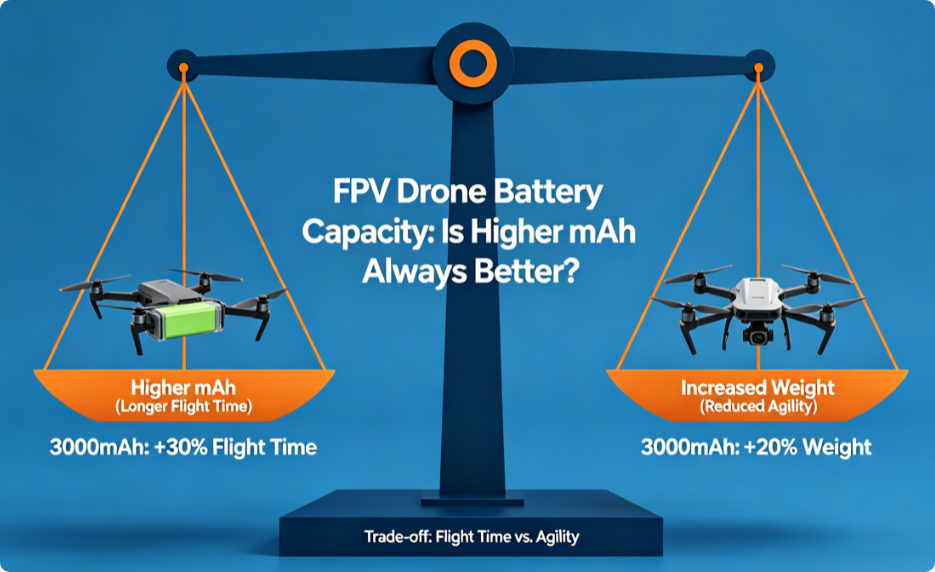
Therefore, choosing the right FPV drone battery capacity is about balancing flight duration, performance, and drone size, rather than simply selecting the highest mAh available.
FPV Drone Battery Size & Weight Matching
1.Drone Size vs Battery Capacity Recommendation
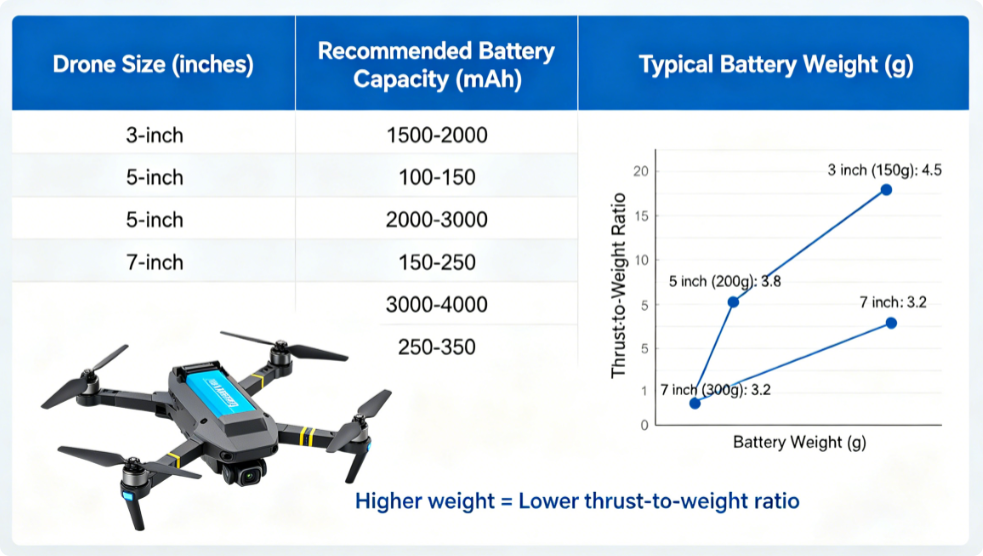
Choosing the correct FPV drone battery size depends on the drone frame and power system, as different drone sizes require different energy levels for optimal performance.
Drone Size | Recommended Battery Capacity | Typical Use Case |
3-inch drones | 450–650mAh | Lightweight, indoor flying, high agility builds |
5-inch drones | 1300–1500mAh | Standard FPV drones, freestyle and general use |
7-inch drones | 1800–3000mAh | Long-range flights and endurance setups |
2.Weight Impact on FPV Drone Flight Performance
Battery weight is a key factor in FPV drone performance because it directly influences the thrust-to-weight ratio. While a heavier FPV drone battery can increase energy storage and potentially extend flight time, it also adds extra load to the motors, requiring more power to keep the drone stable in the air.
This trade-off often results in reduced agility and slower response, particularly in racing and freestyle FPV drones where precise control and fast maneuvering are essential.
In FPV drone battery selection, the key is to balance weight, thrust output, and endurance. The most suitable battery is the one that matches the drone’s frame limits and power system efficiency, ensuring stable flight performance without unnecessary performance loss.
Battery Recommendations for Different Drone Types
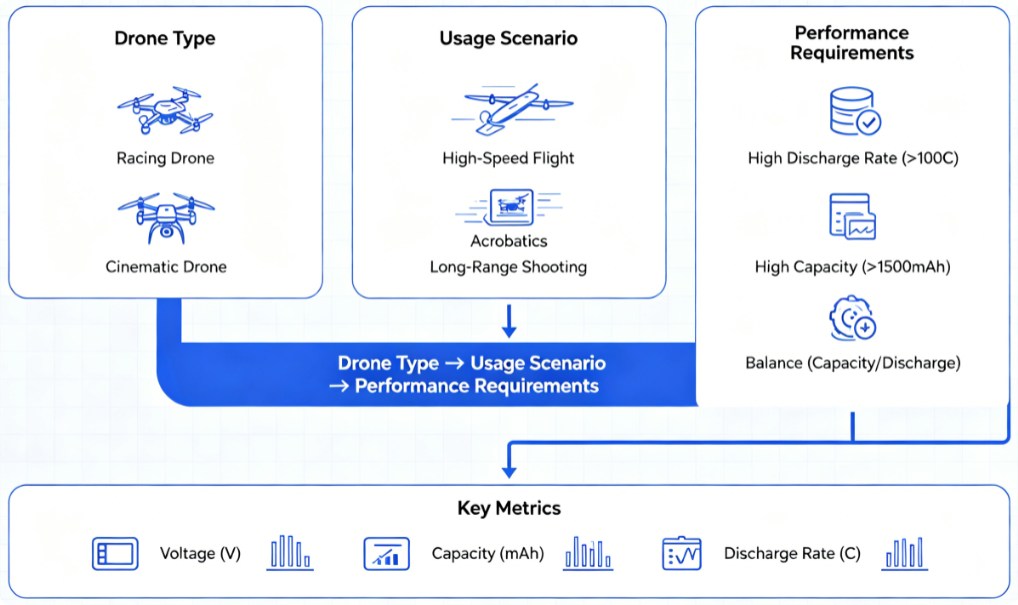
FPV drone battery selection should be based on flight purpose and operating scenario rather than capacity alone, as different use cases require different balances of power, weight, and endurance.
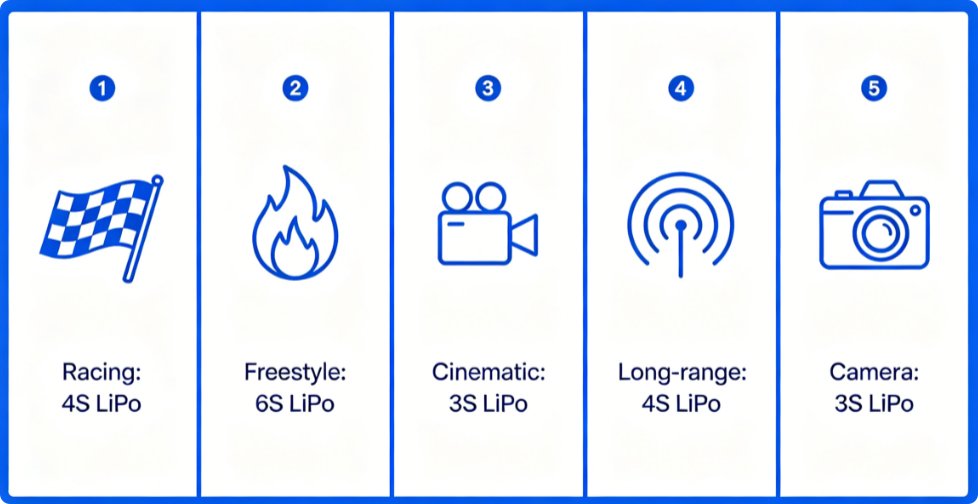
1.Racing FPV drones → Small, high-C LiPo batteries designed for maximum burst power and fast throttle response
2.Freestyle FPV drones → 6S 1300–1500mAh LiPo batteries offering a balanced mix of power, control, and flight time
3.Cinematic FPV drones → Medium-capacity batteries optimized for smooth power delivery and stable, low-vibration flight performance
4.Long-range drones → High-capacity Li-ion battery packs focused on maximizing endurance and flight distance
5.Camera drones → Energy-efficient Li-ion or hybrid LiPo systems designed for longer recording time and consistent stability
How to Choose the Right FPV Drone Battery
Choosing the right FPV drone battery is a system-level decision that directly impacts flight time, performance, handling, and safety. Instead of relying on a single specification, it is important to evaluate multiple factors together to achieve the right balance between power, efficiency, and compatibility.
1.Identify your drone type and frame size
Drone size defines the practical battery range. Smaller 3-inch builds require lightweight batteries to preserve agility, while 5-inch FPV drones typically perform best with 1300–1500mAh packs. Larger 7-inch or long-range platforms need higher-capacity batteries, but the final choice must still respect the drone’s payload limits to avoid performance loss.
2.Match voltage to your power system (1S–6S)
Voltage must be compatible with the motor KV rating and ESC configuration. Lower-voltage setups (1S–4S) are used for smaller or beginner drones with smoother output characteristics, while 6S systems are standard in high-performance FPV builds, offering better efficiency, stable voltage under load, and improved throttle response. Incorrect voltage matching can reduce efficiency or damage components.
3.Select the right capacity (mAh)
Capacity determines total energy storage and flight duration, but increasing mAh also increases weight. Oversized batteries may provide longer theoretical flight time but can reduce real-world efficiency due to higher power demand. The optimal choice is the point where added capacity no longer delivers meaningful gains in flight time relative to weight.
4.Choose the correct C rating
C rating indicates how much current the battery can safely deliver. Higher C-rated batteries are better suited for racing and freestyle FPV, where rapid throttle changes and burst power are required. Lower C ratings are more efficient for smooth cruising and cinematic flights with less aggressive power demand.
5.Check physical size and mounting fit
Beyond electrical specifications, physical compatibility is essential. The battery must fit securely within the frame, strap system, and mounting area. Poor fit can cause movement during aggressive maneuvers, negatively affecting stability and increasing crash risk.
6.Balance weight with thrust output
Battery weight directly affects thrust-to-weight ratio and overall flight behavior. Heavier batteries increase inertia and reduce responsiveness, even if flight time improves. The best configuration maintains a balance between endurance and agility without pushing the drone beyond its optimal performance range.
7.Ensure connector compatibility
Connector type (such as XT30, XT60, or XT90) must match the drone’s current requirements. Undersized connectors can introduce resistance, heat, and power loss under load, while properly matched connectors ensure stable and efficient power delivery during high-demand flight conditions.
Conclusion
Whether you prioritize racing performance, long-range endurance, or cinematic stability, the right battery choice directly impacts flight efficiency and safety. By understanding these key principles, you can significantly improve both flight experience and equipment lifespan.
For reliable FPV drone battery solutions and professional support, contact Yattox to find the most suitable power system for your drone applications and performance needs.