


Semi-Solid State Vs. Lithium-Ion Batteries: Key Differences, Pros, Cons, And Applications
June 29, 2026
As battery technology continues to develop, semi-solid state batteries are becoming an important option alongside traditional lithium-ion batteries. Both are lithium-based rechargeable batteries, but they are designed differently and perform differently in real applications. For users choosing batteries for UAVs, EVs, energy storage, robotics, or industrial equipment, understanding these differences can make battery selection more practical and reliable.
Table of Contents
What Is a Semi-Solid State Battery?
A semi-solid state battery is a rechargeable battery that uses a gel-like, slurry-like, or semi-solid electrolyte instead of a fully liquid electrolyte. It is considered a middle-stage battery technology between traditional lithium-ion batteries and fully solid-state batteries. Compared with conventional lithium-ion batteries, its main structural difference lies in the electrolyte form, while the overall battery system still follows a lithium-based energy storage principle.
What Is a Lithium-Ion Battery?
A lithium-ion battery is a rechargeable battery that stores and releases energy through the movement of lithium ions between the positive and negative electrodes. Most conventional lithium-ion batteries use a liquid electrolyte to help ions move inside the cell. It is a mature lithium-based battery technology used in many rechargeable power systems, with different chemistry options such as NMC, LFP, Li-ion packs, and LiPo batteries.
Semi-Solid State vs. Lithium-Ion Batteries: Quick Comparison
Factor | Semi-Solid State Battery | Lithium-Ion Battery |
Electrolyte | Gel-like, slurry-like, or semi-solid electrolyte | Liquid electrolyte |
Safety | Lower leakage risk and improved thermal stability in many designs | Requires strong BMS and thermal protection |
Energy Density | Higher potential energy density | Mature but limited by chemistry and structure |
Cycle Life | Often better in advanced designs | Depends on chemistry, usage, and pack quality |
Charging Performance | Can support safer fast charging in some designs | Mature fast-charging technology is widely available |
Cost | Higher at current stage | Lower and more cost-effective |
Production Maturity | Developing, partly compatible with lithium battery production | Highly mature and widely available |
Best Applications | UAVs, EVs, aerospace, robotics, high-safety systems | Consumer electronics, standard drones, EVs, power tools, storage |
This comparison shows that semi-solid state batteries are not simply “better” in every situation. They are better suited for applications where safety, energy density, weight reduction, and long-term performance are more important than the lowest upfront cost. Lithium-ion batteries remain a practical choice when cost, supply stability, and mature production are the main priorities.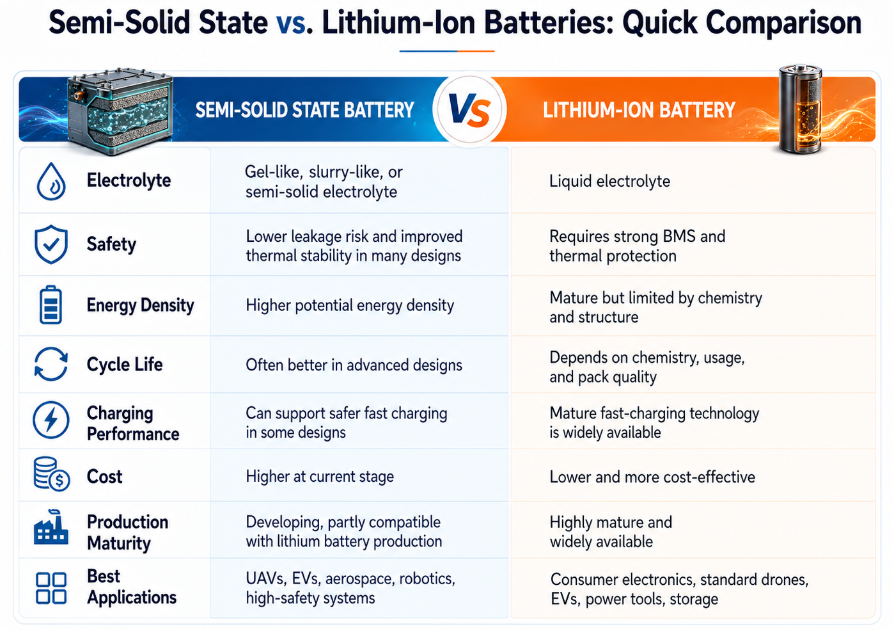
Key Differences Between Semi-Solid State and Lithium-Ion Batteries
Semi-solid state and lithium-ion batteries are both rechargeable lithium-based batteries, but they are built around different electrolyte designs. This difference affects how the battery behaves in safety, energy density, cycle life, charging, cost, and real-world use.
1.Electrolyte Structure
The biggest difference is the electrolyte inside the cell. A conventional lithium-ion battery usually relies on a liquid electrolyte to carry lithium ions between the positive and negative electrodes. This structure is mature and efficient, which is one reason lithium-ion batteries are widely used today.
A semi-solid state battery uses a gel-like or semi-solid electrolyte instead. With less free liquid inside the cell, the battery can have a more stable internal structure. This structural change is the starting point for many of the performance differences between the two battery types.
2.Safety and Thermal Stability
Safety is one of the main reasons semi-solid state batteries are being developed. In a traditional lithium-ion battery, the liquid electrolyte can become a risk factor if the cell is damaged, overheated, overcharged, or poorly controlled. Under severe conditions, problems such as leakage, swelling, fire, or thermal runaway may occur.
Semi-solid state batteries reduce the amount of free liquid electrolyte, which can help lower leakage risk and improve thermal stability. However, this does not mean the battery is completely risk-free. Cell quality, pack structure, BMS protection, charging control, and temperature management still play an important role in overall battery safety.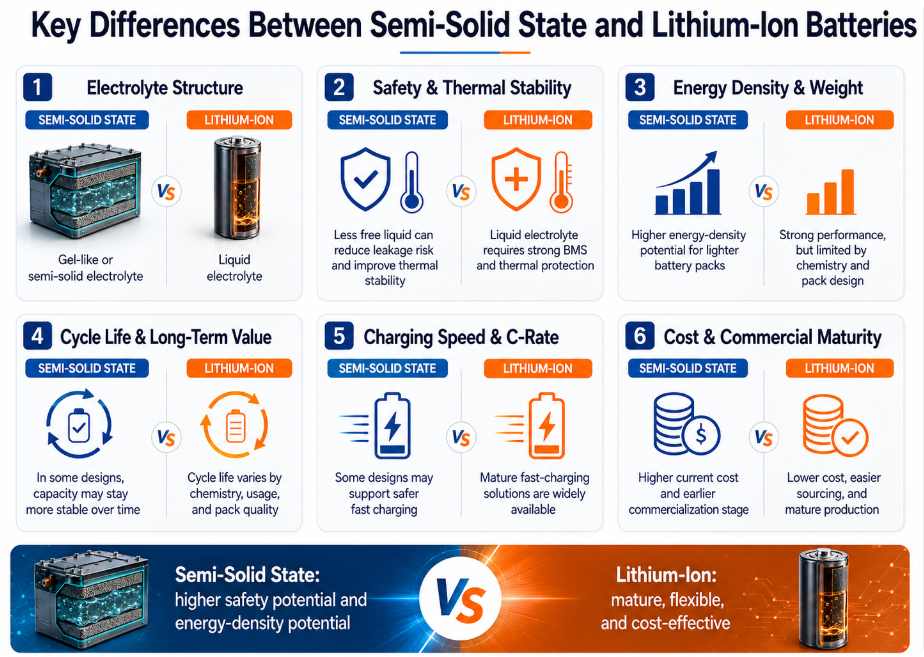
3.Energy Density and Weight
Energy density refers to how much energy a battery can store within a certain weight or volume. This is especially important in systems where every gram matters, such as UAVs, electric vehicles, and portable power equipment.
Semi-solid state batteries often have higher energy density potential than conventional lithium-ion batteries. In a UAV battery pack, this may help increase flight time without making the pack much larger or heavier. Lithium-ion batteries can also deliver strong energy performance, but the result depends on the chemistry, cell format, and pack design.
4.Cycle Life and Long-Term Value
Cycle life shows how long a battery can keep delivering usable capacity after repeated charging and discharging. For equipment that runs frequently, this can matter more than the first purchase price.
Semi-solid state batteries may perform better in some designs because their electrolyte structure can help reduce internal stress and slow down certain types of battery aging. Lithium-ion battery life varies more by chemistry and usage. For example, LiFePO4 batteries are often chosen for long cycle life, while high-discharge LiPo batteries may age faster when used under heavy current or aggressive charging conditions.
When comparing the two battery types, it is better to look at the full service life instead of only the unit price. A battery that keeps capacity more stable and needs fewer replacements may offer better value over time.
5.Charging Speed and C-Rate
Charging performance is not decided by battery type alone. A semi-solid state battery is sometimes described as faster-charging, but the real charging speed depends on cell chemistry, electrode design, internal resistance, BMS settings, charger matching, and heat control.
Some semi-solid state designs may support safer fast charging because of better thermal stability. At the same time, lithium-ion batteries already have mature fast-charging solutions in many markets. For UAV battery packs, charging speed should be considered together with heat generation, cycle life, and discharge requirements.
6.Cost and Commercial Maturity
Lithium-ion batteries are still ahead in cost, availability, and production maturity. They are widely produced, easy to source, and available in many chemistries, sizes, capacities, and pack formats. This makes them a practical choice for many standard battery projects.
Semi-solid state batteries are still at a newer stage of commercialization. They usually cost more, and model options may be more limited. Their advantage becomes clearer when the project needs higher safety, higher energy density, longer runtime, or better performance stability instead of simply the lowest battery cost.
Pros and Cons of Semi-Solid State Batteries
Semi-solid state batteries offer stronger potential in safety, energy density, and long-term performance, but they are not the best choice for every battery project. Their value depends on the required performance level, budget, supply availability, and application environment.
Advantages of Semi-Solid State Batteries
1.Improved safety potential
Semi-solid state batteries contain less free liquid electrolyte, which can help reduce leakage risk and improve thermal stability. This makes them more attractive for applications where battery safety is a major concern.
2.Higher energy density potential
Many semi-solid state battery designs are developed to store more energy within a similar weight or volume. For weight-sensitive systems such as UAVs or portable power equipment, this can help improve runtime without greatly increasing battery size.
3.Better structural stability
The gel-like or semi-solid electrolyte can create a more stable internal structure than a fully liquid electrolyte system. This may help the battery perform more reliably under vibration, movement, or demanding working conditions.
4.Possible longer cycle life
In some advanced designs, semi-solid state batteries may experience slower internal degradation. This can help the battery keep usable capacity for a longer period, especially in applications that require frequent charging and discharging.
5.Suitable for higher-value applications
Semi-solid state batteries are often considered when safety, runtime, weight, and long-term reliability are more important than the lowest initial cost.
Disadvantages of Semi-Solid State Batteries
1.Higher current cost
Semi-solid state batteries are usually more expensive than conventional lithium-ion batteries at the current stage. This can limit their use in cost-sensitive products.
2.Less mature supply chain
Compared with lithium-ion batteries, semi-solid state batteries have fewer standardized models and less mature mass-production capacity. Sourcing, testing, and project matching may take more time.
3.Performance varies by manufacturer
Not all semi-solid state batteries deliver the same results. Energy density, discharge capability, cycle life, temperature performance, and safety behavior can vary depending on cell design and production quality.
4.Not necessary for every application
For standard consumer electronics, low-cost devices, or basic power systems, a well-designed lithium-ion battery may already provide enough performance.
Pros and Cons of Lithium-Ion Batteries
Lithium-ion batteries remain the mainstream choice across many industries because they are mature, flexible, and widely available. Their main advantage is practicality, but they still require careful design and protection to ensure safe and stable performance.
Advantages of Lithium-Ion Batteries
1.Mature and widely available
Lithium-ion batteries have a well-developed global supply chain and proven production process. They are available in many cell formats, capacities, chemistries, and pack designs.
2.Lower cost for many applications
Because lithium-ion batteries are produced at large scale, they usually offer better cost control than newer battery technologies. This makes them practical for mass-market products and large-volume projects.
3.Flexible pack design
Lithium-ion battery packs can be customized by voltage, capacity, discharge rate, size, shape, connector, cable, and BMS configuration. This flexibility makes them suitable for drones, EVs, industrial equipment, medical devices, robotics, and energy storage systems.
4.Multiple chemistry options
Different lithium-based chemistries can be selected for different needs. NMC batteries are often used where energy density matters, LFP batteries are valued for safety and long cycle life, and LiPo batteries are common in high-discharge drone applications.
5.Proven performance in real applications
Lithium-ion batteries have already been used in many demanding industries. Their performance, limitations, and design requirements are well understood, which helps reduce project uncertainty.
Disadvantages of Lithium-Ion Batteries
1.Liquid electrolyte safety concerns
Many conventional lithium-ion batteries use liquid electrolyte. If the cell is damaged, overheated, overcharged, or poorly managed, there may be risks such as leakage, swelling, fire, or thermal runaway.
2.Requires careful protection design
A reliable lithium-ion battery pack needs high-quality cells, proper insulation, stable wiring, thermal protection, and a suitable BMS. Poor pack design can reduce safety and shorten service life.
3.Energy density improvement is becoming harder
Lithium-ion battery technology is still improving, but major gains in energy density are becoming more difficult without affecting cost, safety, or cycle life.
4.Cycle life depends heavily on chemistry and usage
Lithium-ion battery life is not the same across all types. High-energy or high-discharge batteries may age faster under heavy loads, high temperatures, or aggressive charging, while LFP batteries usually perform better in long-life applications.
5.Performance can drop in harsh conditions
Temperature, charging habits, discharge rate, and storage conditions can strongly affect lithium-ion battery performance. For demanding applications, the battery pack must be matched carefully to the real working environment.
Applications: Which Battery Type Should You Choose?
Battery selection should follow the working scenario, not only the battery name. The table below gives a simple direction for common applications.
Application | Better Battery Direction | Main Reason |
Consumer electronics | Lithium-ion battery | Mature supply, compact size, and easy mass production. |
Electric vehicles | Lithium-ion for mainstream EVs; semi-solid state for advanced EVs | Lithium-ion supports large-scale production, while semi-solid state is more suitable for higher-end performance goals. |
FPV racing drones | High-discharge LiPo battery | Strong burst power and fast response are the main priorities. |
Long-endurance UAVs | Semi-solid state or high-energy Li-ion pack | Longer flight time depends heavily on energy-to-weight performance. |
Industrial inspection drones | Semi-solid state battery pack | Stable runtime and safer operation are important for inspection missions. |
Agricultural drones | High-rate lithium battery pack | Heavy load, frequent charging, and high current output are required. |
Cold-weather UAVs | Semi-solid state or low-temperature lithium pack | Low-temperature discharge and charging protection matter most. |
Energy storage systems | LiFePO4 lithium-ion battery; semi-solid state for higher-end projects | LiFePO4 is widely used, while semi-solid state can be considered for projects with stricter performance needs. |
Robotics and industrial equipment | Lithium-ion pack; semi-solid state for advanced systems | Lithium-ion is easier to customize, while semi-solid state suits higher-value platforms. |
OEM UAV platforms | Custom battery pack | Voltage, capacity, C-rate, size, connector, BMS, and pack structure should match the UAV design. |
For UAV projects, the final choice should also match flight time, payload, motor power, charging frequency, and working environment. A well-matched battery pack is often more important than choosing a battery type based on general comparisons alone.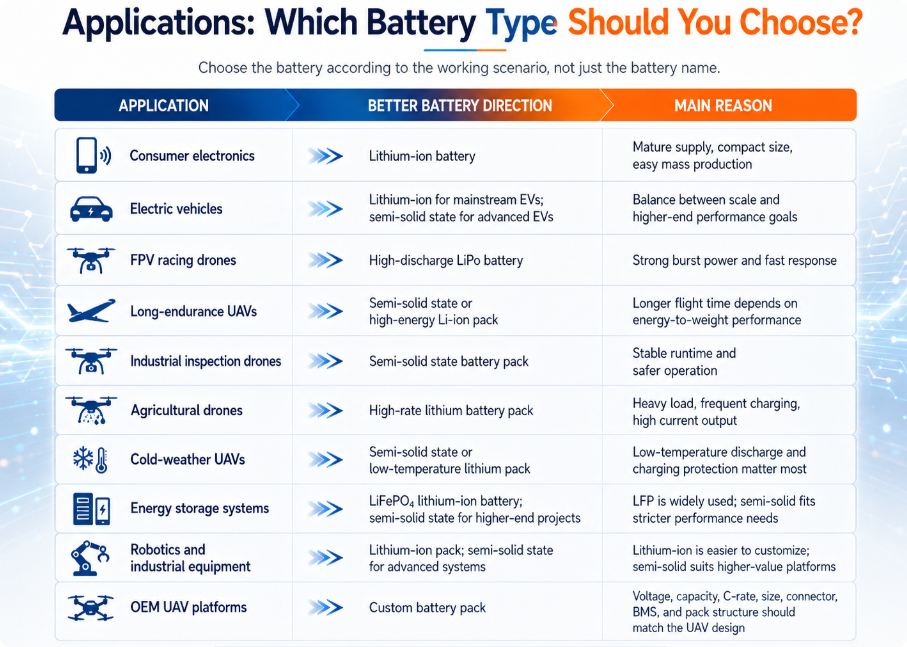
Is a Semi-Solid State Battery Better Than a Lithium-Ion Battery?
Yes, semi-solid state batteries can be better when the goal is to achieve more usable energy in a lighter and safer battery pack. But for projects that already work well with proven lithium-ion designs, switching to semi-solid technology may not always be necessary. The better choice depends on whether the project needs a performance upgrade or a stable, cost-controlled battery solution.
Conclusion
Yattox offers a complete semi-solid state battery product line, along with lithium battery pack solutions for UAVs, drones, robotics, energy storage, and industrial power systems. From cell selection to custom battery pack design, Yattox can support different voltage, capacity, discharge rate, size, connector, BMS, and application requirements.
Contact Yattox to discuss your semi-solid state battery or custom lithium battery pack project and find a suitable power solution for your application.