


What C Rating Does an RC Car Need Without Overheating the Battery?
August 12, 2026
Learn how to calculate RC car battery C rating from capacity and current draw, then diagnose heat from gearing, connectors, wiring, and pack condition.
Table of Contents
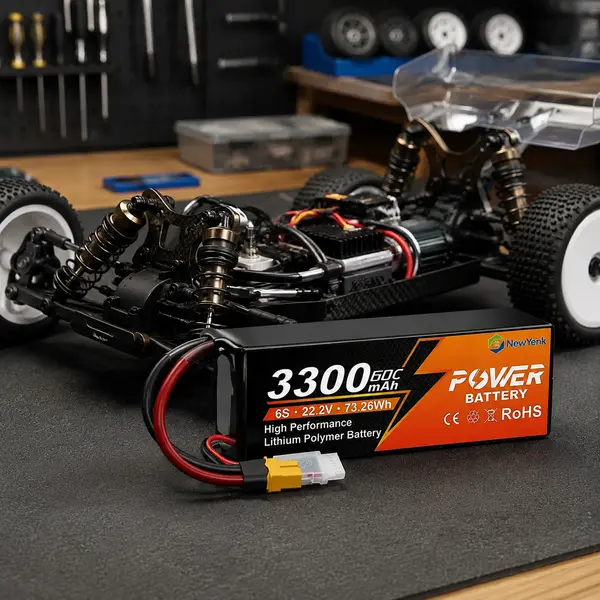
The right RC car battery C rating is the lowest credible continuous-discharge rating that can supply the vehicle’s measured or realistically estimated current with useful margin. It is not automatically the largest number printed on a label. Capacity and C rating work together: a 5000mAh pack rated at 50C has a claimed continuous current capability of 250A because 5Ah × 50C = 250A.
That calculation is a screening tool, not proof that an RC car will draw 250A or that every battery carrying the same rating performs identically. The motor, ESC, gearing, tires, terrain, driving style, connectors, wire resistance, cell quality, internal resistance, temperature, and state of charge all affect real performance. The goal is to match the pack to the load and then verify voltage sag and temperature in the actual car.
What Does an RC Car Battery C Rating Mean?
C rating expresses discharge current as a multiple of battery capacity. For a LiPo pack, the basic calculation is:
Claimed continuous current (A) = capacity (Ah) × continuous C rating
Convert milliamp-hours to amp-hours before multiplying. A 4000mAh pack is 4Ah; at 40C, its claimed continuous current is 160A. Some labels also show a higher burst C rating. Burst duration and test conditions vary, so it should not replace a continuous rating when sizing a battery for sustained load.
| Capacity | Continuous rating | Claimed current | What it does not tell you |
|---|---|---|---|
| 3000mAh (3Ah) | 40C | 120A | Actual vehicle draw |
| 5000mAh (5Ah) | 50C | 250A | Voltage sag under your load |
| 6000mAh (6Ah) | 60C | 360A | Connector and wire losses |
The Battery Rating Is Not the Car’s Current Demand
A battery does not push its full rated current into the ESC. The load draws current according to voltage, motor characteristics, gearing, vehicle mass, traction, and driving conditions. Installing a higher-C pack does not force the motor to consume the label’s maximum current. It provides a pack that is intended to maintain voltage while supplying higher demand.
This distinction prevents two common mistakes. First, a “100C” label does not mean a car requires 100C. Second, an ESC’s current rating is not a complete battery prescription. ESC current limits, motor current, peak acceleration, and average duty cycle describe different parts of the system. The most useful data comes from a current logger or test equipment used in the target vehicle.
How to Estimate the C Rating Your RC Car Needs
Start with reliable current data. If the vehicle manufacturer specifies a recommended battery range, treat it as the baseline. For a custom build, use logged peak and sustained current from a representative run. When direct measurement is unavailable, use the motor and ESC documentation conservatively and avoid treating the ESC’s burst rating as continuous vehicle demand.
- Determine the pack capacity in amp-hours.
- Identify realistic sustained and short peak current.
- Divide required current by capacity in amp-hours to obtain the minimum mathematical C rate.
- Add engineering margin for heat, aging, voltage sag, and variation.
- Select a pack whose continuous rating and test data meet the duty cycle.
Example: if logged sustained current is 80A and the pack capacity is 5Ah, the mathematical requirement is 16C. A 16C label would leave no margin, so a credible higher continuous rating should be selected. The amount of margin depends on run duration, cooling, ambient temperature, pack construction, and how reliably the rating has been verified.
Why LiPo C Ratings Are Not Perfectly Comparable
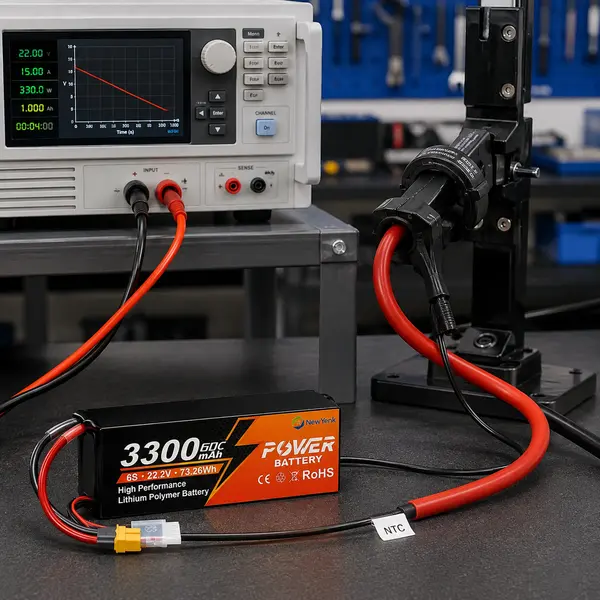
Printed C ratings are not always based on identical test methods, cutoff voltages, temperature limits, or aging states. Two packs with the same capacity and label rating may therefore show different voltage sag and heat in the same car. Cell internal resistance, tab design, weld quality, cell matching, conductor size, connector resistance, and production consistency all influence usable discharge performance.
A responsible specification should distinguish continuous from burst current and state how performance is verified. Yattox describes its discharge options as engineered around real load requirements rather than inflated labels, with capacity, voltage, internal resistance, wire gauge, connector, and pack structure considered together. Buyers evaluating a high-discharge RC battery should ask for relevant test conditions instead of comparing the largest C number alone.
Why an RC LiPo Battery Gets Hot Even With a High C Rating
Battery heat results from current flowing through resistance. A pack with low internal resistance generally loses less energy as heat, but the battery is only one part of the circuit. A hot RC LiPo can also indicate excessive motor load, aggressive gearing, binding drivetrain components, undersized connectors, worn contacts, long adapter chains, insufficient cable gauge, poor airflow, cell imbalance, damage, or aging.
Gearing and tire size
A larger pinion, smaller spur, or larger-diameter tire makes the motor work harder. The car may feel faster initially while current and temperature rise. If overheating began after a gearing or tire change, restore the previous setup and compare before blaming battery C rating.
Connectors and wiring
Resistance at a connector creates a localized hot spot. Loose contacts, poor solder joints, corrosion, repeated adapters, or wire that is too small for the current can heat even when the battery cells remain acceptable. Inspect every connection and use a connector suited to the application. The site’s RC car battery connector comparison covers current handling, fit, and compatibility considerations.
Pack condition
Internal resistance normally changes with temperature, state of charge, use, and age. A pack that suddenly sags more or heats faster than a comparable healthy pack deserves inspection. Stop using a swollen, damaged, punctured, wet, or unusually hot LiPo. Do not recharge it until it has been handled according to the manufacturer’s safety procedure.
Use Voltage Sag and Temperature to Check the Match
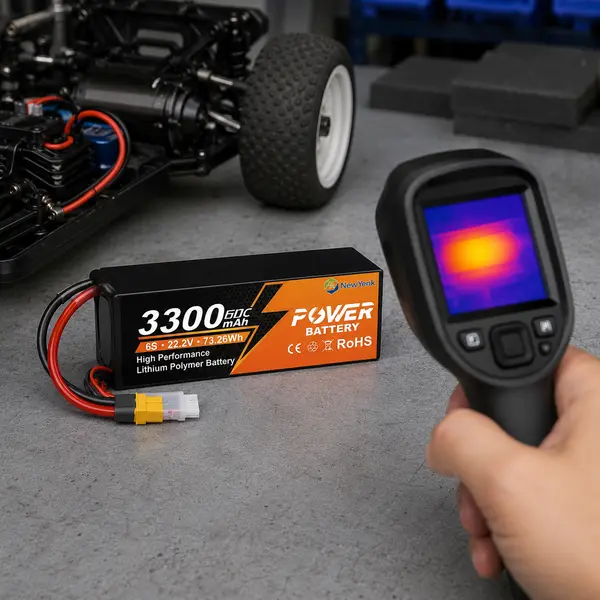
A practical battery evaluation combines current, loaded voltage, temperature, and repeatability. Excessive voltage sag can cause reduced acceleration or early low-voltage cutoff even when capacity remains. Temperature identifies energy loss and overload, while repeated runs show whether performance is stable rather than a one-run result.
Measure under controlled conditions: use the same gearing, tires, surface, driver, ambient temperature, state of charge, and run duration. Check the battery, connector, ESC, and motor separately. Follow the component makers’ temperature limits; a generic internet threshold should not override the documentation for the installed pack, ESC, or motor.
Low-voltage cutoff is equally important. A Horizon Hobby ESC manual explains that its cutoff continuously monitors voltage and reduces output when the threshold is reached. Exact algorithms differ by model, which is why correct LiPo mode and cell-count detection must be confirmed for the installed ESC.
When a Higher C Rating Can Help—and When It Cannot
A higher credible C rating can help when the existing pack shows excessive sag or heating under a properly configured load and the replacement provides lower resistance with adequate conductor and connector design. It may improve throttle consistency and reduce battery stress, especially in high-current racing or heavy bashing duty.
It cannot correct an over-geared motor, seized bearing, blocked fan, poor solder joint, unsuitable adapter, damaged cell, or ESC used outside its voltage/current range. Nor does it guarantee longer runtime; capacity in watt-hours and average power demand are more direct runtime factors. Buying the highest printed number without addressing the system can hide the cause temporarily or add cost and weight without a useful gain.
A Better RC Battery Selection Checklist
- Voltage and cell count match the ESC and motor.
- Capacity and watt-hours fit the required runtime and weight target.
- Continuous current capability exceeds measured sustained demand with margin.
- Burst capability is defined for a stated duration and condition.
- Pack dimensions fit the tray without compression or wire interference.
- Connector and polarity match without unnecessary adapters.
- Wire gauge and length suit the current path.
- Cell matching, internal-resistance control, and test method are documented.
- The charger supports the chemistry, cell count, and balance connection.
For RC Brands, the Specification Should Start With the Load
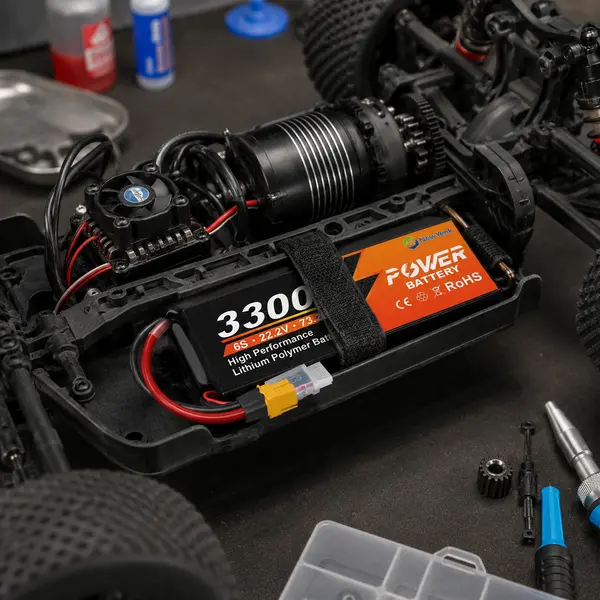
Vehicle developers and private-label RC brands need more than a catalog C number. The pack should be specified around logged current, target voltage, run duration, allowable temperature rise, tray envelope, weight, connector, wire routing, charging method, and expected cycle profile. These inputs guide cell selection, series configuration, capacity, conductor design, mechanical packaging, and verification.
Yattox’s RC battery product range supports discussions around voltage, capacity, discharge demand, and installation size. For non-standard projects, its custom battery development capabilities cover 2S, 3S, and other series configurations, C-rate, dimensions, wire gauge, connector type, and testing. That requirement-led approach is more reliable than choosing a pack from the largest number on a label.
Common C-Rating Questions
What C rating is enough for a 1/10 RC car?
There is no universal value. A light 1/10 on-road car and a heavy 4WD monster truck can have very different current profiles. Use the manufacturer’s recommendation or logged current, divide demand by capacity in amp-hours, and add appropriate margin.
Can a battery C rating be too high for an RC car?
A higher-capability pack does not force extra current into the motor, so the rating itself is not “too high.” However, it may add cost, size, or weight without benefit, and a label alone does not guarantee lower resistance or better quality.
Does a higher C rating make an RC car faster?
Only when the old pack was limiting voltage under load. If the current pack already maintains voltage adequately, a higher printed rating may produce little measurable speed difference. Voltage, motor KV, gearing, traction, and system efficiency remain decisive.
Why does my connector get hot but the battery does not?
Localized connector heat usually points to contact or joint resistance: worn contacts, weak spring force, corrosion, poor soldering, an undersized connector, or an adapter. Stop and correct the connection before further high-current use.